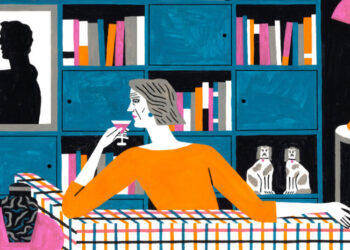
LOOK WHAT YOU MADE ME DO, by John Lanchester
The New York Times’s recent list of greatest living songwriters notwithstanding, I am the very opposite of a Swiftie. More like a Swiffer, when it comes to her catalog. So it took a minute to notice that John Lanchester’s new novel, “Look What You Made Me Do,” shares a title with one of the pop star’s incessant hits.
Lanchester’s most recent novels had similarly evocative names — “The Wall” (Trump, Pink Floyd); “Capital” (Piketty, Marx) — and took on big social issues. He is probably sick of being best known for his debut, “The Debt to Pleasure” (John Wilmot, the Restoration poet): a Nabokovian “cookbook” with sexy fruit on its cover that sophisticates carried around and chortled over in 1996. He has also written witty and useful guides to money. One was called “Whoops!”
Enough about titles. “Look What You Made Me Do,” Lanchester’s version, is a well-knit dark domestic fiction that enfolds the reader quickly and comfortably, like an expensive cashmere scarf. It concerns revenge as a dish served cryogenically cold, with a beefy side of bitcoin. The debt this time, if any, is to Helen Fielding, the creator of Bridget Jones.
In the mid-1980s at Oxford University, an undergraduate, Kate, fell in love at first sight with Jack after overhearing him joke to his crowd in a pub about naming an airline Anal Sex (this was the early days of then naughty-sounding Virgin Atlantic). She tracked down and befriended his girlfriend — “‘stalking,’ as it’s now called, didn’t really exist in the ’80s,” she notes — helping her shoplift an unaffordable design book for his birthday, then brazenly seduced and stole Jack.
This is the back story. When we first meet Jack and Kate, they are long married, childless by choice, and well off: he, an architect successful enough that she’s given up her job as an art historian.
They are getting ready to go to an insufferable-sounding dinner party near Notting Hill given by two other architects. There Jack, who has aged but apparently not matured, jokes that women only do the CrossFit-like British Military Fitness routine “because it has MILF right there in the name.”
When he’s polished off a few pages later, in the same undignified position as Judy Garland and Elvis, you are not terribly sorry.
Kate, though, grieves deeply, King Lear’s lament after his daughter’s death ringing in her head: “Never never never never never.” Numb and put off by “smug marrieds” — Fielding’s phrase — she eventually lets herself be cajoled to a book club. And there she learns that a new hit Netflix series, “Cheating,” about a 50-something husband having a kinky affair with a woman in her early 30s, contains the line “Want your body, disco doll” — a reference to an obscure old New Yorker cartoon that was one of Jack’s catchphrases.
Kate pukes, goes home and begins binge-watching, only to discover that the show, written by one Phoebe Mull, is chock-full of nicknames, quips and shorthand that Kate had presumed belonged to her and Jack alone.
Was her entire marriage a lie, just part of his recurring act? And who, anyway, is this trollop Phoebe, being celebrated as the greatest thing to happen to show business, since — well, since Phoebe Waller-Bridge?
We learn quickly because — along with providing a celebrity profile of her, a spot-on parody of the fawning form — Lanchester slips easily into Phoebe’s own head. She is partnered cozily, if not with complete fulfillment, to Tony, a schoolteacher and aspiring songwriter.
“Sweet and gentle and hot and useless,” she thinks. “I’m the one who brings the talent, the energy, the difficulty, the drama and the appetite for getting things done. He’s the decorative flaky one.”
Characterizing like it’s her job, which it is, Phoebe believes there are “three toxic maternal archetypes: bitch, vampire and squid” (Happy Mother’s Day!) and that her mom, aging without grace, embodies all three. The TV writer is coping with no help from her twin brother, Tristan, who fled, as brothers tend to do in such circumstances, to Australia.
The rundown of the mother’s narcissistic reaction to being taken to a restaurant is choice, reading in part:
full of boring old people
full of boring young people
nobody else in here like me, uncomfortable
everyone in here just the same as me, boring
no hot water in toilet hand basin
water in toilet hand basin so hot scalding risk involved
While Phoebe’s mother might be the most overtly unbearable of Lanchester’s characters, it’s not the paragons of virtue who are rewarded here but the schemers and double-crossers. “Look What You Made Me Do” looks at the friction between boomers and millennials; haves and have-nots; the guilty who get away with it and the innocent unfairly blamed or framed.
Lighthandedly it considers how advancing technology has made us all spies and thieves. (Jack’s “smart home” system provides a crucial plot point, and one thumb drive does a lot of work.)
And bonus points for what must be the first fictional backlash to Yotam Ottolenghi’s vibrant, vegetable-forward cooking: “You see the pomegranate seeds strewn all over everything and you know what’s coming.”
Crime and punishment aside, “Look What You Made Me Do” is a deft piece of what the British call hen lit, pecked out by a cockerel who knows his way around the coop.
LOOK WHAT YOU MADE ME DO | By John Lanchester | Norton | 304 pp. | $31.99
Alexandra Jacobs is a Times book critic and occasional features writer. She joined The Times in 2010.
The post Who’s Been Taking Notes at Our Bedroom Door? appeared first on New York Times.