On a recent spring afternoon, the renowned artist and designer Maya Lin clambered up and down a rocky outcropping in Central Park in New York, undeterred by the crowd of tourists that was shooting photos nearby.
While they snapped selfies, she reflected on how this place — and similar geology near her childhood home in Athens, Ohio — had inspired her latest creation: the stone facade on the western walls of the 60-story JPMorgan Chase skyscraper in Midtown Manhattan. Estimated to have cost from $3 billion to $4 billion, and with glowing artwork at the summit visible citywide, it opened last fall and occupies the block between 47th and 48th Streets and Madison and Park Avenues.
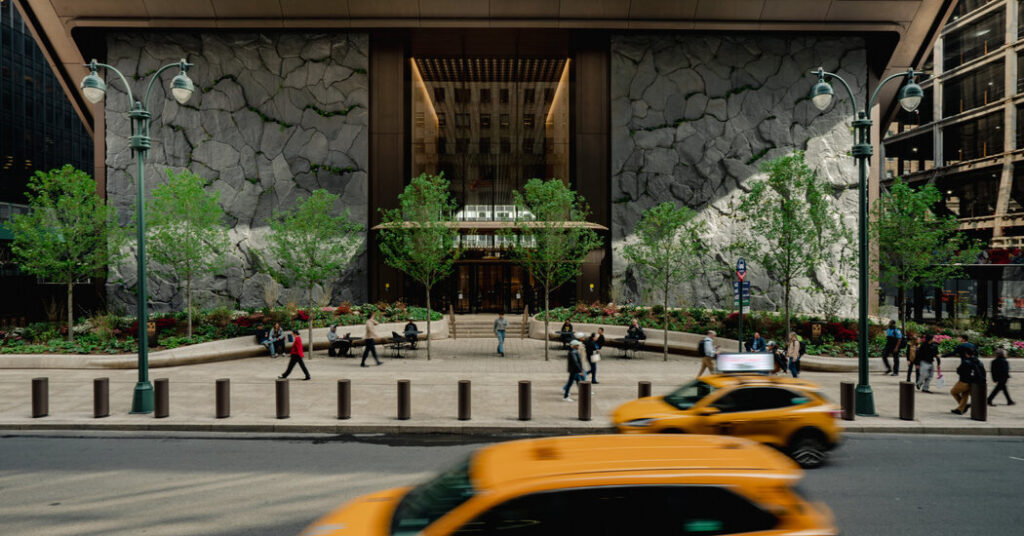
Her project, “A Parallel Nature,” is a sculpture composed of two 59-foot-tall and 55-foot-wide gray stone walls set in an intricate design, with plants that peek out from the crevices. An array of flowers has been newly planted on the walls this spring.
Lin’s long career and passion for the environment made her a natural choice for the project.
Now 66, she began her career as a 21-year-old senior at Yale University when she won a competition to design the Vietnam Veterans Memorial, which was dedicated in 1982 in Washington, D.C. Among her many recent projects is the water fountain installation titled “Seeing Through the Universe” for the Obama Presidential Center in Chicago, set to open to the public next month.
Five of Lin’s works will also be on view at Pace Gallery’s booth at Frieze New York this week. There are pieces that call attention to bodies of water that are disappearing or that have already disappeared — Lake Chad in North Africa and the Aral Sea in Central Asia — along with a piece focused on the Antarctic Circle, and a new silver sculpture, “Silver Yellowstone,” that is inspired by the Yellowstone River, widely considered to be the longest free-flowing river in the lower 48 states.
In a recent series of interviews in her home office on Manhattan’s Upper East Side, at the JPMorgan Chase building and during the ramble through the rocky terrain near the lower eastern end of Central Park known as the “Dene,” a British term for a valley, Lin described the woods and rock cliffs she remembered from growing up in Ohio.
“Water would just subtly drip down the cliffs, and there would be ferns and grasses and things growing there,” she explained, adding, “I was definitely out there in nature almost daily, and very concerned about environmental issues.”
Central Park, which Lin explores regularly when she is in Manhattan, was its own inspiration. Her family also has a home in southwestern Colorado, where she hikes and bikes every summer.
In 2022, she and representatives of JPMorgan Chase and Tishman Speyer, the development manager of the new skyscraper, took a daylong walk through the park, looking for a rock formation that could serve as the model for “A Parallel Nature” and “bring a little bit of the character” of the park to the building, Lin said.
They initially failed to identify anything appropriate. Lin returned the next morning on her own and came across the Dene, which she had seen on previous walks through the park.
“When I first got a call to look at the building site, I realized that the subway would be running underneath it,” Lin explained. “And I saw an excavation photo of Grand Central Station that showed that its construction cut through Manhattan’s bedrock. And I just had an idea, ‘What if I could bring bedrock to the surface in the middle of Manhattan?’”
“What I am interested in is, quite literally, grounding you in what might be right below your feet that you might not be aware of,” she added.
Capturing the Dene on the exterior wall of the skyscraper, Lin explained, would enable her to express the character of an exposed stone outcropping in Manhattan, quite literally bringing bedrock to the surface, in a way that echoes the Dene in Central Park.
Lin identified a type of gray granite from Barre, Vt., for “A Parallel Nature” that she called a perfect match with the metamorphic rock known as gneissic schist on which the JPMorgan Chase skyscraper sits.
The 239 stone pieces mounted atop the artwork’s two walls were cut by the Quarra Stone Company, a Wisconsin-based stone fabricator that transported the stone on large, flatbed trucks from Vermont to Wisconsin and then to Manhattan. Lin called the installation of the walls on the facade of the skyscraper her most difficult commission yet.
“Trying to create something that would be a balance between natural and man-made was the aesthetic challenge,” she explained. “And to keep the artwork as a sculptural creation rather than an architectonic solution — also the engineering to fabricate and install — were intricate and extremely complex.”
The stonework on each wall is composed of over 100 pieces of granite, Lin said, “so by grouping 15 to 20 pieces together and ever so slightly tilting them, I was able to create larger groupings to help create what I call city states. These helped make each wall feel like it was comprised of larger plates.”
Each of the pieces is hung, in a puzzle-like formation, from a steel bracket system installed on a steel ladder frame system anchored to the concrete support wall on the lowest level of the building’s Madison Avenue facade.
At the foot of each wall is a streambed with waterworn rocks that came from near the headquarters of the Wisconsin fabricator, chosen to work well with the gray granite walls. Water gently flows in the beds, creating a burbling stream in the middle of Midtown traffic cacophony. Lin calls the stream “an unexpected natural moment in the busy city.”
There are also two sources of water on the walls themselves, meant to irrigate the plantings in the walls’ seams. One is a drip irrigation line installed behind what Lin calls “plant pockets,” holes 10 to 12 inches deep that range in length from 3 to 7 feet and that are designed to hold the artwork’s vegetation.
The second is a drip irrigation system that runs along the top of the rock walls. This gently drips continuous streams of water that find their way down and beneath the surface of the rock, nourishing the plantings in the crevices and ledges. The system is designed to encourage plant growth and to bring the sound of trickling water to the facade.
Lin is working with specialists on the plantings, including Blondie’s Treehouse, a Manhattan plant installer and supplier; Cecil Howell, a Brooklyn-based landscape architect who has worked with Lin on a number of recent environmental art installations; and Richard Hayden, the project’s consulting horticulturist, who is also the senior director of horticulture for the High Line, a public park built on a historic elevated rail line on Manhattan’s west side.
Though some plants were installed in late October, it was understood that since water would not be available until late fall, spring would be the ideal time for fresh planting.
Urban environments are tough on plants, Lin explained, calling the site’s horticulture “an experiment.” The horticulture team is trying more than 30 varieties of plants to see which ones thrive where, she said, adding that she expected the plants to be monitored and plantings adjusted quarterly.
Lin said she wanted “to create a predominantly native New York landscape reminiscent of what you might find naturally growing on rocks and within crevices in actual rock faces and ledges” to make visitors aware of the nature around them.
New plants growing this spring include maidenhair fern, Eastern red columbine, creeping phlox, Christmas fern and dwarf crested iris.
Just across from each of the artwork’s walls are a flower garden and native red maple trees, as well as long, sinuous concrete benches designed by Norman Foster, the skyscraper’s architect, all meant to create a sort of public park.
“A Parallel Nature,” as its name implies, “neither tries to perfectly recreate nature, nor feel architecturally fabricated,” Lin explained. “It is a work that makes ambiguous the line between the natural and the man-made.”
The sculpture is one of five works of public art commissioned for the new building by JPMorgan Chase — whose art collection was founded in 1959 by David Rockefeller, then executive vice president and vice chairman of Chase Manhattan Bank. The skyscraper’s other new works include that LED light work at the summit by Leo Villareal, whose art will also be on view at the Pace Gallery exhibit at Frieze; two paintings by Gerhard Richter in the building’s lobby; a 3-D printed, bronze column by Foster, also in the lobby; and a display of light and motion at the lobby’s elevator banks, driven by custom A.I. models by the Turkish artist Refik Anadol.
David Arena, head of global real estate for JPMorgan Chase, said the bank had deliberately lifted up both the Madison Avenue and Park Avenue bases of the new building 85 feet to create more outdoor space for pedestrians. “When passers-by step on the Madison Avenue curb,” he said, “they are awe-struck, think differently, have a moment of respite.”
“We thought it would be a great spot to make a gift to Manhattan and to people in the neighborhood who can come up, have a seat, enjoy a cup of coffee, enjoy some great art, maybe think differently,” he said.”
He also called Lin “one of the most accomplished modern-day artists, a strong enough talent to be a counterpoint to Norman Foster.”
Lin agrees with Arena’s predictions about the artwork. “Even though it can dialogue with the building in scale, it adds an unexpected, natural respite from the busy street life, offering a different feeling,” she said.
The post Maya Lin Connects Nature to a New Manhattan Skyscraper and Beyond appeared first on New York Times.