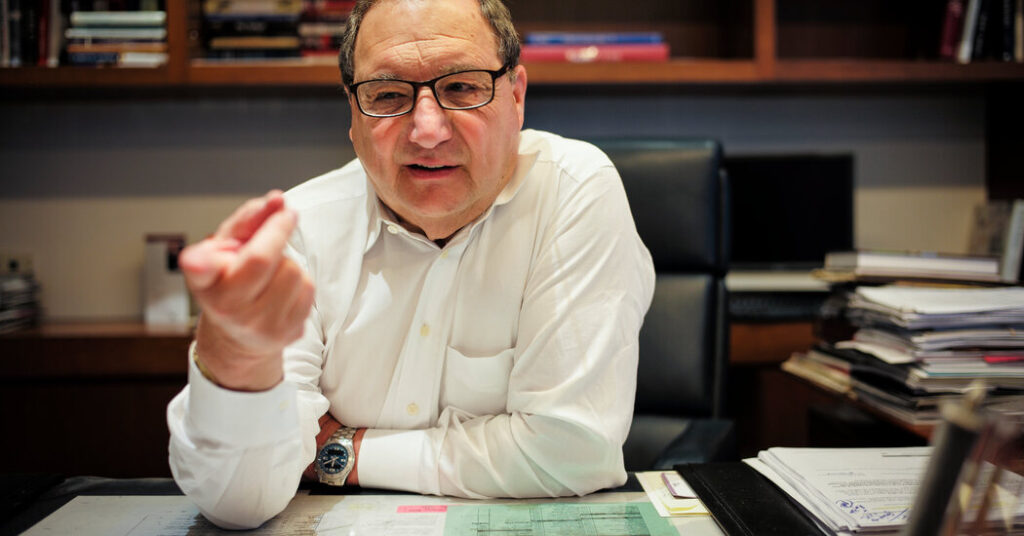
Abraham H. Foxman, a hidden child of the Holocaust who became the chief warrior against antisemitism in the United States as national director of the Anti-Defamation League for almost three decades, died on Sunday in Manhattan. He was 86.
His death, at a hospital, was confirmed by his son, Ariel.
Mr. Foxman spent half a century working for the ADL, and from 1987 to 2015 was its chief executive. Whenever there was an incident that displayed hatred or hostility toward Jews — a synagogue firebombing, an unprovoked stabbing of a skullcap-wearing young man or a celebrity’s bigoted remark — Mr. Foxman would be called on for a public comment.
His well-earned indignation, a streetwise, sometimes pugnacious, voice and a gift for articulating the fine distinctions of an issue made his comments stand out from more diplomatic responses by leaders of other Jewish groups.
In 1999, during a wave of violent attacks against synagogues, cemeteries and Jewish institutions in Europe, Mr. Foxman took to task the leaders of France and Germany for failing to grapple with the issue.
“It has taken Europeans far too long to admit that the problem of antisemitism in Europe today is not a history lesson but a current event,” Mr. Foxman wrote in his 2003 book, “Never Again?: The Threat of the New Anti-Semitism.” “Never as a Holocaust survivor did I believe I would witness another eruption of antisemitism. But the resiliency of antisemitism is unparalleled.”
In issuing such jeremiads, he won access to presidents, popes and prime ministers, meeting frequently with Pope John Paul II. So powerful was his voice that he became a source of absolution for luminaries such as the fashion designer John Galliano, the former CNN anchor Rick Sanchez and the Irish tenor Ronan Tynan after they were accused of making bigoted statements.
They came to him like Henry IV, the Holy Roman Emperor, traveling to Canossa Castle in 1077 to seek forgiveness from Pope Gregory VII. Mr. Foxman was willing to redeem them as long as they apologized and were willing to study the history of the persecution of Jews or undertake penitential acts like visiting the Auschwitz concentration camp.
“If you don’t believe you can change people’s hearts and minds, why bother?” Mr. Foxman said, defending his approach in a Times interview in 2020. “If you are not going to try and change hearts and minds, why are you in this business at all?”
The most publicized episode, that involving the actor Mel Gibson, played out in more complicated fashion. In 2003, Mr. Foxman assailed Mr. Gibson’s film, “The Passion of the Christ,” even before its 2004 release, for depicting Jews as responsible for the death of Jesus, and he accused Mr. Gibson of harboring antisemitic views. Mr. Gibson responded that his film merely portrayed events as described in the four gospels.
But in 2006, Mr. Gibson’s prejudices were exposed during an arrest on charges of drunken driving. He asked the arresting officer if he was a Jew and shouted that “the Jews are responsible for all the wars in the world.” Mr. Gibson issued two apologies and Mr. Foxman accepted the second, but, according to Mr. Foxman, Mr. Gibson did not submit to a program of instruction about Jewish history.
One reason Mr. Foxman was consulted by journalists and academics was that he made sure his organization could back up its claims with facts and statistics. It maintained an annual catalog of attacks and took periodic polls of antisemitic attitudes.
A 2014 survey of 102 countries by the league not long before Mr. Foxman’s retirement found that one in four respondents believed classic stereotypes, such as, for example, that Jews control the world’s financial institutions and media. Half of the 53,100 adults surveyed had never heard of the Holocaust.
His views were also influential when it came to making distinctions between anti-Zionism and antisemitism or explaining when skepticism about the legitimacy of Israel as a Jewish state crossed over into antisemitism. He challenged critics of the privileges Israel grants Jews but not Palestinians like the automatic right to immigrate. Why, he asked these critics, didn’t they take theocracies like Saudi Arabia or Iran to task for the advantages granted Muslims?
“If the only nationalism you find apartheid in is Jewish nationalism, then you’re an antisemite,” he said in a 2015 interview.
Gary Rosenblatt, a Substack columnist and former editor of The Jewish Week newspaper, lauded Mr. Foxman for his genuine passion for the subject.
“He led from his kishkes,” Mr. Rosenblatt said, using the Yiddish word for guts. “He’s emotional and has authenticity.”
Still, Mr. Foxman was sometimes criticized for too often crying “gevalt”— the Yiddish expression of alarm or shock — even as Jews had become one of the most successful and admired ethnic groups. In 2006, he was accused in a letter signed by over 100 professors of intimidating the Polish consul general into canceling a talk in New York by Tony Judt, a professor of European history at New York University, about the pro-Israel lobby.
Mr. Foxman elevated the nonprofit organization to one that worked to safeguard civil rights in general, protesting incidents of discrimination against Black people, immigrants and gay people. When Mr. Foxman retired in 2015, he could claim that he helped build up an organization that had a $60 million budget and 27 offices across the United States and one in Jerusalem.
But his main focus was on antisemitism, calling out statements by the writer Roald Dahl and jokes by the comedian Trevor Noah.
When Khalid Abdul Muhammad, an aide to Louis Farrakhan, the leader of the Nation of Islam, delivered a virulently antisemitic speech in 1993, Mr. Foxman held his verbal fire, opting for a more strategic response: placing a full-page ad in The New York Times that reprinted excerpts from Mr. Muhammad’s speech under a headline “Minister Louis Farrakhan and the Nation of Islam Claim They Are Moving Toward Moderation and Increased Tolerance. You Decide.”
Abraham Foxman was born Avraham Chanoch Hanach Fuksman on May 1, 1940. His father, Joseph Fuksman, had been the editor of a Zionist publication in Warsaw; his mother, Helen (Radoshitzki) managed the home.
When the Germans invaded Poland in September 1939, the Fuksmans fled east, giving birth to Avraham in Baranovichi, a small city in what is today Belarus, and winding up in Vilnius in what is today Lithuania but was then under Soviet occupation.
When the Germans invaded the Soviet Union in June 1941 and seized Vilnius, eventually slaughtering 100,000 of its Jews, the Fuksmans decided there would be a greater chance of survival if the family split up. They turned Avraham over to a nanny, Bronislawa Kurpi. His mother escaped Vilnius’s Jewish ghetto and secured Aryan papers, posing as a Christian. She was able to keep an eye on her son, who was told she was his aunt. His father, after periods confined to Nazi labor camps, hid out in forests.
For four years, the nanny raised Avraham as her son, had him baptized as a Catholic and gave him the name Henryk Stanislaw Kurpi.
“I’ve heard that whenever I passed a church I would make the sign of the cross, and when I met a priest on the street I would stop to kiss his hand,” Mr. Foxman recalled. “I would spit when Jews from the shtetl were being marched by, and call out, ‘Dirty Jew!’”
In 1945, as the Germans retreated in the face of a steady Soviet advance, his parents reclaimed 5-year-old Avraham, though the nanny objected, leading to a custody battle in a Lithuanian court that the parents ultimately won.
Though the family survived the war, 14 relatives perished in the Holocaust. Mr. Foxman returned to Jewish observance quite easily. “My father was a very wise man,” he said. “He started taking me to synagogue and little by little I made the transition,” he said.
After four years in camps for displaced people run by the Allies, the family immigrated to the United States in 1950. Starting in the seventh grade, Mr. Foxman attended the Yeshivah of Flatbush and stayed through the end of high school.
He then earned a B.A. in political science and history from the City College of New York and studied law at New York University, graduating in 1965. Promptly after passing the bar, he was hired as a legal assistant in the ADL’s international division. In 1987, he replaced the longtime national director, Nathan Perlmutter.
During his tenure, Mr. Foxman was sometimes accused of raising the specter of antisemitism too often. But in an interview with The Times upon his retirement, he retorted that “unfortunately time has proven me correct.”
The figure he gave then of bigoted attitudes worldwide only mushroomed as a result of Israel’s response to a Hamas attack on Oct. 7, 2023, that killed more than 1,200 Israeli civilians and soldiers.
The Palestinian death toll of more than 60,000 and videos broadcast worldwide of the destruction of Gaza’s buildings and of starving children set off a shift in American public opinion, with more Americans siding with the Palestinians. There was also an upsurge in antisemitic incidents. In 2023, the ADL recorded 8,873 antisemitic incidents in the United States — a 140 percent increase over 2022 and a 10-fold increase over a decade before.
Mr. Foxman could often surprise both his supporters and critics. He drew complaints from many New Yorkers for opposing the opening of a mosque near the World Trade Center site after the Sept. 11, 2001, attacks. But he won tributes from the administration of Barack Obama when he stepped in to support Susan E. Rice, the president’s national security adviser, against newspaper advertisements accusing her of a “pattern of callous disregard for genocide.”
He was not protective of Jewish figures whose remarks skirted on bigotry, sharply faulting a former Israeli ambassador for writing that President Obama’s Middle East policy was dictated by an early upbringing as a Muslim.
In addition to his son, Ariel, he is survived by his wife, Golda (Bauman), a retired public-school teacher whom he met in a Zionist summer camp in Wisconsin; a daughter, Michelle Foxman; and four grandchildren. He lived in Bergen County, New Jersey.
Mr. Foxman could laugh at himself and his work, for example, calling his redemption of celebrities who had made insensitive or bigoted statements a “kosher certification.” At his retirement party at the Waldorf Astoria, Mr. Foxman expressed how meaningful these absolution processes were to him.
“Some of my most satisfying moments as director of the ADL,” he said, “were in witnessing people who did bad things and said vile things turn around and become better people.”
So identified was Mr. Foxman with the battle against antisemitism that in 2016, when campuses of the City University of New York grappled with incidents many Jews saw as bigoted, Eric Alterman, a professor of English at Brooklyn College, could say in an opinion article: “When it comes to antisemitism, if Abe Foxman is not worried, I’m not worried.”
Alex Traub contributed reporting.
The post Abraham Foxman, Warrior Against Antisemitism, Dies at 86 appeared first on New York Times.