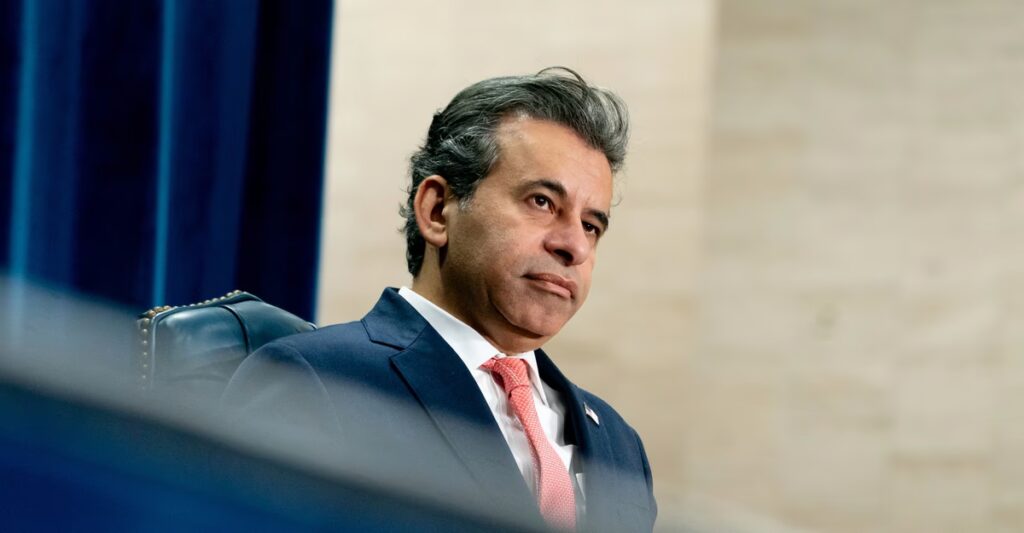
Marty Makary, the Johns Hopkins surgeon who has led the FDA for the past year, is facing criticism from all sides. Vaping advocates are angry because of the FDA’s slow progress on green-lighting their products. Pro-life groups have called for Makary’s firing because he has not been tough enough on abortion. Current and former FDA officials have repeatedly warned that the agency is in turmoil. Even drug companies, typically cautious about criticizing regulators, have raised concerns about the state of the agency. Donald Trump has now reportedly signed off on a plan to fire Makary—although when, exactly, that axe might fall is unclear. On Friday evening, the president told reporters gathered at the White House that he knew nothing about Makary’s future.
Traditionally, FDA commissioners have been less dramatic figures; they have approached their role as steward of an organization whose strength stems from its independence. The logic of that position is simple: Putting a drug on the market simply because of a commissioner’s or a president’s preference, or burying politically inconvenient research, doesn’t inspire much confidence in the safety of America’s food and drugs. But Makary has shown again and again that he’s willing to put politics first, a strategy that may have created the conditions for his own fall from power. (Neither Makary nor the White House agreed to comment for this story.)
The problems began shortly after Makary’s confirmation. In June, he announced the launch of the Commissioner’s National Priority Voucher, a pilot program meant to dole out speedy approvals for drugs that “align with one of five critical U.S. national health priorities.” The program quickly became a tool for political influence. The FDA frequently does speed up review for important drugs, but drugs that are given a golden ticket must address a serious, unmet medical need. For the new program, all decisions to award vouchers were cleared by the White House, STAT News reported. As such, the vouchers appeared to have become a bargaining chip in negotiations with drug companies over their pricing. On the same day that the White House announced that Eli Lilly and Novo Nordisk would drop the price of their GLP-1 weight-loss drugs and sell them on a Trump-branded website, both companies were also granted vouchers for new weight-loss drugs.
Makary and his deputies have also regularly overruled career staff, often with nakedly political motives. During his confirmation hearing, for instance, Makary promised lawmakers that he would “take a solid, hard look at the data” concerning the safety of the abortion drug mifepristone. And although Makary has claimed that FDA scientists have begun reviewing the data, news broke in December that he had also instructed FDA staff to delay the review until after the midterm elections. (At the time, the Department of Health and Human Services, which oversees the FDA, denied any political motivations.) Vinay Prasad, whom Makary hired as the director of the Center for Biologics Evaluation and Research, replaced a longtime FDA official who had disagreed with Secretary Robert F. Kennedy Jr. over the safety of vaccines; Prasad quickly moved to limit young, healthy people’s access to COVID vaccines. Prasad was also behind the FDA’s short-lived decision to block the review of a new mRNA flu vaccine. He said that these decisions were motivated by a need for stronger evidence, but they also aligned with Kennedy’s personal skepticism of COVID and mRNA vaccines. Both of these decisions were reportedly made against the advice of FDA staff. (Prasad has since been pushed out of the agency.)
Ironically, the scandal that may cost Makary his job—the FDA’s reluctance to authorize the sale of flavored vapes—involves him ignoring the advice of FDA officials while apparently misreading, or perhaps disregarding, the politics of the issue. The commissioner has shown himself to be exceptionally skeptical about these products. He has publicly said that he does not believe the government’s own data showing that the epidemic of youth vaping has improved and only 5 percent of young people now vape. At a September 2025 press conference, he claimed that “the broken CDC that we inherited under the Biden administration” had used a flawed methodology to collect the data. (The long-running survey he alluded to is generally regarded as the best source of national data on youth vaping.) According to The Wall Street Journal, Makary personally overruled FDA scientists who recommended authorizing flavored vapes that include features designed to prevent use by anyone under 21.
But Makary was putting his own preferences before the president’s. Trump appears to see vaping as a political issue: During his campaign he publicly promised to save the industry, and he reportedly confronted Makary about the FDA’s approach toward vaping. It’s unclear whether this frustration in particular is what has prompted Trump to seriously consider firing Makary, but shortly after the dressing down, the FDA announced that the vapes the commissioner had originally blocked would now be authorized.
Makary came into this job with gripes about the agency. His 2024 book, Blind Spots, is full of criticisms of FDA decisions that he says represent “medical dogma.” And in a recent CNBC interview in which he was confronted about the decision during his own tenure to not approve a skin-cancer drug, he sounded a lot like his predecessors by decrying political pressure. “You have a decision when you come in as commissioner: Do you throw science out the window and do whatever the media tells you to do, and whatever the lobbyists and corporate interests tell you to do, or do you do what’s right?” he said. And some of the recent flack the FDA has received has come from companies and commentators who thought that the agency was holding back approvals or asking for too much evidence. Not all of the controversial calls for better data came from Makary or Prasad, either; during the review of the skin-cancer therapy, for instance, the calls for more data came from longtime FDA officials.
It’s easy enough for an FDA commissioner to make enemies. What people put in their bodies is controversial, and an FDA commissioner has to make hard decisions about the products of powerful, well-resourced companies. Makary is not the first commissioner to buckle to political pressure, but he’s the only one who has so evidently made it a habit. The disparate critiques of Makary are interrelated: They show how, time and again, he’s put his or his bosses’ preferences first. These decisions may end his career as commissioner, but they’ve already set a dangerous precedent for political interference at the agency.
The post A Political End for an Unusually Political FDA Commissioner appeared first on The Atlantic.