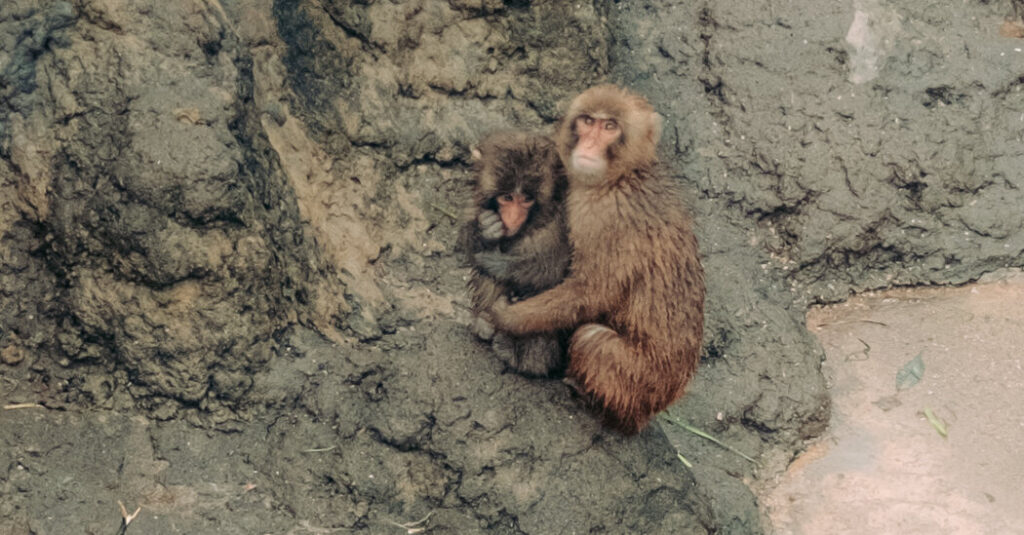
It was feeding time on Monkey Mountain at the Ichikawa City Zoo. Grunts and squeals broke out among the 56 resident macaques as a zookeeper made the rounds with a bucket of apples, sweet potatoes and cabbage.
Moments later, Monkey Mountain’s most famous resident emerged: Punch, the now 9-month-old macaque who became an internet sensation after he was abandoned by his mother at birth and turned to an orangutan toy for comfort.
“Look at him go!” said David Lena, 11, from Spain, who was visiting the zoo in the leafy suburbs of Tokyo with his parents for the third time in a week. “I want to hold him so badly!”
Punch twirled and leaped into the air. He hung upside down while chomping on a biscuit. He paraded around the enclosure on a zookeeper’s arm.
Punch’s journey began in July, when zoo officials said his mother abandoned him because of a difficult labor during a heat wave. He was reintroduced to the troop in January, but without his mother’s guidance he had a difficult time integrating, often playing by himself.
In Japan, he is now affectionately known as “Punch-kun.” (Kun is a term of endearment for boys.) He has inspired “Team Punch” T-shirts, social media stickers and action figures. IKEA sold out of the orangutan toy that he made famous. Hundreds of people have sent letters and drawings to the zoo.
Celebrity is no small thing for a six-pound macaque. It has come with hordes of photo-seeking fans, an abundance of gossip (“PUNCH GOT A GIRLFRIEND  ,” a YouTuber recently reported, with TMZ-like excitement), and comedic scrutiny (“Saturday Night Live” pretended to interview Punch’s mother, and Jon Stewart lampooned him on “The Daily Show”).
Punch has handled the limelight better than most young stars. Since first hitting the headlines, he has slowly integrated into his troop and made friends — monkey and human alike.
He is also starting to shed some of the crutches of his youth, including the stuffed orangutan. He no longer gallivants around Monkey Mountain with the toy, though he still cuddles up to it at night. (The zoo keeps two plushies to allow for daily cleaning.)
Yet thousands of people still make the trek each day to the Ichikawa City Zoo, seeking a real-life glimpse of the monkey and the meme. Punch largely ignores them. He keeps busy playing with chains that dangle from rocks in his enclosure; sitting for grooming sessions by elders; or, very occasionally, stealing snacks from other members of the troop.
In tumultuous times, Punch has provided his legions of fans relief from doomscrolling about war, climate change, hunger or rising gas prices, becoming a global symbol of resilience.
Riko Kusumoto, 23, who sells home furnishings, took an overnight bus from Kobe, about 340 miles away, to Ichikawa on a recent day, carrying Punch’s signature toy.
“When I look at Punch-kun, I don’t have to think about things like rising prices or wars,” she said. “All I could think was, ‘Hang in there, Punch!’ I just had a really heartwarming and pleasant time.”
Yuko Tanaka, 66, visited the zoo with her daughter, Manami, 46. She said she was inspired by Punch’s determination in the face of abandonment and bullying. “He doesn’t give up and just lives his life to the fullest, and that’s what’s so moving,” she said.
Punch’s celebrity has transformed the fortunes of the Ichikawa City Zoo, which had faced budget deficits and struggled to attract patrons. It has received more than $200,000, or about 32 million yen, in donations since February, when it announced Punch to the world. The number of visitors has roughly tripled from a year ago, reaching 90,000 in March.
The zoo had no sense of his potential when it first shared his story on social media on Feb. 5.
“Currently, there is a baby monkey in the monkey enclosure holding a stuffed animal,” zoo officials wrote on X. “His name is Punch, and he’s a boy! Please watch over Punch’s growth with warmth!”
Soon, the zoo was flooded with messages of encouragement from around the world. There were also complaints, including from people worried about conditions at the zoo. Monkey Mountain is a crowded, man-made rock formation that lacks shade.
Some fans were bothered by videos showing Punch’s elders dragging and hitting him. Animal rights groups, including PETA, called on the zoo to transfer Punch to a sanctuary.
The zoo has defended its efforts to reintegrate Punch, issuing half a dozen statements on primate behavior, power dynamics in troops and bullying.
“Some people think Punch is cute; some people feel sorry for him,” said Takashi Yasunaga, who oversees the zoo. He said the zoo’s aim was to support Punch and “give him the best life possible.”
Shumpei Miyakoshi is one of Punch’s main keepers. He feeds him milk, and Punch often grips his arm during snack time. As Punch grows older, Mr. Miyakoshi said he would like to see him live a regular life with his troop.
“He has changed so much,” he said. “I hope he forgets me someday.”
Javier C. Hernández is the Tokyo bureau chief for The Times, leading coverage of Japan and the region. He has reported from Asia for much of the past decade, previously serving as China correspondent in Beijing.
The post Punch, the Lonely Monkey, Is Growing Up. He’s Still a Star. appeared first on New York Times.