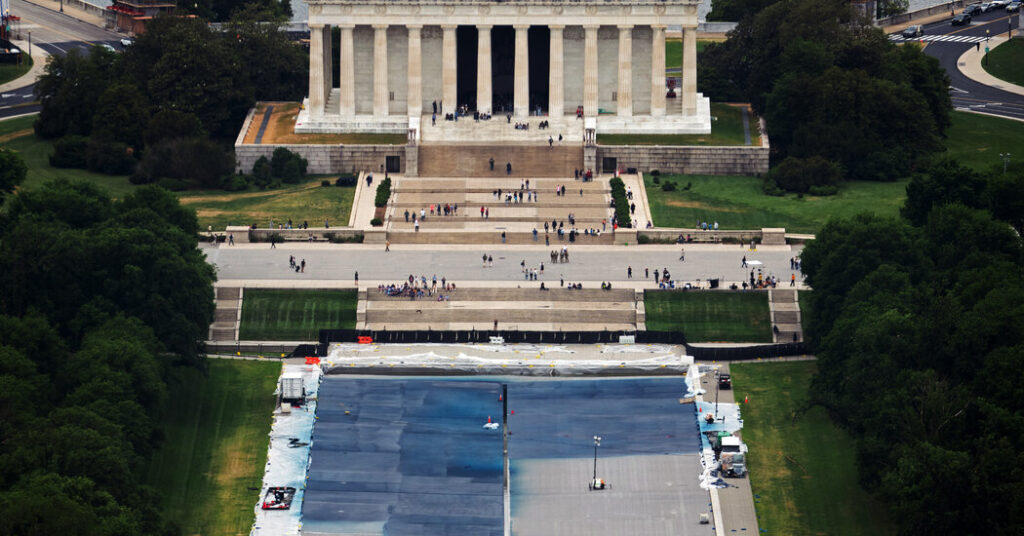
For a century, the Lincoln Memorial Reflecting Pool has captured Washington’s history, a vast mirror for moments great and small.
Then, this spring, President Trump said he decided to paint it blue, and steered a government contract to somebody he said had worked on his swimming pools.
In the process, he made the pool into a reflection of Washington’s present.
To give out that $6.9 million no-bid contract, Mr. Trump’s administration invoked an exemption meant for urgent situations, The New York Times found. The exemption was supposed to be used only to prevent “serious injury, financial or other, to the government.” Administration officials made no public claim that such injury was likely; rather, officials said, Mr. Trump wanted it changed for the country’s birthday party on July 4.
“This project is now being completed at ‘Trump speed’ to ensure the iconic landmark is totally restored ahead of the 250th celebrations,” said Taylor Rogers, a White House spokeswoman, in a statement to The Times.
The pool is the latest in a string of cases where Mr. Trump’s government invoked special powers to shut down required competition, and then handed contracts directly to the president’s preferred vendors.
The renovation plans exemplify how Mr. Trump views much of the nation’s capital as his imperial realm — to decorate, or even destroy, as he sees fit. In doing so, he and his administration have run roughshod over a decades-old review process for changes in Washington’s core, as well as rules intended to ensure government money is spent wisely and without favoritism.
Mr. Trump paved over the Rose Garden’s lawn without seeking approvals. He has installed a 13-foot statue of Christopher Columbus on White House grounds without submitting a plan to any panel. And, most prominently, he tore down the historic East Wing of the White House without consulting any oversight board.
Tim Whitehouse, the executive director of the watchdog group Public Employees for Environmental Responsibility, said the renovations in the capital have “become a secretive project where the friends and business associates of the president are being rewarded with no public scrutiny.”
The Reflecting Pool holds particular significance. Built in 1922, it was designed to be a dignified tie between monuments to two of the country’s greatest presidents, George Washington and Abraham Lincoln. Over time, it became the recognizable backdrop for the Rev. Dr. Martin Luther King Jr.’s “I Have a Dream” speech in 1963, major protests against the Vietnam War, and other gatherings that galvanized the left and right.
Mr. Trump has boasted about the Reflecting Pool renovations at least five times in recent weeks, casting the contract as an example of his ability to cut through government red tape and improve upon existing icons.
“You’re going to end up with a beautiful, beautiful Reflecting Pool, the way it’s supposed to be,” Mr. Trump said in the Oval Office on April 23. “Much better than it ever was, actually,”
Last weekend, he celebrated the plan with a social-media post that showed a fake image of himself floating shirtless in a bright blue version of the pool.
But government documents obtained by The Times say the contract has already cost far more than Mr. Trump said it would, and that repairs would be needed again far sooner.
They also show that Mr. Trump’s plan does not address one of the pool’s main problems: faulty plumbing in its filtration system. As a result, experts said it was unclear if Mr. Trump’s pool would remain blue — or if it would soon be obscured by a recurring layer of green algae.
“Painting is not going to solve that problem,” said Tim Auerhahn, the chairman of the Aquatic Council, a consulting firm for the pool and hot-tub industry.
Mr. Auerhahn said he was also concerned by Mr. Trump’s decision to drive his motorcade across the pool’s surface on Thursday night to hold a press event highlighting the renovations. That might have put huge amounts of weight on the notoriously leaky — and newly repaired — joints between its concrete slabs.
“If it were my project, I’d require an immediate inspection,” Mr. Auerhahn said.
Green and Matted
The pool repair contract was given on April 3 to Atlantic Industrial Coatings, based in New Canton, Va. Contracting records show the firm had never previously held a federal contract.
Mr. Trump said he consulted with three companies that had worked on his swimming pools, but chose one that had performed work at his Trump National Golf Club in Sterling, Va.
Trump Administration: Live Updates
Updated
- Trump plans to fire the F.D.A. commissioner, Marty Makary.
- The administration has targeted 12 immigrants to revoke citizenship.
- The Pentagon releases files on U.F.O.s.
“I have a guy who’s unbelievable at doing swimming pools,” Mr. Trump said to reporters in the Oval Office on April 23. “He looked at it. He called me up. He said, ‘Sir, we can do something on it.’”
The Times could not independently confirm that the company had worked for Mr. Trump’s golf club. One of the company’s owners, Curtis E. Wood, who goes by Eddie, declined to comment on the contract. “I’m not at liberty to discuss that,” he said in a brief phone interview.
Atlantic Industrial Coatings does not appear to advertise an expertise in painting swimming pools.
The company’s website shows it specializes in waterproofing highway culverts, pipes, roofs and chemical and water storage tanks. The site does not mention swimming pools, at Trump golf clubs or anywhere else.
The contractor is tackling a decades-long headache. The Reflecting Pool is not a swimming pool, and the unusual elements that make it beautiful also create vexing problems.
The pool extends more 2,000 feet, requiring dozens of joints that have proved prone to leakage.
Algae is another concern. The pool’s shallow depth enables a mirror effect, but also turns the pool into a warmed-over petri dish under Washington’s withering summer sun. From above, the pool often looks as green as the grassy lawns around it.
Between 2010 and 2012, the Obama administration spent more than $35 million trying to solve those problems. It failed. The pool was green and matted within a month. It still leaks 16 million gallons of water a year, which the National Park Service must pay to replace.
Pet Projects
In 2019, Park Service officials in the first Trump administration tried again to fix the problems.
They came up with a three-part plan: Seal the joints. Add a better filter. And replace two miles of broken or faulty pipes that feed water into that filter.
Charles F. Sams III, who inherited the plan as head of the National Park Service under President Joseph R. Biden Jr., said the pipe replacement was especially vital. Yet the repairs never happened. Mr. Sams said the bids from vendors had been unexpectedly high for the complete overhaul, over $100 million.
The Park Service turned to a stopgap measure, draining and cleaning the pool every year.
But with the 250th birthday celebration looming, Mr. Trump has been pushing through contracts for pet projects, including the pool.
By law, federal agencies are generally supposed to let vendors compete for contracts, obtaining multiple bids to find the one that could do the best work for the least cost. There are exceptions, including urgent situations where time is so short and the stakes so high that any delay would produce serious injury to the government.
Experts said that exception is not meant for cases where the government is merely behind schedule.
“The government cannot create its own urgency,” said Jessica Tillipman, a professor who studies contracting law at George Washington University.
Before Mr. Trump’s second term, the Park Service had rarely invoked that kind of exemption. A Times analysis previously found that less than 1 percent of the agency’s contract spending over the last decade had relied on claims of urgency.
Last month, The Times reported that the Park Service used a similar urgency exemption to give a secret, no-bid contract now worth $17.4 million to the same firm that Mr. Trump chose to build his White House ballroom. The contract was for a seemingly mundane job: fixing the ornamental fountains in Lafayette Park, across Pennsylvania Avenue from the White House.
This spring, it said the Reflecting Pool repairs were also too urgent to take time gathering other bids.
Atlantic Industrial Coatings was hired to perform only one of the three tasks that the Park Service said was needed. The company is supposed to reseal the pool’s joints, and waterproof the slabs.
The government has already agreed to pay the company $6.9 million — more than triple the $1.8 million Mr. Trump promised. The Park Service’s internal estimates indicate the cost could exceed $12 million. Documents reviewed by The Times show that at least part of the work would be paid for with fees paid by guests visiting national parks.
The documents also show that officials predict the repairs will hold up for seven to 10 years, whereas Mr. Trump had said they would last 50.
At the same time, the Park Service used the same exemption for urgent situations to hire a separate contractor, the Ohio-based Greenwater Services, to add an upgraded water-purification system. The contractor’s chief executive declined to say if the company had done work for Mr. Trump’s private business previously.
The third task that the Park Service said was needed — replacing two miles of faulty pipes — remains undone. A spokeswoman for the Interior Department said it has plans to start that work in the fall.
The New Blue
Mr. Trump said that adding the paint job to the Reflecting Pool was his idea.
“I said, ‘Well, what about turquoise, like in the Bahamas?’” Mr. Trump recounted asking the contractor. “He said, ‘Well, this is Washington, sir. We can give you turquoise, but why don’t you try — like, we have a color, it’s called American flag blue.’”
As of Thursday, it was still dry and mostly still gray. Crews had applied dark blue paint to less than a quarter of its surface.
The Trump administration has not submitted the pool’s paint job for review by the Commission of Fine Arts, an independent federal agency established in 1910 that reviews designs for federal buildings, monuments and memorials.
That is a break from past practice. The Reflecting Pool’s last major project, which included a rehab of the pool, landscape improvements and the installation of security barriers, went before the panel for review in 2010.
Without a formal review, landscape architects said they could only guess at how the blue paint would change the pool’s appearance.
The blue is unlikely to change the pool’s reflective quality. People looking across a bluer pool would still likely see a mirror of the monument at the other end.
But, the experts said, a blue pool might look jarringly different if viewed from a higher angle, such as from the top of the Washington Monument.
Seen that way, it might suddenly seem out of place in a landscape of trees, grass and gray stone, said Peter Aeschbacher, a professor of landscape architecture at Penn State University.
“It’s supposed to be invisible,” Mr. Aeschbacher said.
Andrea Fuller and Kenneth P. Vogel contributed reporting. Julie Tate and Kitty Bennett contributed research.
David A. Fahrenthold is a Times investigative reporter writing about nonprofit organizations. He has been a reporter for two decades.
The post The No-Bid Contract That Is Turning Washington’s Reflecting Pool Blue appeared first on New York Times.