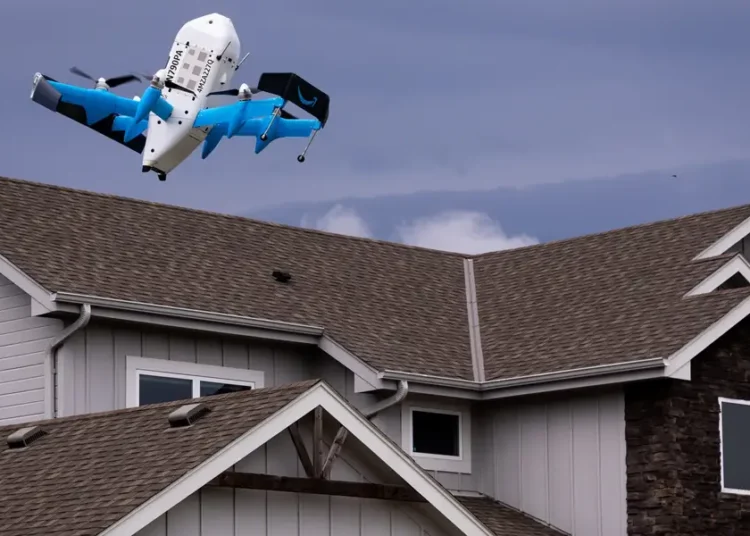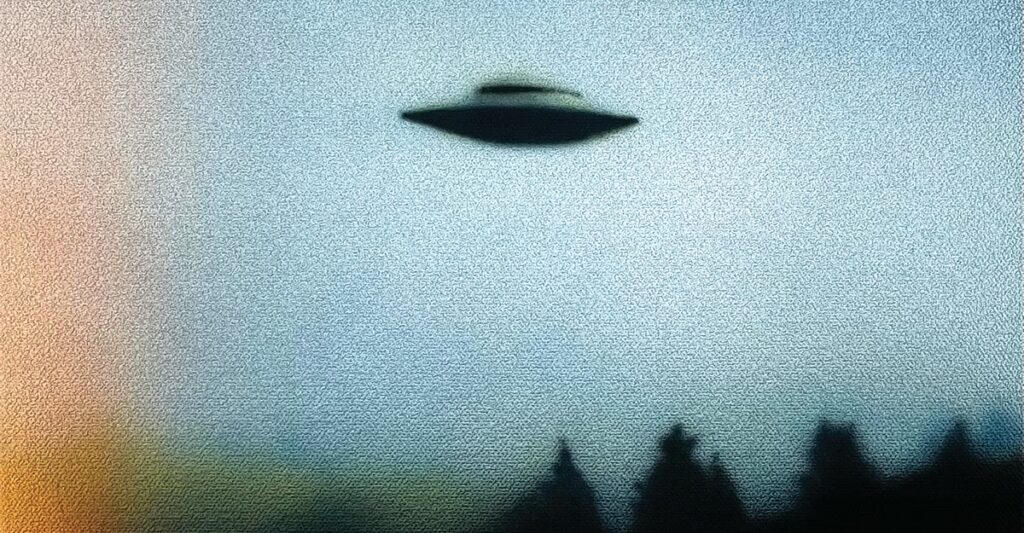
“There has been a threat to publicly release government material long shrouded in secrecy.” This sentence could have been intoned by a TV newscaster anytime in the past few years, about any number of real or alleged cover-ups—of Joe Biden’s mental decline, or the names in the Epstein files, or the origins of COVID‑19. In fact, it comes from the trailer that aired during the Super Bowl for Disclosure Day, Steven Spielberg’s new movie, opening June 12. For people who believe in aliens, or who would like to be able to believe in them, that title leaves no doubt about the kinds of secrets in question: Disclosure refers to the long-awaited moment when the U.S. government will admit what it really knows about visitors to our planet.
When President Trump promised, in a social-media post in February, “to begin the process of identifying and releasing Government files related to alien and extraterrestrial life,” he implied that disclosure might be just around the corner. It wasn’t: This morning, the Pentagon released a tranche of historic images on a new website, war.gov/ufo, which feature plenty of black-and-white murk but nothing that looks even a little like an alien spacecraft. Still, if history is any guide, this disappointment won’t put an end to the belief that the government is hiding a spaceship or an alien corpse; according to one of the best-known UFO legends, both were retrieved from a crash site near Roswell, New Mexico, in 1947. Or the proof could be something less tangible—a clear image of a nonhuman craft in flight, a radio signal from an extraterrestrial civilization. However it happens, disclosure will finally reveal the truth—not just about aliens, but about the authorities that have been deceiving us for so long.
This isn’t a new theme for science fiction, or for Spielberg. His career as a director took off in a post-Watergate climate when Hollywood was obsessed with official conspiracies and heroic whistleblowers—think of Alan J. Pakula’s All the President’s Men, Sydney Pollack’s Three Days of the Condor, and Francis Ford Coppola’s The Conversation. Spielberg brought this suspicious, anti-establishment mood to his early blockbusters, starting in 1975 with Jaws, in which the mayor of a northeastern beach town tries to cover up a deadly shark attack.
[Read: The blockbuster that captured a growing American rift]
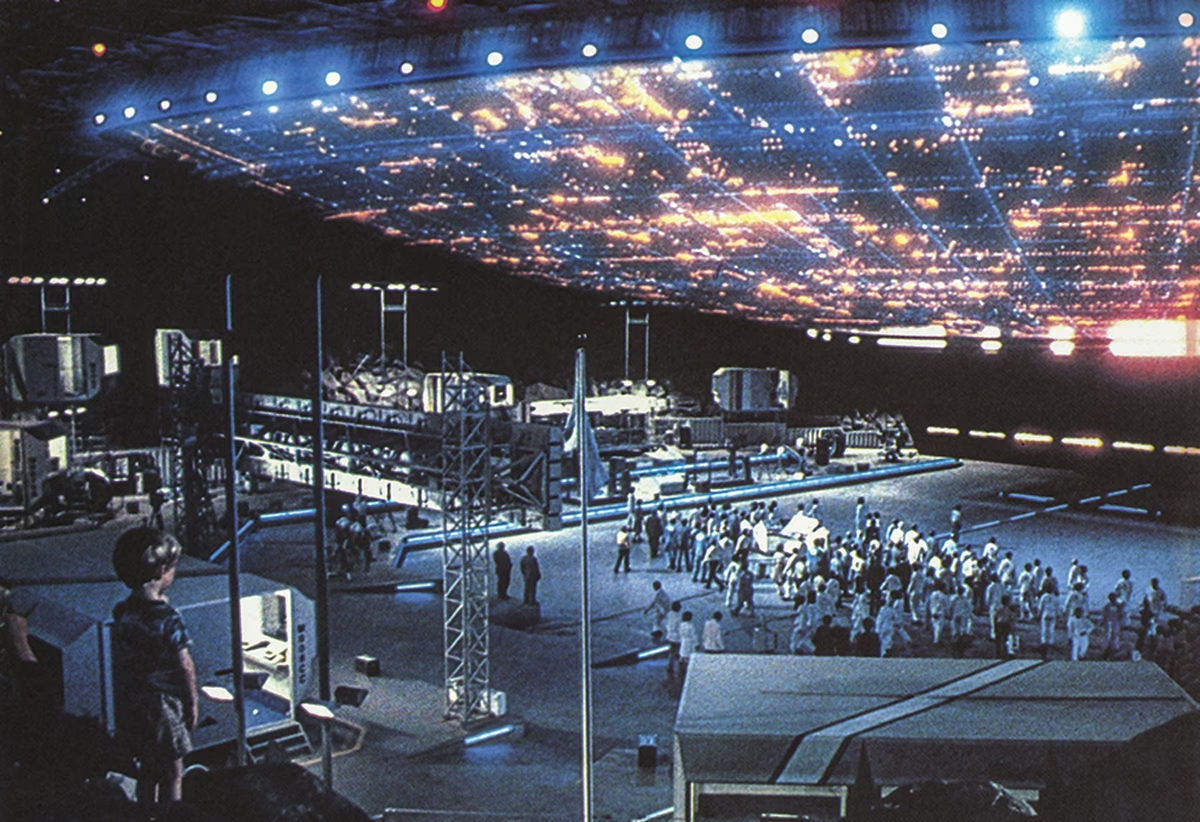
But the perfect genre for a story about government lies was the UFO movie, as Spielberg showed with Close Encounters of the Third Kind in 1977. “All I wanna do is know what’s going on,” says Roy Neary, the working-class hero played by Richard Dreyfuss, after a brush with a UFO. Unfortunately, powerful forces are determined to keep him from finding out. The term gaslighting wasn’t as popular then as it is today, but every military and government official in the movie is engaged in exactly that—trying to convince Neary, and other ordinary people like him, not to trust their own eyes.
“Now, there are all kinds of ideas that would be fun to believe in—mental telepathy, time travel, immortality, even Santa Claus,” a condescending government spokesman says to a group of UFO witnesses. At the film’s climax, the Army invents a story about a chemical-weapons spill as an excuse for evacuating a swath of Wyoming where the aliens are expected to land. If they hadn’t finally shown themselves at the end of the movie—in a sky-filling, strobe-lit mother ship too awe-inspiring to conceal—there’s no doubt the U.S. government would have gone on hiding the truth forever.
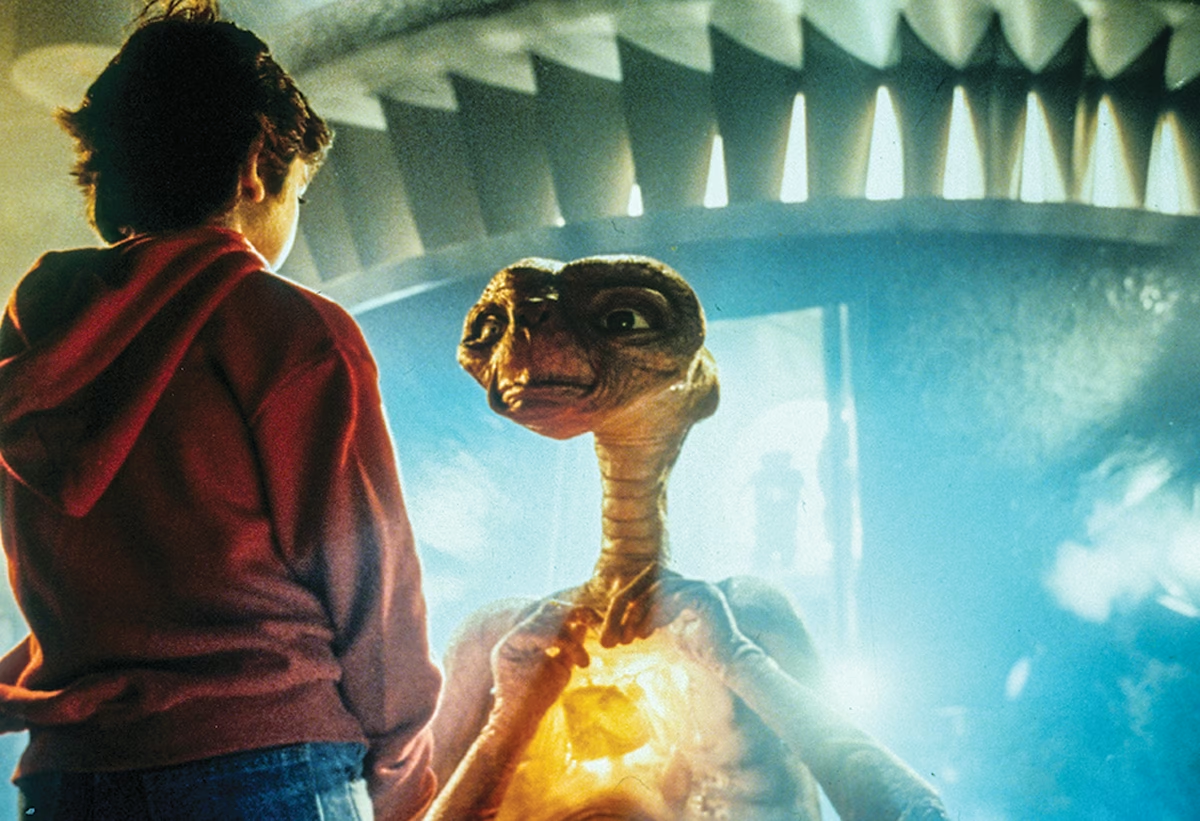
That’s just what it tries to do in Spielberg’s next alien movie, E.T. the Extra-Terrestrial, from 1982. When the government learns that Elliott, a young boy, is hiding an adorable alien, his entire house is sealed off in a plastic tarp—a quarantine that also serves as a perfect concealment. When the boy and the alien manage to break out, they are pursued by agents with guns, escaping with the aid of a bicycle and the power of imagination.
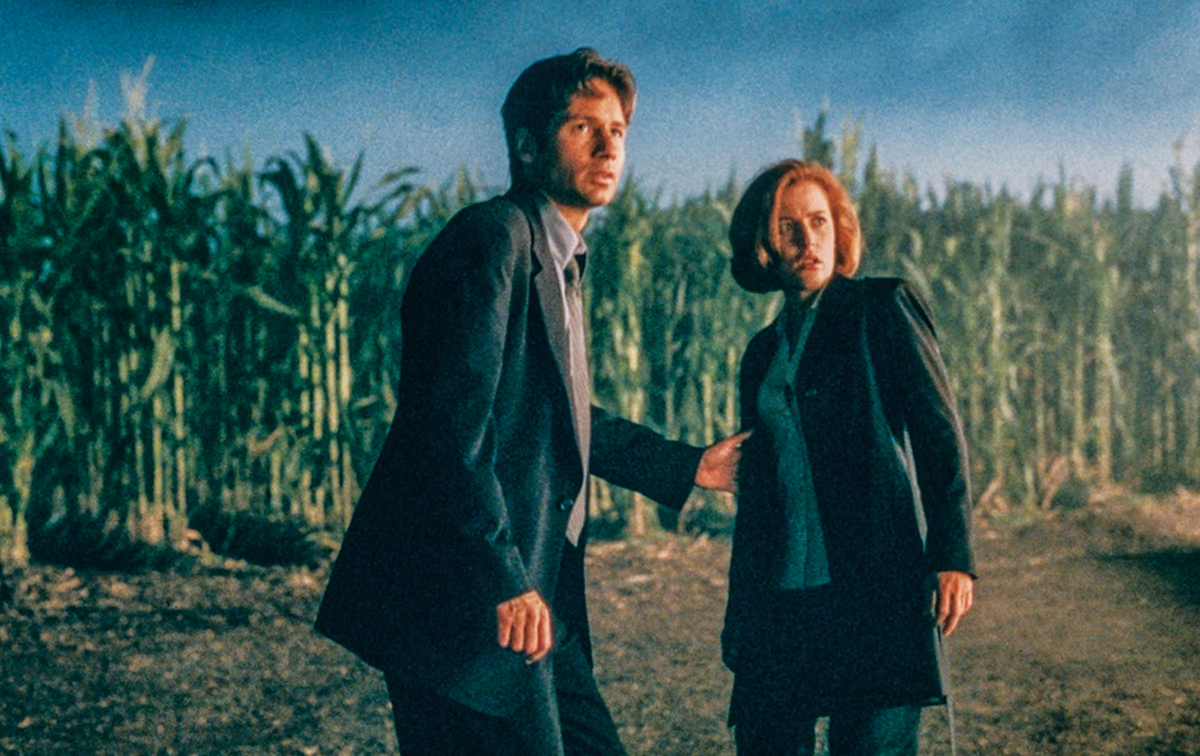
The lesson of these movies is clear: Trust yourself, not the government. It’s a message deeply in the American grain, and science fiction has been amplifying it for decades. In the long-running TV series The X-Files, the FBI agents Mulder and Scully battle the “Syndicate,” a conspiracy at the highest levels of power to sell out the human race to alien invaders. The Men in Black movies play the idea for laughs, imagining a world where law enforcement keeps tabs on aliens living among us in disguise. The titular agents use a “neuralyzer” device to wipe the memory of anyone who stumbles upon the secret.
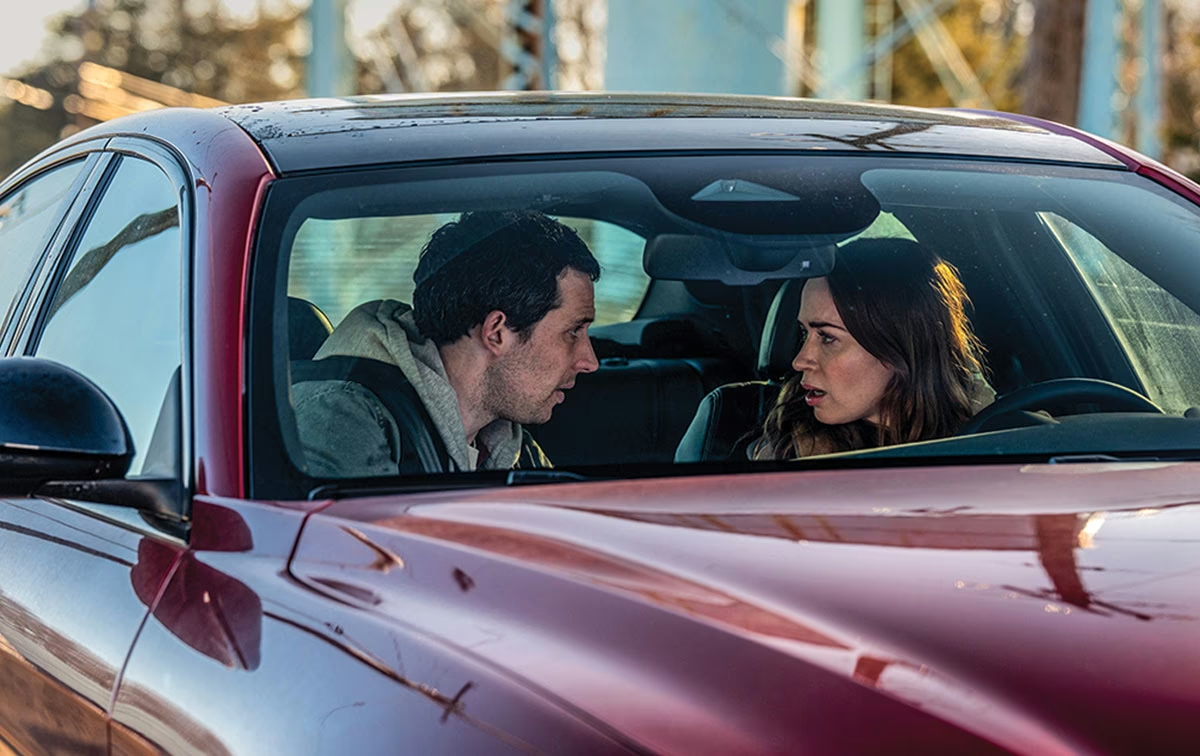
Disclosure Day promises a new kind of UFO story, in which government secrecy is defeated and the world finally learns the truth. Spielberg may be a half century older than when he made Close Encounters, but he clearly hasn’t lost his power to read the mood of American culture. In the past decade, a profound shift has taken place in the way we talk and think about UFOs. To quote the title of a 2025 documentary on the subject, we are living in “The Age of Disclosure.”
The most important sign of this change is that aliens have become respectable. It used to be that only supermarket tabloids such as the National Enquirer reported on UFO sightings; now they are seriously discussed in mainstream media and congressional hearings. Even the term UFO has fallen out of favor, tainted by its long association with crankery. Government officials and true believers alike now prefer to talk about UAP. At first the acronym stood for “unidentified aerial phenomena,” but aerial was soon changed to anomalous, to include all kinds of “space, airborne, submerged, and transmedium objects.” That is how UAP are defined in the mission statement of the All-Domain Anomaly Resolution Office, a government agency created in 2022 “to synchronize efforts across the Department of Defense, and with other U.S. federal departments and agencies, to detect, identify and attribute objects of interest.”
Our age of disclosure was born on December 16, 2017, when The New York Times published an article headlined “Glowing Auras and ‘Black Money’: The Pentagon’s Mysterious U.F.O. Program.” The story revealed that, from 2007 to 2012, the Defense Department had allocated approximately $22 million to the Advanced Aerospace Threat Identification Program (AATIP), a secret task force charged with investigating reports of flying objects that maneuver and accelerate in ways that ordinary aircraft cannot.
Such sightings aren’t new. Americans have been noticing inexplicable things in the sky since World War II, when pilots over Germany reported being followed by glowing balls that they nicknamed “foo fighters.” The term unidentified flying object was coined in the early 1950s to describe such phenomena in a neutral, noncommittal fashion. But of course, what made UFOs fascinating was the possibility that they could be extraterrestrial spacecraft.
In 1966, public concern about the issue prompted the Air Force to convene a panel of scientists to review UFO reports. The committee, headed by the physicist Edward Condon, bluntly concluded that such sightings were meaningless, blaming them on “inexperienced, inept, or unduly excited” observers who mistake ordinary sights like planets and balloons for flying saucers. “Nothing has come from the study of UFOs in the past 21 years that has added to scientific knowledge,” the committee reported, and “further extensive study of UFOs probably cannot be justified.”
That verdict led the U.S. military to stop officially taking notice of sightings, even by its own pilots. But the 2017 revelations about AATIP seemed to prove what advocates of disclosure had always maintained: Though the Pentagon publicly denied that it had any evidence of aliens, it actually knew they were real. In fact, it possessed videos of encounters between UAP and American military aircraft. The Times and other news outlets published several of these videos online—low-resolution black-and-white footage of what looked like a small blob zooming over the ocean.
All of this respectful attention drove a transformation in public opinion. In 1996, a Newsweek poll found that 20 percent of Americans believed that UFOs were “probably alien ships or alien life forms.” When a YouGov poll asked the same question in 2022, that figure had increased to 34 percent. Even people who don’t think aliens have been here are now much more likely to believe that they will be here soon. In 1996, 69 percent of Americans thought that humanity would not contact aliens in the next half century; by 2022, only 39 percent did.
No wonder politicians who would once have scoffed at UFOs began to see them as a winning issue. Disclosure has never seemed closer than it did on July 26, 2023, when the House Oversight Committee held an open hearing on UAP as a national-security threat. Witnesses with apparently unimpeachable credentials testified under oath that the U.S. military has been hiding its knowledge of UFOs for decades. David Fravor, a retired Navy pilot, said that in 2004, his fighter squadron encountered a “white Tic Tac object” in the sky off the coast of San Diego. The craft had “no rotors, no rotor wash, or any sign of visible control surfaces like wings,” yet it was able to outrun fighter jets.
David Grusch, a former Air Force intelligence officer, made even more explosive claims. “I was informed in the course of my official duties of a multi-decade UAP-crash retrieval and reverse-engineering program” that operated in secret, “above congressional oversight,” Grusch testified. In interviews with journalists, he was more explicit, saying that the U.S. government possessed both intact spacecraft and extraterrestrial bodies.
Last year’s documentary The Age of Disclosure includes similar claims. Pilots talk about seeing objects with no wings or engines that seemed to defy the laws of physics, or at least the limits of human technology; Fravor mentions an oval-shaped object that could move at speeds of “32,000 miles an hour.” The narrator of the film, Luis Elizondo—a former Army intelligence officer who worked on AATIP—talks about a Defense Department effort he calls the “Legacy Program,” which has “been capturing, retrieving, and reverse engineering UAPs since at least 1947. On numerous occasions, these retrievals included the bodies of nonhumans.”
These are exactly the kinds of admissions that disclosure was supposed to bring, and though the more outlandish claims were denied by the government and treated skeptically by the mainstream media, they couldn’t be ignored—not when they were taken seriously by people such as Secretary of State Marco Rubio and former Director of National Intelligence James Clapper, both of whom appear in The Age of Disclosure. Who could blame UFO believers for thinking that the world was about to change in profound and disconcerting ways? “This is Disclosure. This is it Right Now,” a Reddit user announced on r/UFOs, a forum with hundreds of thousands of weekly visitors, in the aftermath of the House hearings. “If you have loved ones, it may be a good idea to begin deciding how you will broach the subject, especially if they are dependents.”
In the Disclosure Day trailer, one character asks what would happen “if you found we weren’t alone. If someone showed you, proved it to you.” But showing and proving are exactly what Elizondo and other self-styled whistleblowers have never been able to do. For all the attention paid to UFOs over the past decade, we still have no evidence that they exist. The public may be more willing to listen to claims about downed spaceships and alien life forms, but we haven’t actually seen any. The murky Pentagon UFO videos have not been followed by clear pictures of alien spacecraft, which could theoretically be taken by anyone with an iPhone.
The most parsimonious explanation for this failure is that there is nothing to disclose. But UFO believers are compelled to reject this idea, because the U.S. government is better equipped than any entity on Earth to detect the arrival of extraterrestrials. If they have been here, some kind of cover-up is a logical necessity. At least one person is certain enough to bet on it: In February, the prediction market Kalshi recorded two wagers, totaling almost $300,000, that the U.S. government would announce the existence of aliens by the end of the year. Inevitably, the news prompted speculation that the bettor was a Trump-administration insider who knows that something big is coming.
[Read: This looks like an insider bet on aliens]
Disclosure isn’t just about logic, however. It is awaited with an almost religious fervor because it will give UFO believers the same kind of affirmation that the coming of the Messiah will give religious believers. Faith, the New Testament says, is the evidence of things not seen. But at the end of days, when God finally becomes visible, faith will give way to knowledge: “For now we see through a glass, darkly; but then face to face.” UFOs are not supposed to be supernatural; if they exist, they must obey the same laws of physics that reign here on Earth. But for now, they remain objects of faith because we have never been able to see one face-to-face. Disclosure will show that this faith was justified all along—that the believers were right and the skeptics wrong.
If this sounds a bit like a revenge fantasy, that’s understandable. UFO belief, like traditional religion, tends to attract the scorn of what the Protestant theologian Friedrich Schleiermacher called “cultured despisers,” people who consider themselves too sophisticated to fall for a popular error. How sweet it will be when disclosure proves that the experts and elites were wrong—worse, that they were actively suppressing the truth that nonexperts always knew was out there.
This dynamic of condescension and vindication has become central to American life over the past decade. It drives all kinds of populist causes: vaccine skepticism, the MAHA movement, Roswell-level conspiracy theories such as QAnon and Pizzagate. Every kind of “truther” makes a demand for disclosure—to stop hiding the truth about why the World Trade Center collapsed on 9/11, or where Barack Obama was born, or how Trump’s ear got bloodied in Butler, Pennsylvania.
[From the June 2020 issue: Adrienne LaFrance on a dangerous new phase of American conspiracism]
It’s tempting to dismiss these as fantasies born of ignorance and nourished by paranoia. And the cultured despisers are right, most of the time. There is no convincing evidence that the Earth has been visited by aliens, just as there is no convincing evidence that vaccines cause autism. And yet, the Pentagon really was hiding videos of flying objects that could not be readily explained. Jeffrey Epstein really was friendly with royals and presidents. These things were disclosed only after years of public pressure from people who weren’t content with the official story.
And when people are convinced that they know a secret, world-shaking truth, they are willing to wait a long time for vindication. This is another way in which UFO disclosure resembles the coming of the Messiah: Both are constantly running behind schedule.
In 1950, Donald E. Keyhoe, a pilot and fiction writer, published a book called The Flying Saucers Are Real, in which he argued that the government’s apparent UFO denials were actually “part of an elaborate program to prepare the American people for a dramatic disclosure.” After all, the news that there are aliens among us would likely have devastating consequences. People would panic about a possible invasion of the planet and turn against institutions that had been hiding the truth. Nations would compete to benefit from the newcomers and their technology, and religious authorities would have to rethink the foundations of their faith.
It makes sense that the custodians of such knowledge would want to release it little by little, to help humanity prepare for the shock. In fact, UFO believers have long speculated that Hollywood stories about aliens play a role in this acclimatization process. Some online theorists are already arguing that Disclosure Day itself is part of such a campaign: “Is this all just coincidence + perfect marketing timing for the movie? Or has someone been dropping clues?” one Redditor asked after the first trailer appeared.
Keyhoe promised that “the official explanation may be imminent.” In 2024, Elizondo used virtually identical language in his book, Imminent: Inside the Pentagon’s Hunt for UFOs, looking forward to “imminent government disclosure about nonhuman intelligence.” Three-quarters of a century is a long time for disclosure to remain imminent. But if it proves once and for all that humanity is not alone in the universe, isn’t it worth the wait? Religious believers have been waiting thousands of years for the apocalypse, the vision of the End Times described in the biblical books of Daniel and Revelation. Apocalypse and disclosure are, in fact, Greek and Latin ways of saying the same thing: Both refer to uncovering, the removal of concealment. And as long as we’re convinced that some great, mysterious truth is being hidden, we don’t have to confront an even more unsettling possibility—that there’s nothing out there to believe in at all.
This article appears in the June 2026 print edition with the headline “Alien Nation.” When you buy a book using a link on this page, we receive a commission. Thank you for supporting The Atlantic.
The post The Alien Conspiracy appeared first on The Atlantic.