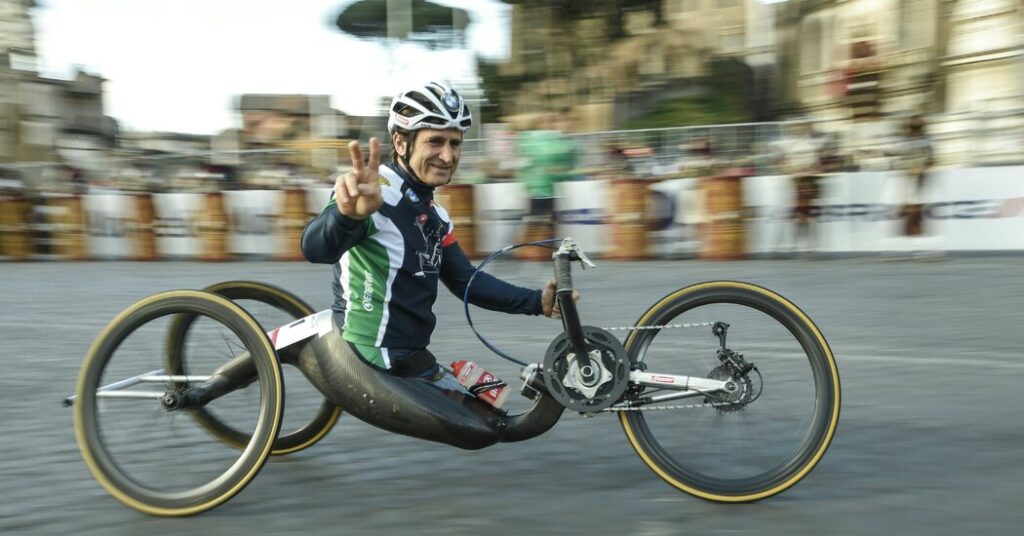
Alex Zanardi, the indomitable Italian racecar champion who lost both legs in a horrific crash in 2001, returned to competitive driving by using special hand controls and, in a second career, won the New York City Marathon in the hand-cycling division and four gold medals in the Paralympics, died on May 1 in Padua, Italy. He was 59.
His death was announced by his family. No other details were given.
Zanardi sustained serious head injuries in a second crash, in 2020, when he collided on his hand bike with a truck during a road relay in Tuscany. He was placed into a medically induced coma and withdrew from public life during a long rehabilitation process.
“He gave all of us much more than victory; he gave hope, pride and the strength to never give up,” Giorgia Meloni, Italy’s prime minister, posted on the social media site X.
In 1997 and 1998, Zanardi won overall championships in what is now called the IndyCar Series, which features open-wheel racing most prominently seen in the Indianapolis 500.
On Sept 15, 2001, he entered an Indy-style race near Klettwitz, Germany. Originally called the German 500, it was renamed the American Memorial 500 in honor of victims of the 9/11 terrorist attacks four days earlier. Zanardi was leading with 13 laps remaining, when he appeared to accelerate too quickly while exiting a pit stop.
He lost control, and his car swerved across a grassy area and onto the track. He spun into the path of an oncoming driver, Alex Tagliani of Canada, who broadsided Zanardi’s car while traveling roughly 200 miles per hour.
Zanardi’s chassis was split in two, and debris scattered across the track. He said in a 2004 appearance on “The Late Show With David Letterman” that he was administered last rites with the oil of his car’s engine. He was airlifted by helicopter to a Berlin hospital, and doctors amputated both legs above the knee. Tagliani was not seriously injured.
In his memoir, “My Story” (2004), written with the Italian journalist Gianluca Gasparini, Zanardi recalled that his heart stopped three times on the flight to the hospital, and that he arrived with less than a liter of blood in his body. “Part of the car stayed with me, and the other part left, with parts of me in it,” he wrote.
He experienced depression early in his recovery and a feeling of detachment from his body, as if speaking to himself through a microphone from a distance. He also found it arduous to have his prosthetic legs fitted correctly. But his wife, Daniela Manni, said in interviews that he adopted an attitude of “What’s next?” instead of “Why me?”
Charming, optimistic and an easygoing storyteller, Zanardi often joked about making himself taller with his prosthetics. In his droll appearance with Letterman, who is co-owner of an IndyCar team, he said that he no longer had to worry about washing his socks, and that he received so much German blood during transfusions in Berlin, he should have been given a German passport.
Then he swiveled his left prosthesis to eye level and placed a drinking cup on the bottom of his shoe.
Some people wondered whether he was scared to drive again, Zanardi told Letterman, but he considered himself less vulnerable than before his accident. “If I break one of my legs, I only need a 4-millimeter screw and I can fix it very rapidly,” he said to laughter from the audience.
Alessandro Leone Zanardi was born on Oct. 23, 1966, in Bologna, Italy. His father, Dino Zanardi, was a plumber. His mother, Anna, was a seamstress who also ran the household.
Prompted by a boyhood fascination with Formula One racing, Alex built a go-kart from the wheels of a trash bin and pipes from his father’s garage. After his older sister, Cristina, an aspiring Olympic swimmer, died in an automobile accident in 1979 when she was 15, his parents became overprotective, he wrote in his memoir. They eventually relented and bought him a racing go-kart when he was 13, believing it would be safer on a track than the mopeds commonly used on roads.
At 21, he advanced to auto racing, then competed on the Formula One circuit with middling results in the early 1990s. He had much greater success in the IndyCar Series, where the theatrical Zanardi popularized the so-called “doughnut” celebration of his victories by spinning his car in circles with his tires smoking.
In May 2003, 20 months after losing his legs, Zanardi returned to the same German speedway and, in a specially adapted car, drove the final 13 laps to symbolically complete the race he didn’t get to finish.
“I went back,” he wrote in his memoir, “because I wanted to show something to those in search of an inspiration to get back their life.”
He began competing in touring car championships — street cars modified for racing — along with sprint series races. In 2019, he drove the prestigious 24-hour endurance race at Daytona with three teammates, using a modified BMW steering wheel that permitted him to drive without wearing his prosthetics.
“I feel a bit like Jimi Hendrix,” he told The New York Times before the race. “I play with both my hands.”
He found another racing outlet with handcycles, three-wheeled bikes that use hand cranks instead of foot pedals. In 2011, he won the handcycle division of the New York City Marathon and followed by winning two gold medals and a silver medal at both the 2012 Paralympics in London and the 2016 Paralympics in Rio de Janeiro.
He was credited in 2017 with becoming the first adaptive athlete to break nine hours in an Ironman Triathlon: swimming 2.4 miles with a buoyancy device and without his prosthetics; using a handcycle to bike 112 miles; and completing the 26.2-mile marathon in a racing wheelchair. He finished in 8 hours 58 minutes 59 seconds.
Zanardi told Forbes in an interview published after his death that he experienced similar sensations on a hand bike and in a car. “You are chasing the limit and that is exciting because you are risking something,” he said.
He is survived by his wife, whom he married in 1996; his mother; and a son, Niccolo.
“He subverted the narrative of disability,” the Italian news agency ANSA wrote in a tribute. “He was a man triumphant beyond all human pity.”
Jeré Longman is a Times reporter on the Obituaries desk who writes the occasional sports-related story.
The post Alex Zanardi, Racer Who Made Daring Comeback After Crash, Dies at 59 appeared first on New York Times.