Before Ted Turner created a world of endless news, he imagined how the news would end. In 1980, in the run-up to the launch of CNN—in the days when 24-hour news cycle was a pipe dream, and something of a joke—the future mogul commissioned a segment to be aired in the case of environmental disaster, nuclear holocaust, or a similar Armageddon. CNN’s “Doomsday video,” as it is commonly known, has existed, over the years, less as a piece of content than as a piece of lore, a production first rumored and then leaked and now existing, for the most part, as a series of grainy screenshots and short clips.
Its main feature, though, is a soundtrack—a military band playing “Nearer My God to Thee,” in a purposeful callback to the musicians of the Titanic who chose, in their final moments, the melody’s quiet dignity. The segment suggests resignation: The network, too, is prepared to go down with the ship. It is also insistent, and a bit cocky. It assumes that humanity will end not with a bang or a whimper, but with one last spectacle, offered up by CNN.
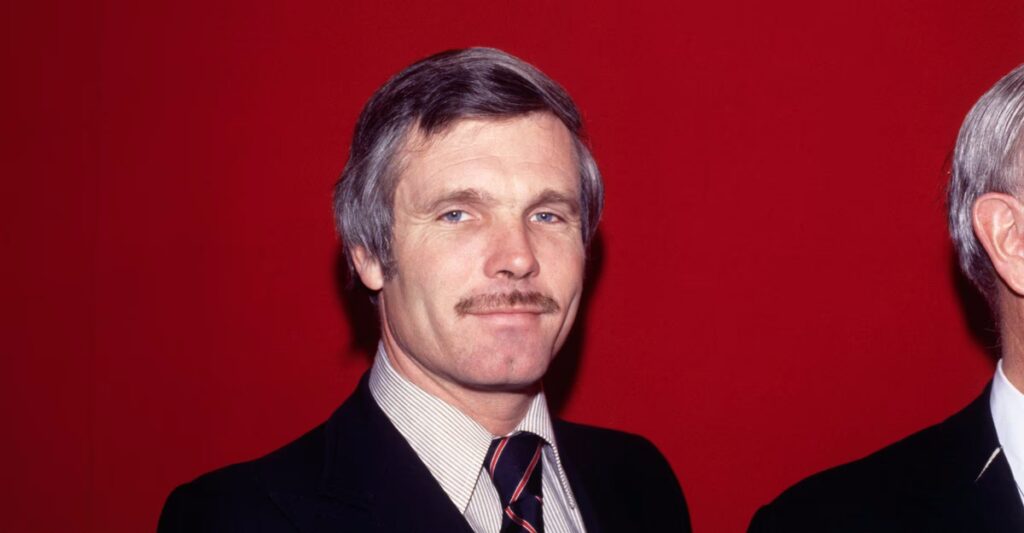
Turner died yesterday at the age of 87, having found a form of vindication: His vision became an empire. He was an icon in a classically American mold—an industrialist in the manner of Andrew Carnegie, a showman in the manner of P. T. Barnum. And the Doomsday tape is a testament to his place in that firmament. CNN would be so enduring that it would pay witness to the very last, turning the ultimate breaking-news story into a eulogy for civilization itself. Confronting apocalypse, the network would also make it telegenic. “We will cover the end of the world, live,” Turner said at the time, a brash promise that, in hindsight, could be read as an omen.
[Read: The new age of performance anxiety]
Today, 24-hour news cycle is nearly a slur, a metonym for a media environment that prizes the outrageous and the merely outraged. But Turner founded CNN as a civic ideal: American democracy, propelled forward by constant information. Reliably confident and unapologetically arrogant, he was also, in his way, selfless. His greed was idealistic. CNN was his proof. Always-on news, he believed, would be good business. But it would also be a gift—to the country and to humankind. Well before move fast and break things became shorthand for a particular, and destructive, style of entrepreneurship, Turner was writing its principles into the workings of mass media. He was doing so guided by the conviction that, when it came to breaking news, moving fast would fix things.
He was brash. He took big risks. He could seem larger than life, in part because he was so adept at the artificial inflation of his image. He had a gift for the dramatic and a prescient understanding, well before the advent of social media, of how easily people could turn themselves into clickbait. He practiced one of his favorite pastimes, the regular public insult of his rivals, with the dedication of an athlete and the verve of a poet.
His approach to business hewed mostly to the all-publicity-is-good-publicity school. Like so many of his fellow showmen, he understood that even self-mockery, correctly pitched, could be a branding exercise. He embraced the faint-praise nicknames assigned to him over the years (“the Mouth of the South,” “Captain Outrageous”), once remarking that “if only I had a little humility, I’d be perfect.”
Turner’s media empire brought a stark new literalism to the promise of “the greatest show on Earth.” But great shows tend to come with high costs. CNN, true to his vision, made information newly accessible and in many ways newly engaging. Today, though, the network—and the many imitators it spawned—are prime pieces of evidence that the critic Neil Postman, writing in CNN’s early days, was correct: On television, Postman observed, the only thing worse than being wrong is being boring. Cable television turned spectacle into a mandate, and then into a banality of American life. Whether or not people watch the content, they live in a media environment ruled by the ravenous beast of infinite air.
One of the most striking things about Turner’s audacity, though, was that he often used it to benefit other people. Also: He could be humble. While giving an interview to The New Yorker in 1988—the magazine’s reporter asked him about rumors of the apocalypse tape—Turner picked up a kaleidoscope from a nearby table and looked through it while making a point about his career arc and eventual environmental advocacy. “When I was younger, racing all over the world and having a ball, I didn’t think about the world situation,” he said. “I used to think everything was fine.” Then—peering, still, into the colors of the device—he described the founding of CNN and his gradual realization that he “needed to find out what was happening in the world. You know, what was really happening.”
In the course of looking around to find out, Turner said he realized that “at the rate we’re going, man is the most endangered species on Earth.” He came to the conclusion that “we had to take better care of our planet, because in taking care of our planet we might be able to save ourselves.”
The scene, for all its Bond-villain overtones (Turner, as described, might as well have been stroking a hairless cat), gestures at something remarkably selfless. The Turner of the article, reaching for a prop—giving the print reporter the gift of a cinematic anecdote—makes a broad concession. He describes his realization of his own ignorance. He then suggests how he solved the problem: by following his curiosity.
[Read: The 21st century’s greatest, ghastliest showman]
As a human disclosure, the claim is not extraordinary—but it is extraordinary in the context of Turner’s status as a mogul. The strategy he used on his way to environmental philanthropy—“I started studying the world, and I got together with a group of experts and politicians who understand the planet better than I do”—is one he would deploy repeatedly: while establishing the Goodwill Games, say, or when he pitched the idea that the Cartoon Network should air stories about “a superhero for the Earth.” The birth of Captain Planet is most directly attributable to Turner’s power; guess whose company owned the Cartoon Network? But the figure’s endurance is due, in large part, to Turner’s lack of vanity. The character, as IP, may have served Turner’s bottom line; it did fairly little to serve his public image.
In that sense, Turner defied the models that were so common among his predecessors in mogulhood. The robber barons of the 19th and early 20th centuries, practicing a form of philanthropy that was both blatantly loud and reservedly apologetic, used their donations to burnish their reputations. Carnegie, having transformed the urban skyline with his industrialized steel—and having amassed a fortune in the process—offered, to the un-millionaired masses, universities and museums that took their aesthetic inspiration from the marble masonry of ancient Greek structures. John D. Rockefeller, enriched by Standard Oil, turned a portion of his wealth over to health-care efforts and other public works. Whether motivated by duty or by the wan necessities of image management, Turner’s forebears were typically ostentatious in their generosity, announcing their contributions so systematically that, today, their names are practically pieces of infrastructure.
Turner, who named one of his networks TNT—the initialism is not a reference to explosives—flirted with monomania. But his philanthropy is notable in that he typically declined to brand it. Captain Outrageous gave us Captain Planet, with little further fanfare. For all his outward brazenness, Turner ultimately chose a quieter exercise of power. I got together with a group of experts and politicians who understand the planet better than I do: This was a piece of his character arc—the hero, taking a step on his journey—that spoke to his essential character.
The Doomsday tape, ideally, will be a waste of energy and resources: an obituary that, dutifully produced, will never air. But it is one more component of Turner’s legacy—awkwardly, but also movingly, visionary. Any entrepreneur can change the present, disrupting and innovating recklessly fast. The wise ones demonstrate, with sincerity, that they care most of all about the world they will leave behind.
The post The End of the World as He Knew It appeared first on The Atlantic.