The surveillance video begins with a seemingly innocent scene: A Jewish man stands next to a bus shelter, adjusting his yarmulke. Suddenly, he is pummeled by a passerby and stabbed repeatedly until he is propelled off-screen. The victim’s skullcap, which had fallen into the street, slowly wafts away in the wind.
This assault was the culmination of a violent spree that has shocked many in Britain. Last Wednesday, according to authorities, a man named Essa Suleiman allegedly attacked Ishmail Hussein, an acquaintance he’d known for decades, in South London. He then traveled eight miles to Golders Green, one of the most Jewish areas in the United Kingdom, and stabbed two random Jewish men in religious garb whom he did not know, including the one at the bus stop, before finally being apprehended. The two victims, ages 34 and 76, were hospitalized but survived.
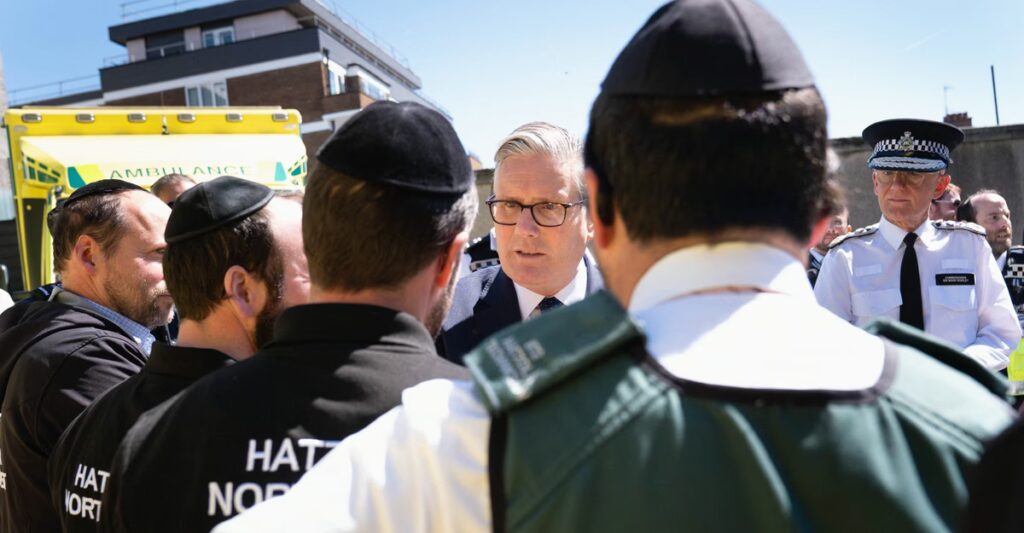
On its own, this incident would be disturbing. But the Golders Green onslaught was just the latest in a series of escalating anti-Semitic attacks across Britain, and the third one in five weeks in the same Jewish community. This past month, multiple synagogues in Golders Green were targeted by arsonists, as was another Jewish institution. The month prior, four ambulances owned by Hatzola, the local Jewish-run charity-ambulance service, were set on fire and destroyed. Last week, Hatzola medics used their remaining resources to treat the victims of the Golders Green stabbing attack. And yet, despite pious protestations from politicians, the country appears to have no idea how to prevent any of this from happening.
[Yair Rosenberg: “The more I’m around young people, the more panicked I am”]
Last October, a man named Jihad al-Shamie drove his car into a Manchester synagogue and began stabbing worshippers, one of whom was killed in the subsequent crossfire with police. In February, the Community Security Trust, which tracks anti-Semitic activity in Britain, announced a grim milestone: “For the first time ever, CST recorded over 200 cases of anti-Jewish hate in every calendar month in 2025.” One of Britain’s oldest minorities now feels itself under siege. “British Jews are super concentrated in NW London,” wrote Ben Judah, the author of This is London and a former adviser to the British government, on social media. “There are only 250k of us. Roughly around 100k of us live in this area and surrounding areas. It’s like a small town that’s now under sustained attack.”
The responses to the stabbings in Golders Green help explain how this predicament arose —and why it continues. Even as the victims were still in the hospital, an array of online apologists associated with Britain’s ascendant hard-left explained away the incident and its implications. Some pointed to the reported mental-health issues of the assailant, as though this somehow excluded an anti-Semitic motive. Whatever the alleged perpetrator’s internal demons, he didn’t travel across London to attack Presbyterians. He went to a historic Jewish neighborhood and attempted to kill Jews. The initial altercation with his acquaintance was a common crime; the knifings in Golders Green were hate crimes.
Other commenters attempted to change the subject from the attacker’s treatment of his Jewish victims to the police’s treatment of the attacker. “Contemptible abuse of police power,” read a representative post on X. “Why kick him in the head several times when he’s already tasered & in your control?” Some called for the suspension or imprisonment of the police officers. In reality, as the full video of the confrontation showed, the police were not gratuitously roughing up the alleged assailant; they were attempting to disarm him as he was actively refusing to relinquish his knife despite repeated instructions.
These deflections were soon distilled into a single post that was addressed to Britain’s police commissioner, Mark Rowley, and reshared by Zack Polanski, the leader of the country’s Green Party: “So essentially [Rowley’s] officers were repeatedly and violently kicking a mentally ill man in the head when he was already incapacitated by taser.” (Polanski, who is Jewish, later apologized in a statement “for sharing a tweet in haste.”)
Some seemed inclined to shift blame from the anti-Semitic attacker to Jews themselves. Suleiman made no reported claims about Israel during his London rampage. But this did not stop some commentators from attempting to make the story about Israel, and implying that British Jews played a role in their own persecution because they were not expressing the right opinions about Israel at the right volume. “The UK Jewish community could help to damp down the likelihood of such outrages by making it clear that it is as appalled by the brutality of Israeli policy as almost everyone else is,” wrote Sir Tony Brenton, a former British ambassador to Russia.
“Jews, like everyone else, are entitled to protection from attack and murder without having to agree with Sir Tony’s analysis of foreign policy,” retorted two members of the House of Lords. “He overlooks the facts that the Jewish community in this country has a wide range of opinions on Israel and that the antisemites responsible for recent outrages do not care about the views of the people they are trying to kill. All that matters to them is that they are Jewish.”
The refusal to acknowledge overt anti-Jewish prejudice in Britain is one reason the prejudice persists and proliferates. But the responses to Golders Green that do recognize the problem have also fallen short.
Before and after the assault, many politicians called to ban pro-Palestine protests—which have at times featured anti-Semitic iconography and chants—in the country’s capital. “It pains me to say this, but I think we may have reached a point where we need to have a moratorium on the sorts of marches that have been happening,” Jonathan Hall, the U.K.’s independent reviewer of terrorism legislation, said last week. “It’s clearly impossible at the moment for any of these pro-Palestine marches not to incubate within them some sort of anti-Semitic or demonising language.”
Chants such as “Globalize the intifada” certainly continue to age poorly as Jews are stabbed, firebombed, and shot around the world by bigots purporting to act in the name of Palestine. But many participating in pro-Palestine marches do not harbor violent hate for Jewish people, and throttling their free expression in order to punish a mendacious minority will sweep up innocents and stoke resentment.
Speech policing is particularly perilous in the case of anti-Semitism, because anti-Semites claim that a powerful cabal of perfidious Jews is covertly controlling society behind the scenes. Efforts to castigate anti-Jewish bigots are thus easily twisted into confirmation of the anti-Semitic conspiracy theory. As the Guardian columnist Jonathan Freedland put it, “We will be blamed for censoring free expression, cast as the shadowy string-pullers who put a gag on everyone else.” Big Government cracking down on speech is quickly refashioned as the machinations of the Jews.
Heavy-handed tactics can also make offending speech seem more transgressive and alluring, and turn malign actors into martyrs. But such approaches are being championed by the country’s rising hard right, just as the deflections from the problem are being promoted by the hard left. The result: The most energized voices in British politics are the ones with the least serious solutions.
[David Frum: Anti-Semitism is becoming mainstream]
Meanwhile, the historically unpopular Prime Minister Keir Starmer has so far resisted shutting down the pro-Palestine protests, even as he has condemned slogans such as “Globalize the intifada” as “calling for terrorism against Jews.” Instead, the British police have allocated 25 million pounds in emergency funding to secure Jewish communities. But there are some things money can’t buy.
“We want normal to be like normal is for everyone else,” said Barry Frankfurt, a synagogue president who was interviewed by BBC Radio alongside his daughter. “But it’s not. Normal for us is that when Libby was 5 in primary school, she was told what the code word was that meant she had to hide under the table. Now she’s 16 and she says she goes to a school and her bus is checked routinely.”
“The response broadly is: ‘We know we have a problem, and the answer we’re gonna give is that we’re gonna spend more money on making sure that there can be Jewish buildings which have even higher gates and even more security guards,’” Frankfurt continued. “And that isn’t solving the problem.” Across the political spectrum in Britain, no one seems to know what will.
The post No One Knows What to Do About Britain’s Exploding Anti-Semitism appeared first on The Atlantic.