Scientists equipped with soil vapor detection equipment and ground radar were at the home of the mother of Kristin Smart’s killer for a second day, scanning the ground for secrets in the dirt 30 years after she vanished.
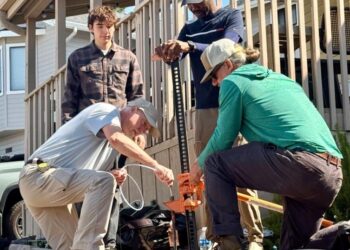
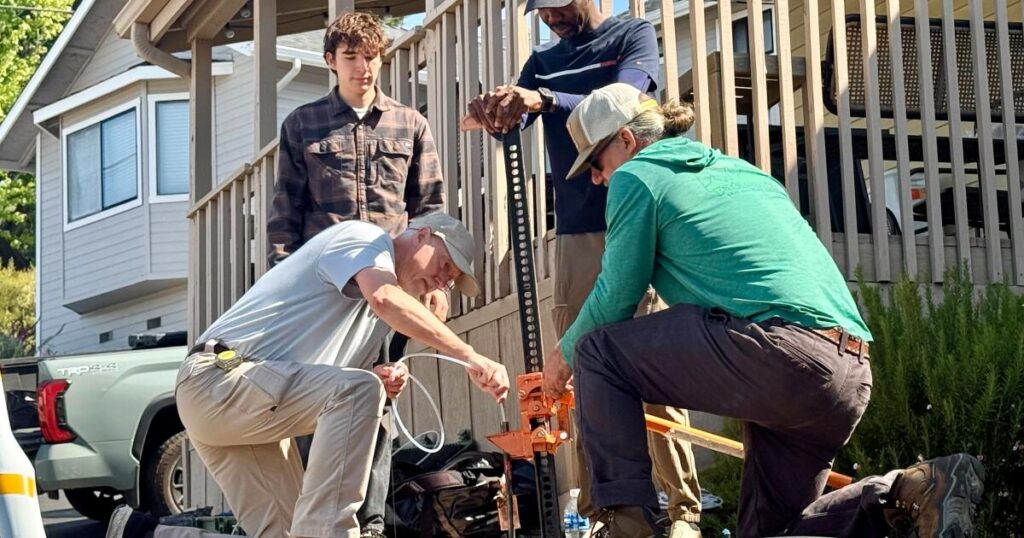
On Thursday, soil engineer Tim Nelligan and former FBI chemist Brian Eckerode, assisted by local soil scientist Steve Hoyt, placed probes into the ground near Susan Flores’ property in the heart of Arroyo Grande. They were joined by a team of ground radar experts who scanned the heavily concreted property, assisting the San Luis Obispo County Sheriff’s with serving a search warrant at the home.
“We’re rooting around for answers,” Neilligan said, “We all want to bring Denise and Stan Smart some peace after all these years.”
Susan Flores’ son, Paul Flores, was the last person seen with Smart as the two walked toward her dormitory at Cal State San Luis Obispo after a 1996 Memorial Day weekend party. She was eventually declared dead, but her remains have never been found.
Decades passed before Flores was arrested and tried. He was sentenced to 25 years to life in prison three years ago for Smart’s murder. But, insisting on his innocence, he has never provided a location for her remains.
Three years ago, Nelligan and his colleagues, working from the backyard of a neighbor of Susan Flores, used soil vapor sampling to detect volatile organic compounds they say may be associated with decomposing human remains. Nelligan, an environmental engineer from San Clemente, met Smart in college. He recalls her knocking on his door and asking to use his landline phone.
Nelligan was visible again in that yard this week. He pushed a small tool known as a soil vapor probe, with a long, straw-like attachment, about 3 to 5 feet into the earth. Any gases the probe encountered were vacuumed in and collected, then sealed in a canister. The extracted volatile organic compounds can then be sent for analysis.
Nelligan said that, since 2023, they had refined the science and were preparing to publish an academic paper on groundbreaking body detection methods in soil.
But perhaps more importantly, in September 2023, they helped federal investigators in Yakima, Wash., locate two bodies, said Tim Perry, a former federal prosecutor and top Department of Homeland Security official. One of the bodies, that of a pregnant woman, was found just 10 feet away from where their probes suggested human remains lay as they worked with Homeland Security Investigations, according to Nelligan.
Since then, they have worked with control samples and real bodies buried in soil at a body farm to refine their methods further. Some of the work led to Wednesday’s search warrant for the property in the 500 block of East Branch Street in Arroyo Grande.
San Luis Obispo County Sheriff Ian Parkinson, along with investigators and the experts, appeared at the home on Wednesday morning shortly after a detective served a search warrant on Susan Flores.
“This investigation is related to the Kristin Smart disappearance,” the Sheriff’s Office said in a statement. “This activity is the result of a search warrant signed by a Superior Court judge. The Sheriff’s Office remains committed to bringing Kristin home to her family.”
That warrant was based in part on the work of Nelligan’s team. After their initial findings, the Sheriff’s Office asked for additional data and academic research to support their new method for detecting remains using soil vapor.
Although the practice is still in the theoretical research stage, scientists have spent two decades studying the chemical compounds associated with the breakdown of the human body.
The San Luis Obispo Sheriff’s Office has previously said officials have also been in touch with the FBI about the men’s research. The science at that time was unproven and had never been used in any criminal proceedings, but the group told The Times they were confident in their findings.
San Luis Obispo County Dist. Atty Dan Dow said his office made a commitment to the Smart family and this community: to bring Kristin home.
In a statement, Dow said his bureau of investigation and Assistant Dist. Atty. Eric Dobroth helped get authorization for the warrant.
“While those responsible for Kristin’s death — and those with knowledge of her whereabouts — could provide answers at any time, we remain firmly committed to using every lawful tool available to locate Kristin’s remains and to support her family until she is brought home,” he added.
The public’s on-again, off-again interest kept Smart’s disappearance in the news sporadically, but a podcast called “Your Own Backyard,” begun in 2019 by Chris Lambert, shone a new spotlight on the cold case.
In November 2019, Nelligan began researching how bodies decompose in soil. Two months later, he recruited Shoyt, another Cal Poly grad with a doctorate in environmental science, who has built a business on the Central Coast testing soil samples. Eckenrode, a retired FBI forensic scientist and expert in human decomposition, joined them in 2021.
Authorities had repeatedly searched the backyards of homes owned individually by the parents of Paul Flores. Sheriff’s deputies even used ground-penetrating radar and cadaver dogs to search Ruben Flores’ Arroyo Grande property in 2021. No remains were uncovered, but a month later, both Flores men were arrested and charged in connection with Smart’s murder.
In 2023, the trio keyed in on the Arroyo Grande home of Susan Flores, a short distance from Ruben Flores’ house. The property had been the subject of search warrants in the past — including one that stemmed from civil litigation with the Smart family.
Susan Flores has never been charged in connection with her son’s crimes. During the search three years ago, she maintained that he didn’t kill Smart and that her family doesn’t know the missing student’s whereabouts.
Attorney Harold Mesick, who secured a not -guilty verdict in Ruben Flores’ accessory charges, told The Times in 2023 the idea that a body could be in Susan Flores’ yard is “ludicrous.”
The post Kristin Smart murder case: Investigators probe grounds to unlock a 30-year mystery appeared first on Los Angeles Times.