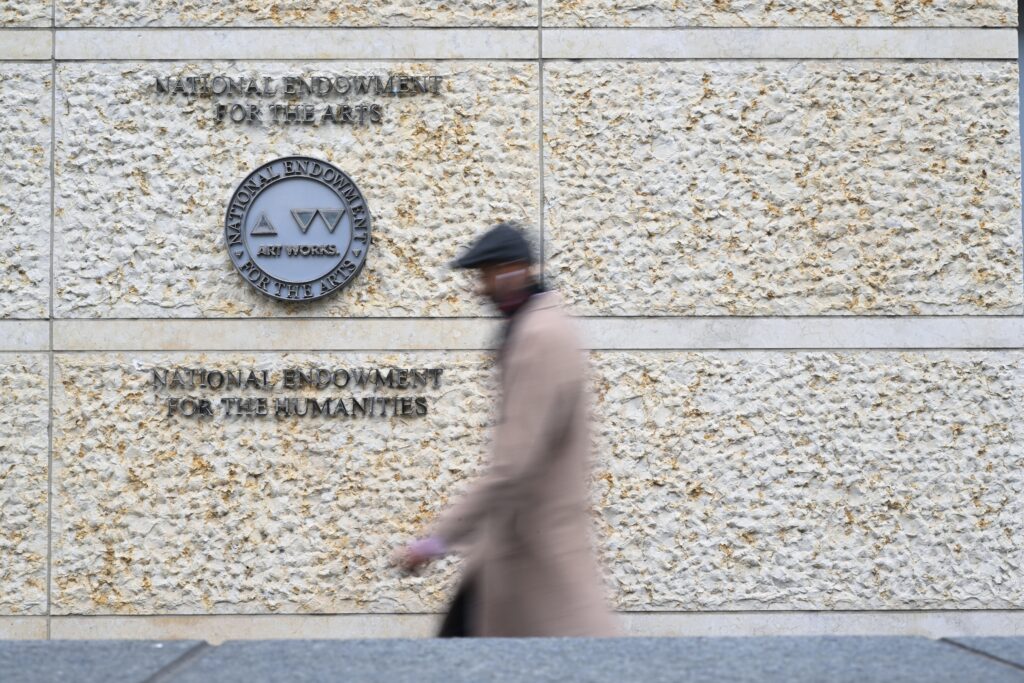
A federal judge ruled Thursday that the U.S. DOGE Service did not have the authority to cancel National Endowment for the Humanities grants, which made up more than $100 million in congressionally appropriated funds.
U.S. District Judge Colleen McMahon said DOGE selected grants for termination last year in ways that violated the First Amendment and the equal-protection component of the Fifth Amendment, calling the case “a textbook example of unconstitutional viewpoint discrimination.”
Citing depositions of two members of DOGE who had directed the grant cuts, McMahon wrote that the cost-cutting group had used ChatGPT to decide which grants would promote diversity, equity and inclusion, or DEI, but did not tell the AI chatbot how it defined the term.
The decision comes after more than a year of litigation over the grant cuts, which revealed new information about DOGE’s inner workings and influence over key decisions.
Humanities organizations — made up of the American Council of Learned Societies, American Historical Association and Modern Language Association of America — argued the grant cuts were arbitrary and capricious because the funding was terminated en masse without considering the specifics of each grant. In depositions, the DOGE members, Justin Fox and Nate Cavanaugh, testified they were focused on eliminating grants they viewed as promoting DEI and other grants they believed contributed to debt. (State humanities councils, which receive funding from the NEH, have also sued over the cuts.)
In depositions and government documents made available through discovery, it was revealed Fox and Cavanaugh had directed the NEH’s acting chairman Michael McDonald in the grant cutting. McDonald’s signature appeared on the letter that canceled grants, but it was placed there by DOGE.
The grants DOGE chose to cancel included funding to provide educational programming about the Holocaust at Seton Hall University, a virtual reality demonstration of Indigenous culture at the Mesa Verde National Park and Wupatki National Monument and a book about HIV in prisons.
McMahon said Congress had conferred no authority on DOGE to cut funding it appropriated, and it was President Donald Trump’s “duty to execute the laws Congress has enacted.”
“DOGE had no statutory authority to terminate NEH grants,” McMahon wrote. “And on the undisputed evidence, DOGE — not the NEH Chairperson or anyone else at NEH — effectuated the terminations at issue here.”
Plaintiffs called the decision a “complete victory.”
“We are gratified that justice was done, grateful to our amazing legal team at Fairmark Partners, and we will be watching closely to make sure every one of these grants is restored,” said Authors Guild CEO Mary Rasenberger in a statement.
The White House and NEH did not immediately respond to requests for comment about the decision.
The judge ordered the government to rescind its termination letters to grantees but said the order does not require the government to immediately pay grant funds.
McMahon also highlighted Fox and Cavanaugh’s lack of understanding about the grants and experience in government. The two had come from tech backgrounds and were recruited through Elon Musk’s allies to join DOGE at the beginning of the administration.
They relied heavily on AI to sort the grants into spreadsheets, asking ChatGPT: “Does the following relate at all to DEI? Respond factually in less than 120 characters. Begin with ‘Yes.’ or ‘No.’ followed by a brief explanation.”
While the government suggested that it was ChatGPT’s determinations of what DEI was and not the government’s, McMahon did not accept that reasoning.
“That argument brings to mind, for someone of my generation, the great comedian Flip Wilson, whose character ‘Geraldine Jones’ would excuse her behavior by saying, ‘The devil made me do it,’” McMahon wrote. “That excuse did not work for Geraldine Jones, and it does not work for the Government.”
The post Judge rules DOGE’s cuts to humanities grants were unconstitutional appeared first on Washington Post.