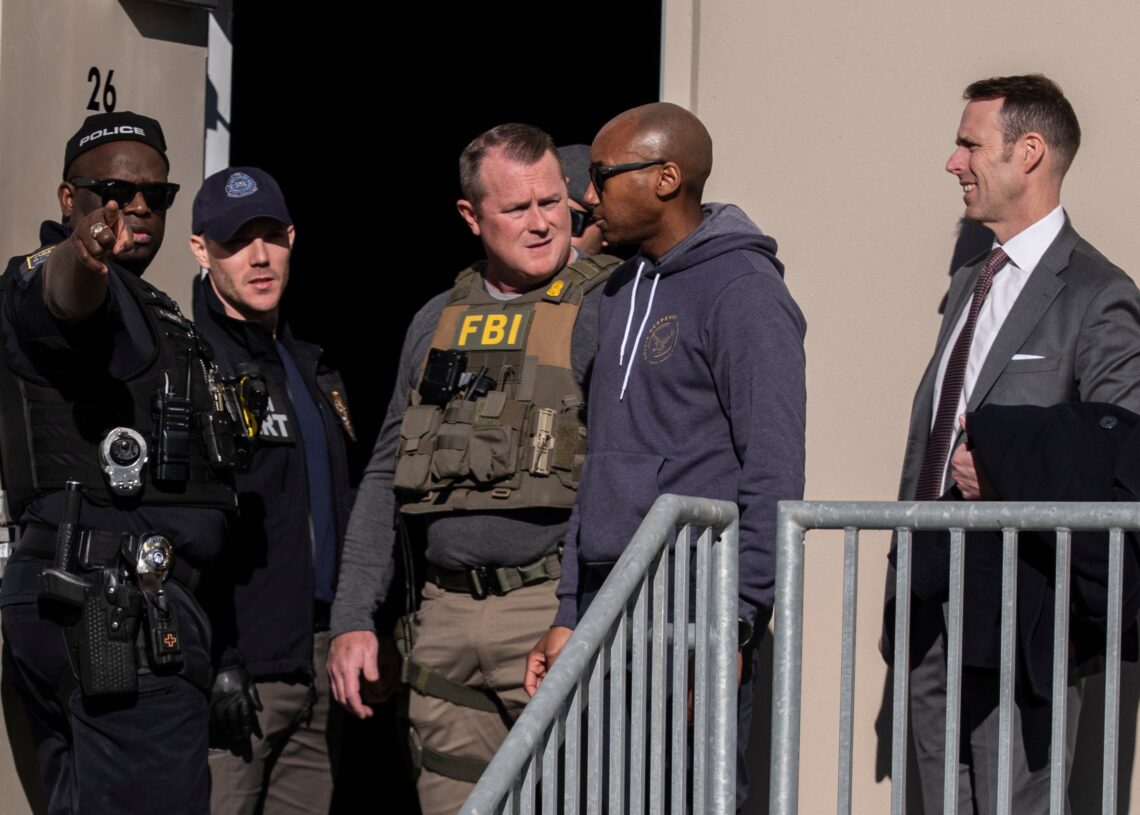
A federal judge on Wednesday rejected a request to order the return of more than 600 boxes of voting material seized earlier this year by the FBI amid an investigation involving a Georgia county at the heart of President Donald Trump’s grievances about his 2020 election loss.
U.S. District Judge J.P. Boulee described the events surrounding the bureau’s January raid on an election warehouse in Fulton County — where Atlanta is located — as “in many ways unprecedented” and called some aspects of the investigation, including its reliance on previously debunked conspiracy theories, “troubling.”
But Boulee concluded county officials had not met the high legal bar necessary for him to intervene in the ongoing criminal probe and to instruct agents to give back the seized material, which includes the original ballots cast in the 2020 vote.
“The seizure in this case was certainly not perfect,” wrote Boulee, a Trump appointee. But the county had not shown that its rights were callously disregarded “either through the lack of probable cause … or by the manner of the execution of the seizure,” he said.
The ruling clears the way for the Justice Department to move forward with its inquiry into Trump’s election loss to Joe Biden, a contest he lost in Georgia by about 12,000 votes.
Trump has remained fixated on that defeat and continues to promote baseless accusations of fraud as he pushes for more national control over state-run elections. Multiple audits, nearly a dozen court rulings and Trump’s former attorney general, William P. Barr, have previously concluded there was no evidence of widespread errors or wrongdoingsufficient to affect the outcome of the race in Georgia.
The search of the Fulton County facility stoked alarm among election officials and democracy advocates across the country, who have condemned the Justice Department’s efforts to relitigate the election’s outcome six years on.
County officials expressed disappointment in Boulee’s ruling Wednesday and hinted at a possible appeal.
“Our fight has exposed the flawed affidavit and suspicious timeline of federal actions,” Fulton County Chairman Robb Pitts said in a statement. “We will continue, as always, to stand by our election workers and the voters of Fulton County. We intend to vigorously pursue all available legal options.”
The investigation began with a referral in January from former Trump campaign lawyer and prominent election denier Kurt Olsen, who Trump named last year to a White House post tasked with monitoring election integrity.
In recent months, the Justice Department has also launched an inquiry into Arizona’s 2020 results. Trump, meanwhile, has continued to demand that Republican lawmakers “nationalize elections,”and impose voter ID requirements, ban voting machines and eliminate mail-in voting in states across the country.
Fulton County officials sued days after the January raid, seeking the return of the material and arguing investigators misled an Atlanta-area federal magistrate judge to obtain a warrant authorizing the seizure.
They pointed to an FBI affidavit submitted in support of the warrant that cited well-worn and previously debunked conspiracy theories to suggest that “deficiencies” in Fulton County’s 2020 vote tabulation might be the result of intentional wrongdoing.
The affidavit relied on accounts from 11 people — many of them prominent election deniers or members of Georgia’s Republican-controlled State Election Board — to suggest that “unknown people” may have sought to tamper with the results.
But the issues cited by the FBI, including claims of duplicate ballots and missing ballot images, have been addressed by previous audits. County officials described many of them in a court filing as matters that had no actual bearing on the county’s official vote count or “types of human errors that … occur in almost every election — without any intentional wrongdoing whatsoever.”
“There’s no basis in reality for most of the witness statements,” said Ryan Macias, an election security expert who testified on behalf of the county at a March hearing. “The information [that] was relied upon doesn’t reflect reality, what actually happened.”
For instance, the affidavit, in suggesting that a crime may have occurred, says that during a recount after the election the county reported a vote total that was roughly 17,000 ballots short of the figure reported in its original count, then replaced that tally with one that matched the first tabulation.
In his March testimony, Macias said that the lower total was actually a mid-count update that was never circulated externally.
“These are common things in the election world that would happen every day,” Abbe Lowell, an attorney for the county, said at the hearing. “And the magistrate judge … should have been told that.”
Even if the Justice Department were able to substantiate accusations of wrongdoing in Fulton County’s 2020 vote count, Lowell argued, it still could not pursue criminal charges under the two laws cited as the basis for the investigation.
Both statutes — one requiring officials to retain voting records, and the other criminalizing efforts to defraud voters by denying them an impartial election — have five-year statutes of limitations.
In a sign of the priority the Justice Department has placed on the investigation, it dispatched Tysen Duva, the head of the department’s criminal division, to lead its response to the county’s challenge at the hearing in March.
He balked at the county’s suggestion that the FBI affidavit had been crafted to mislead the judge who signed the search warrant and noted that despite relying on statements from witnesses skeptical of the election’s integrity, the affidavit also repeatedly cites audits and investigations that found no evidence of wrongdoing. The judge, Duva noted, authorized the search warrant anyway.
“If the agent was intentionally trying to mislead or misdirect,” Duva said, “why would you write something that would take away from your probable cause?”
Boulee credited that argument in his ruling Wednesday, though he described the affidavit as “defective in some respects.”
“While the affidavit was certainly far from perfect,” the judge wrote, “this is not a situation where an officer left out all the facts that might undermine probable cause or where an officer intentionally lied.”
He also deemed unpersuasive claims by county officials that allowing the FBI to keep the ballots as the investigation plays out would undermine public confidence in the security of local elections. Since the raid, agents have given the county access to electronic copies of the seized material.
In justifying his decision, the judge cited a legal standard established by the U.S. Court of Appeals for the 11th Circuit when Trump unsuccessfully sought the return of records seized from his Mar-a-Lago estate amid an investigation into his alleged retention of classified documents after he left the White House. The 11th Circuit oversees appeals arising from matters in Georgia and Florida.
While the status of the seized ballots has been tied up in court before Boulee for months, the Justice Department has not let the issue slow its investigation, which is now being overseen by Dan Bishop, a former Republican member of Congress and Trump administration official who was named interim U.S. attorney for the Middle District of North Carolina late last year. In March, former attorney general Pam Bondi deputized Bishop to oversee election integrity investigations across the country.
His office issued a subpoena last month to Fulton County officials seeking personal information on thousands of employees, volunteers and contractors who played a role in the counting and tabulation of the county’s 2020 vote.
County officials have asked a court to block the effort, describing it as a legally baseless attempt to harass election workers that will chill their willingness to participate in future elections. A judge has yet to rule.
correctionAn earlier version of this article incorrectly said the ruling came down Thursday. It was Wednesday.
The post Judge denies request to return 2020 ballots seized from Fulton County, Georgia appeared first on Washington Post.