Few MAGA influencers were as committed to the digital cause as Ashley St. Clair.
The 27-year-old former brand ambassador for the late Charlie Kirk’s Turning Point USA published an anti-transgender children’s book, appeared prime-time on Fox News and posted selfies from President Donald Trump’s Mar-a-Lago estate.
On X, where St. Clair has more than 1 million followers, she had become a legend: a young conservative woman fighting back against the perceived liberal excesses of “brain rot” feminism and the “‘woke’ agenda” — a reputation that swelled last year, when she revealed that she had secretly had a child with the platform’s multibillionaire owner, Elon Musk.
But in the past few months, St. Clair has become one of the right-wing internet’s most scathing and visible critics. Many of Trump’s top online cheerleaders are actually just mercenaries of the attention economy, she argues, working to turn political outrage and talking points coordinated with administration officials into paid promotional deals.
“There is no free thinking here,” she said in a TikTok video last month about the movement she joined when she was 19. “They are waiting to get marching orders and a direct deposit.”
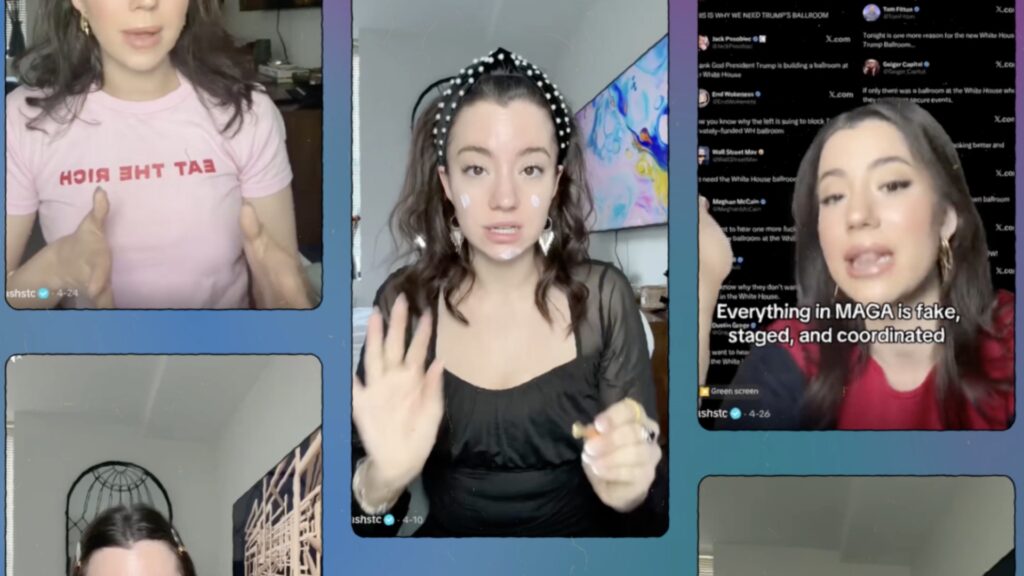
St. Clair’s transformation from a self-described “good little foot soldier” to MAGA turncoat has unspooled in near-daily monologues to more than 77,000 followers on her TikTok feed, where she applies makeup from her New York apartment and claims to expose the secrets of her former allies and the hidden machinery that made them social media stars.
Her viral criticism has triggered unease across the online right, where some of her ex-compatriots have argued she is a disgruntled attention-seeker moving onto her next grift. Naomi Seibt, a far-right German activist and influencer, said in an X post that St. Clair is “projecting her guilt and bitterness for a decade of selling out onto us.”
St. Clair, however, contends that she is speaking out of remorse over her former conduct, which she said contributed to a movement built on fear and false patriotism, where “everything is staged, everything is for a dollar, everything is about making money.”
“They can say whatever they want about me, but they know I’m not a liar,” she said in an interview, referring to her critics. “That’s why they’re so angry.”
St. Clair has become one of the most notable defectors from a once-unified cohort of MAGA provocateurs, whose viral posts and meme videos helped promote Trump’s policies on the campaign trail and in the White House.
But her comments add to a growing wave of disillusionment amid Trump’s movement from well-known figures of the conservative media ecosystem, such as Tucker Carlson, Candace Owens and Joe Rogan, who have argued that Trump’s support for a war with Iran and his administration’s immigration strategy have shaken the support of his political base.
The White House declined to comment. Carlson, Owens and Rogan did not respond to requests for comment.
Renée DiResta, an associate research professor at Georgetown University who wrote about political influencers in her book “Invisible Rulers,” said St. Clair has helped clarify a long-running debate about the animating factors of political influencers’ beliefs.
“She’s saying out loud what people who track the space have observed on the outside to be highly likely,” she said. “It’s a lucrative space for people willing to skirt ethical … obligations.”
St. Clair rose through the ranks of MAGA influence in the years after Trump’s first term, gaining millions of views for her posts on X, including one in which she referred to Hillary Clinton and Kamala Harris as “insufferable wenches” and another in which she complained about migrants flying in “premium seats” on her flight from Phoenix to New York.
Her online popularity helped her unlock access to the highest levels of conservative power, including with visits to Mar-a-Lago and photos with figures like Kash Patel, now the director of the FBI.
Her posts on X, then called Twitter, also won her the attention of Musk, leading to a secret relationship and, as she revealed in February 2025, the birth of their son, her second child. The two have gone to court over custody of the boy and are now estranged. Musk did not respond to requests for comment.
In the months after her announcement, as her dispute with Musk gained attention, St. Clair mostly vanished from the internet. She later described this period in a TikTok video as a time of doubt and self-reflection, when she realized she “didn’t understand what [she] was talking about.”
She had grown disillusioned seeing how her political allies had talked about or treated women, she said, but she had stayed quiet for fear that contradicting them would mean “blowing up [her] entire life.”
As a prominent right-wing influencer, “it’s not just your political beliefs but your social community, your finances — everything is tied to MAGA,” she said. “I couldn’t exactly leave and get a job at Starbucks or Pinterest with my Google search results.”
In January, she reappeared, saying in X posts that she felt “immense guilt” for her role in spreading anti-transgender views and for building a following on a site “run on performative viciousness.”
In recent weeks, St. Clair has spoken about that guilt in 10-minute TikTok videos, where she has shared text messages from, and spoken bluntly about, some of the MAGA internet’s biggest names.
St. Clair renders the clips in the style of “get ready with me” videos, speaking into the camera as she critiques, for instance, the cakiness of the reformulated version of Armani Beauty’s Luminous Silk foundation.
Throughout the videos, she lays bare what she says are some of the MAGA influencer space’s biggest secrets. In some, she alleges that top MAGA internet personalities, some of whom have portrayed themselves as grassroots activists, depended on talking points delivered to them by administration officials and congressional Republicans in group chats with names such as “Fight, Fight, Fight,” which Trump said while being whisked off stage after an assassination attempt during a 2024 rally in Pennsylvania.
After an armed man entered the hotel where the White House correspondents’ dinner was being held last month, St. Clair remarked online that many influencers had posted strikingly similar comments about how the incident reaffirmed Trump’s need for a White House ballroom. Although St. Clair can no longer access the group chat, she said, she recalled that many of them had been long-running participants in the conversation.
In the roughly 24 hours after the shooting, more than 100 right-wing influencers, politicians and commentators posted about the importance of a White House ballroom, according to a Post analysis of posts on X, Gettr, Gab and Truth Social. It’s not clear how many accounts, if any, posted as a result of seeing the group chat.
Some of the influencers, she said, further benefited from signing onto undisclosed digital-marketing campaigns that paid them based on how many views they could get on X posts boosting conservative candidates or policy goals.
She shared a screenshot with The Washington Post showing one campaign from the influencer-marketing platform Urban Legend, created within a week of the U.S. Capitol riot on Jan. 6, 2021, which instructed participating influencers to tell their audiences to “pledge to vote against any House Members who supported [Trump’s] impeachment.”
“They were sent to Washington to work for the American People, not divide us,” read a follow-up message, offering suggested language. The screenshot does not specifically indicate that money changed hands.
Urban Legend’s website tells creators that it is an invite-only platform that “pays you for driving action on topics you’re already talking about” and encourages them to “never promote something you don’t believe in.” An Urban Legend representative said conservative messaging makes up only a portion of its business, which also includes campaigns for parenting, sports and food content.
The Federal Trade Commission requires influencers to tell viewers when they have been paid to endorse a product, but that rule doesn’t apply to political ads. Advocacy groups such as the Campaign Legal Center have urged regulators to require more thorough disclosures for social media, in line with radio and TV ads. Voters can be “deprived of crucial information necessary to make an informed electoral choice,” Saurav Ghosh, the group’s director of federal campaign finance reform, wrote in December.
Some of the offers were made via direct messages, St. Clair said. She shared a screenshot with The Post of a message from a Republican strategist asking her to repost messages from conservative candidates in California and saying he was “happy to pay of course.” She said such deals were common and shared screenshots of messages and documents discussing sponsored posts and “influencer compensation” packages worth thousands of dollars per deal.
Right-wing influencers have disproportionately benefited from that style of direct outreach, said Matthew Sheffield, a former conservative blogger and consultant who has since become a critic of the right-wing media and now runs the newsletter and podcast network Flux. There is growing interest in building a similar infrastructure on the left through groups like the liberal influencer platform Chorus, Sheffield said, but Democratic spending still favors more traditional get-out-the-vote efforts and TV ads. (A Chorus representative said the group doesn’t disseminate messaging but pays creators who attend sessions related to social media strategies and progressive political views.)
Some of the messages St. Clair recalled were less about boosting money than digital attention. She shared a message from James Blair — a Trump campaign official who later became White House deputy chief of staff and is now on leave to run Trump’s political operation — asking for her help sharing his personal X post in October 2024 about how the Federal Emergency Management Agency had given “money to illegal immigrants.”
“Can E help gas this fire?” Blair wrote, likely referring to Musk, who later responded and promoted at least two of Blair’s posts criticizing Democrats’ conduct before the presidential election the next month. The message made no suggestion about payment, according to a screenshot shared with The Post. Blair did not respond to requests for comment.
In her videos, St. Clair said she was drawn to the life of a flame-throwing partisan influencer because of her personal insecurities, need for validation and the allure of fame and financial reward. She has also spoken in caustic terms about some of her former fellow combatants, calling them “cerebral speed bumps” and alleging that some were incompetent or had used drugs.
“My hands are not clean, okay? I have contributed to this rhetoric, absolutely, and I am incredibly remorseful about my role in this,” she said in a video last week.
That has led some of her critics to argue that she is a flawed or begrudging messenger. Rogan O’Handley, a MAGA influencer known as “DC Draino” who once dated St. Clair, said in a statement on X that she only wanted to “attack and demonize people whose America First politics she opposes.”
Another, Benny Johnson, said St. Clair was involved in “grifting e-girl drama.” O’Handley and Johnson did not respond to requests for comment.
St. Clair said in an interview that she is recounting her experience in such a raw fashion because she worries that the viral-outrage infrastructure she participated in will outlive Trump’s time in office, fostering even more secretive cooperation between political operatives and influencers that could corrode American politics.
For now, she said, she is spending most of her time raising two children and finishing her undergraduate studies while preparing to enter law school. She said she is committed to exposing the machinery she once contributed to so that others will “see the rot.”
“I have everything to lose and nothing to gain from speaking out about the most powerful people in the world,” she said. “At the same time, I want my kids to know they should never sacrifice what’s right for being materially comfortable.”
Jeremy Merrill contributed to this report.
The post Inside a MAGA influencer’s turn against the right-wing machine appeared first on Washington Post.