The average American enjoys more than five hours of leisure time per day. That’s according to the latest data from the Bureau of Labor Statistics, which tracks how Americans spend their time. That five-hour average holds up regardless of wealth or education status.
Most Americans—nearly 90%, according to one recent survey—have a hobby. But a majority of us spend less than five hours per week pursuing our hobbies, the same survey found. Meanwhile, the latest statistics show that we spend more than two hours per day on social media, while TV and other screen-based entertainments also take up a significant chunk of our leisure time.
There’s nothing wrong with a little screen-based relaxation. But experts who study hobbies tend to distinguish them from passive leisure pursuits like TV viewing and social-media scrolling. This distinction between hobbies and passive leisure is important because, according to research, true hobbies are a vital component of a healthy and gratifying life.
“One thing that separates a hobby from other kinds of leisure is that it involves the acquisition of skills, or learning,” says Daisy Fancourt, a professor of psychobiology and epidemiology at University College London. “Hobbies provide a sense of accumulation and growth—of stretching ourselves to improve or to meet new goals—and that can help us fulfill our needs for meaning and purpose.”
In some of Fancourt’s research, she and colleagues have found that when older adults have hobbies, they tend to be happier and more satisfied with their lives, as well as less depressed. Other research has found similar benefits among younger adults: Hobbies support mental health and well-being, improve quality of life, and reduce anxiety, stress, and depression.
“It can be hard to define what is or isn’t a hobby,” says Jessica Bone, a senior research fellow at University College London who has studied hobbies and their role in mental health. “But, first off, it’s not a paid activity—it’s something done for its own reward or pleasure, not for money—and it involves an active element. So you’re actively creating something or investing your energy and resources in something that builds your skills or competencies.”
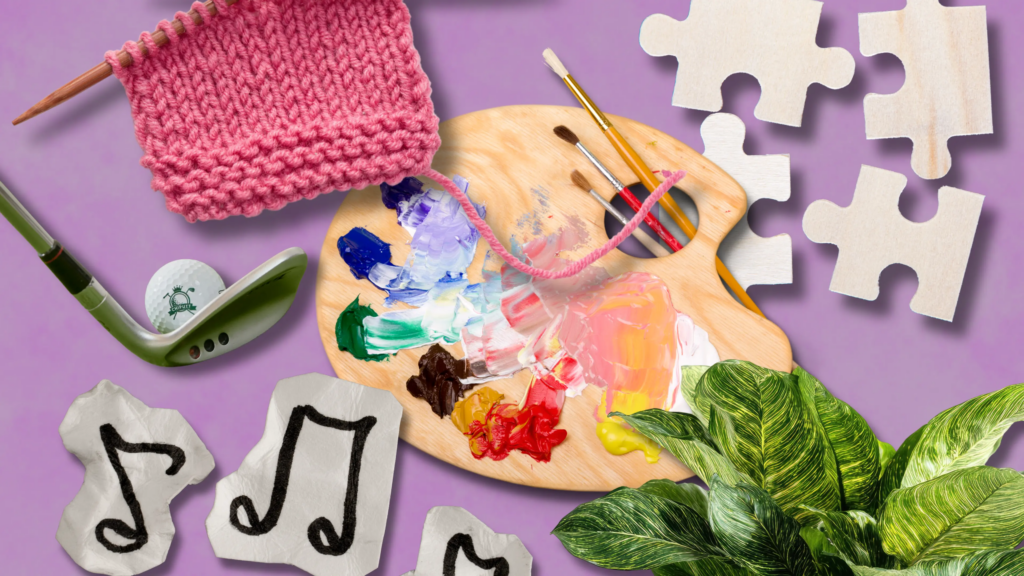
According to some of Bone and Fancourt’s work, hobbies frequently involve novelty, creativity, sensory activation, self-expression, and cognitive stimulation. Bone mentions exercise—especially if that exercise is progressively challenging or involves other people—as one example of a hobby. Gardening, collecting, arts and crafts, and learning a language are other examples.
“Hobbies can help build our self-esteem and confidence,” she says. “They give us an opportunity to use our brain or social skills or abilities in ways that our jobs might not provide.”
Read More: 10 Walking Mistakes You Don’t Even Realize You’re Making
A lot of the research literature on well-being distinguishes between “hedonic” and “eudaimonic” forms of happiness. While hedonic wellbeing often stems from minor and fleeting pleasures, such as the enjoyment people get from eating delicious food or watching something funny, eudaimonic pleasures refer to experiences that provide a deeper, more profound sense of accomplishment or contentment.
Hobbies, which some researchers refer to as “serious leisure pursuits,” seem to scratch this eudaimonic itch.
“They support the more authentic dimensions of life and create conditions for self-actualization,” says Yazdan Mansourian, a senior lecturer and leisure researcher at Charles Sturt University in Australia. “People are not only doing what they enjoy, but becoming who they really want to be.”
For many people, hobbies help satisfy needs left unfulfilled by paid work and passive free-time pursuits. “At work, achievements are typically tied to income, performance metrics, or career progress,” Mansourian says. But when it comes to our hobbies, our accomplishments retain their meaningfulness without the same need for external validation. “This allows people to pursue excellence for its own sake, which can be satisfying and restorative,” he says.
While many of us recognize the benefits of hobbies and are willing to devote time to them, a common problem remains: Finding a hobby that you actually want to pursue.
In the U.K. and, increasingly, in certain parts of the U.S., health providers are adopting “social prescribing” practices, where they prescribe hobbies or other healthy activities to their patients just as they would medications. “I think social prescribing is a really great route to hobbies,” Bone says. “The kind of conversation that often happens is about what matters to you—whether that’s time outdoors or time with other people—and how to fill any gaps with hobbies that appeal to you.”
Read More: The Sleep Trick That Actually Quiets a Racing Mind
In her new book Art Cure: The Science of How the Arts Save Lives, Fancourt describes the many profound benefits people derive from engaging with music, painting, dance, and other art forms. These benefits include improved well-being, reduced stress, and lower risks for diseases like dementia and depression. “Arts engagement provides multisensory stimulation, and it involves creativity and imagination,” she says.
While she’s an enthusiastic proponent of art-based hobbies, people should keep an open mind about what might click. “I recommend that people start by giving themselves lots of new arts experiences,” she says. You could take some painting or dance classes, for example, or learn to play an instrument. “You don’t know if you’ll like it until you try it.”
Whatever new hobby you decide to pursue, she recommends sticking with it for at least 10 to 12 weeks. “If you stay with it for a few months, that often changes the experience so that you feel more comfortable and confident doing it,” she explains. “Typically, studies show improvements in mental health and wellbeing within three months. If you’re not feeling these benefits, it can be a good time to try another activity instead.”
Keep in mind that the goal of a hobby isn’t achievement or excellence: It’s about deepening your engagement with something you find fascinating and enjoyable.
“I would suggest starting not with the question ‘What should I do?’ but ‘What pulls me?’” Mansourian says. “People sometimes feel they need to choose the right activity from the beginning, but exploring a few possibilities is part of the process.”
And, for that matter, part of the fun.
The post Hobbies May Be the Key to a Satisfying Life. Here’s How to Find One appeared first on TIME.