Democrats are increasingly optimistic about retaking the Senate in the midterm elections — an aspiration that appeared all but out of reach at the start of President Donald Trump’s second term.
The political terrain heading into November remains forbidding for Democrats, who need to win races in at least five states that Trump carried in 2024 to recapture the Senate. But Trump’s crumbling approval ratings and the Iran war’s weight on the economy have given the party fresh hope less than six months from Election Day, even as big hurdles remain.
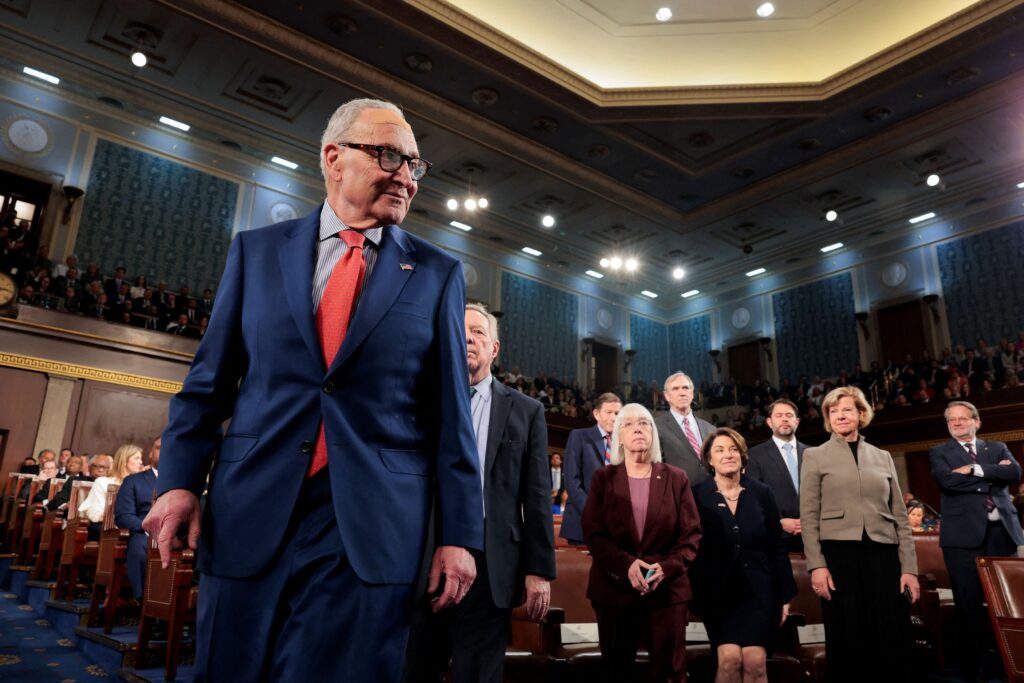
In an interview, Senate Minority Leader Charles E. Schumer (D-New York) said he is confident that Democrats can pull it off, citing Trump’s weakness in polls and the strength of the candidates Schumer has recruited to run in red-leaning states.
“A year ago, no one thought we had a chance to take back the Senate,” Schumer said. “I was one of the very few. And I laid out a plan which is now working.”
For months, Democrats have been far more bullish about retaking the House, which requires flipping only a few seats. But Trump’s unpopularity has made Republicans in both chambers appear more vulnerable.
Thirty-seven percent of Americans approve of Trump’s job performance, according to a recent Washington Post-ABC News-Ipsos poll. Sixty-two percent disapprove, the highest level of either of Trump’s terms. Trump’s approval rating was even lower for his handling of the economy and inflation, which both parties view as crucial to the midterms.
A recent Pew Research Center survey found Trump faring even worse: 34 percent of Americans approved of his performance, and 64 percent disapproved.
Schumer said the political environment feels similar to 2006, when Democrats capitalized on discontent with the Iraq War in President George W. Bush’s second term to pick up six Senate seats and flipped the chamber against the odds.
“There’s a very unpopular president, there’s a war on, and it’s a really hard Senate map,” J.B. Poersch, who runs Senate Majority PAC, the flagship Democratic super PAC in Senate races, said in an interview. “Those are all similarities to ’06. We won in a scenario where we weren’t supposed to win [in 2006] because the map was so challenging — and this one’s challenging, too.”
A few conservatives have started sounding the alarm. AFP Action, a conservative super PAC, warned last week in a memo, first reported by Politico, that “the Republican Senate majority is at risk.” Republicans have a 53-47 majority in the chamber.
Democrats still face obstacles to retaking the Senate — with little room for error.
Republican super PACs have stockpiled hundreds of millions of dollars more than Senate Majority PAC, even as Democratic candidates have outraised their Republican rivals in several crucial Senate races. And Democrats are dealing with a fractious primary in Michigan, which the party probably needs to hold to retake the majority.
Republicans say they are confident they will hold on — or even pick up seats.
Sen. Tim Scott (R-South Carolina), chairman of the National Republican Senatorial Committee, said his party will benefit if gas prices decline in the coming months and as Republicans campaign on their accomplishments.
“I think there is a good chance that we will be able to expand the majority if everything goes our way,” Scott said in an interview.
Alex Latcham, who runs Senate Leadership Fund, the flagship Republican super PAC in Senate races, said he is confident Republicans will hold the majority but that he is taking nothing for granted. The problem with Schumer’s strategy, Latcham added, is that it relies on everything going right for Democrats.
“It’s equivalent to pitching a perfect game and hitting a grand slam at the end,” he said.
The road to the majority
Schumer’s strategy relies on Democrats holding all their Senate seats — including Michigan and Georgia, which Trump carried in 2024 — and flipping four Republican seats. He views Democrats’ best shots as Maine, North Carolina, Ohio and Alaska.
Polling indicates each of those races is competitive — but Democrats would need to win all of them to retake the Senate. So they are eyeing other states, too.
Schumer sees Democrats as increasingly competitive in Iowa, where Republican Sen. Joni Ernst is not seeking reelection, and Texas, where Republican Sen. John Cornyn could lose a bitter primary runoff this month to state Attorney General Ken Paxton. He is even talking about trying to oust Republican Sen. Cindy Hyde-Smith in Mississippi, where Democrats have not won a Senate race in more than four decades.
Senate Leadership Fund has reserved $29 million for advertising in Iowa, underscoring that both parties view it as competitive. The super PAC is waiting until after the May 26 primary runoff to decide whether to make reservations in Texas — but there are signs it could be in play.
State Rep. James Talarico, the Democrat whom Cornyn or Paxton will face in November, raised more than $27 million in the first quarter of the year — an enormous amount even in an expensive state such as Texas. And a University of Texas-Texas Politics Project poll conducted last month found Talarico leading Cornyn by seven percentage points and Paxton by eight points in the general election.
Cornyn said Talarico represents “a genuine threat” to Paxton if he wins the runoff, citing Paxton’s blemished record. (Paxton was impeached by Texas’s Republican-controlled House in 2023 on charges including misuse of office, though he was acquitted by the state Senate.) But Cornyn dismissed the idea that Talarico could win if he prevails in the GOP runoff.
“He appears to be a nonthreatening, reasonable Democrat, but actually he is cut out of the same cloth as Bernie and AOC,” Cornyn told reporters, referring to Sen. Bernie Sanders (I-Vermont) and Rep. Alexandria Ocasio-Cortez (D-New York). “And I just don’t think that dog’s going to hunt in a place like Texas.”
Democrats’ primary problems
Democrats have some primary problems of their own.
Maine Gov. Janet Mills, whom Schumer recruited to take on Republican Sen. Susan Collins, suspended her campaign last week, saying she had run out of money. Instead, Collins is likely to face Graham Platner, an oyster farmer and Marine Corps combat veteran whom Republicans have attacked ruthlessly for old Reddit posts in which he suggested — among other things — that women bore some responsibility for sexual assault. Platner has distanced himself from the comments, saying he was at a low point in his life in 2013 after returning from a fourth deployment to the wars in Iraq and Afghanistan.
In Iowa, state Rep. Josh Turek, whom Schumer and his allies view as their best shot at winning the seat, is locked in a primary with state Sen. Zach Wahls, whom Sen. Elizabeth Warren (D-Massachusetts) has endorsed. VoteVets, a Democratic PAC, has spent more than $6 million on ads backing Turek, according to AdImpact.
No Senate primary has generated more Democratic angst than the one in Michigan, where Rep. Haley Stevens, state Sen. Mallory McMorrow and Abdul El-Sayed, a former Wayne County health official, are locked in a tight race that has split Senate Democrats. Schumer and his allies see Stevens as the most competitive candidate in November. Other Senate Democrats have endorsed McMorrow; Sanders is backing El-Sayed.
Republicans, meanwhile, have united around former congressman Mike Rogers, who came close in 2024 to winning Michigan’s other Senate seat.
El-Sayed has drawn criticism for campaigning with Hasan Piker, a streamer who once said the United States “deserved 9/11” and has described Hamas as less objectionable than Israel. Asked about El-Sayed’s decision to campaign with Piker, Sen. Gary Peters (D-Michigan), who is not running for reelection, said he had tried to remind candidates for his seat that the general election matters more than the primary.
“I think we’ve got a pretty spirited primary going right now,” Peters said. “I would prefer that [it] was less spirited.”
El-Sayed said he is looking to win in November by reaching new voters.
“Winning a general election means bringing people in who have been locked out of our politics,” he said in a statement. “We go everywhere and talk to everyone for a reason.”
A Republican cash advantage
Republican super PACs have built an enormous financial advantage over Democrats to help defend the Senate majority.
Senate Leadership Fund had $166 million on hand on March 31 — more than twice as much as Senate Majority PAC. The Republican super PAC has announced $342 million in ad reservations in eight Senate races; Senate Majority PAC has not made any reservations public yet except for in Ohio, where it has reserved $40 million in TV ads.
Even more worrying for Democrats is the nearly $350 million that Trump-aligned super PAC, MAGA Inc., has on hand. It’s not clear how much Trump and his allies will decide to spend in Senate races this year or where he will deploy it.
In the interview, Schumer acknowledged Republicans’ financial edge but said Senate Democrats would have enough money to counter Republicans’ attacks.
“Are we going to have as much money as the Republicans? No,” Schumer said. “But we don’t need it, because the atmosphere, the ether is so pro-Democratic and anti-Trump that … we don’t need to match them one-to-one to take back the Senate.”
Democrats have blunted Republicans’ cash advantage in several crucial races by outraising them, in some cases dramatically. Sen. Jon Ossoff (D-Georgia) had more than $31 million in his campaign account on March 31 — more than eight times what any of the three Republicans battling each other in the primary to face him could command.
Former North Carolina governor Roy Cooper, whom Schumer recruited to run for an open Senate seat, had more than $18 million on hand; former Republican National Committee chairman Michael Whatley, the Republican nominee, had $2.5 million.
Sen. Thom Tillis (R-North Carolina), who is not running for reelection, said Whatley would need outside support to erode Cooper’s current lead in polls of the race.
Democrats are “smelling blood, and they’re going to spend a lot of money,” Tillis said. “And so we need to make sure every organization that has resources they can spend in the state will. We’re going to need all of it.”
Scott Clement contributed to this report.
The post Democrats see Senate control within reach — but some big hurdles remain appeared first on Washington Post.