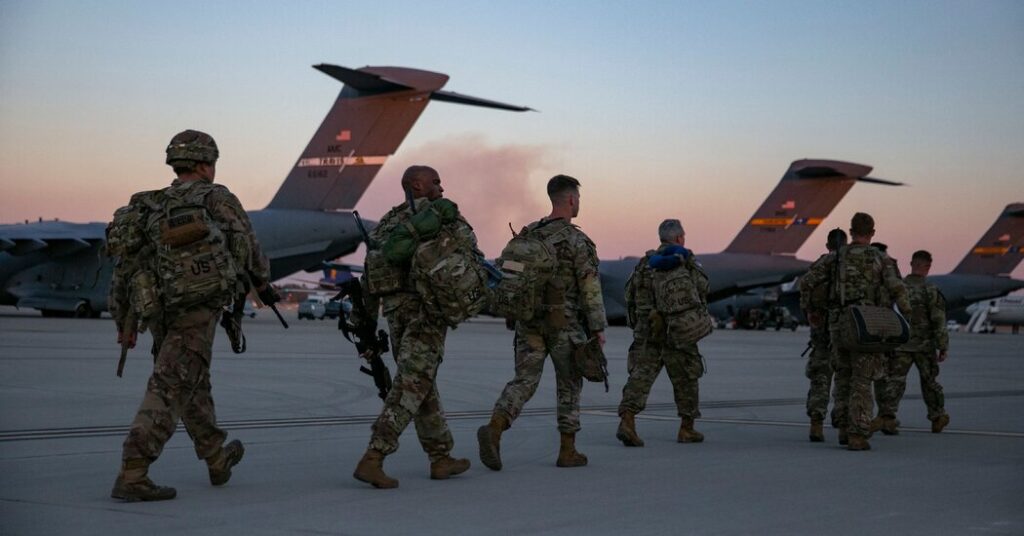
President Trump tasked some 50,000 troops to his war against Iran, sending them in aircraft carriers, destroyers, Marine expeditionary units and warplanes.
With parachutes in their packs and survival kits at their sides, they have been part of Mr. Trump’s declared mission against Iran “to destroy their missiles and raze their missile industry to the ground.”
Now, the U.S. military is on standby in the region, as the White House gives contradictory signals about the status of the war effort.
On Tuesday, Secretary of State Marco Rubio declared that Operation Epic Fury, the name given to the U.S. campaign, was “over.” Defense Secretary Pete Hegseth said the big effort was to help ships get through the Strait of Hormuz, though Mr. Trump later said that even that effort was paused.
Then on Wednesday, the president said on social media that he would end the war and offer safe passage to vessels through the strait if Iran “agrees to give what has been agreed,” without elaborating.
He added: “If they don’t agree, the bombing starts.”
The U.S. Navy is still enforcing a blockade on all shipping in and out of Iranian ports imposed after Iran effectively closed the strait. A Navy warplane disabled an Iranian-flagged oil tanker that was trying to cross the blockade on Wednesday.
Before the war started in February, there were typically about 40,000 U.S. troops at bases and on ships in the Middle East, including in Saudi Arabia, Bahrain, Iraq, Syria, Jordan, Qatar, the United Arab Emirates and Kuwait. But as Mr. Trump escalated the war, the number rose to more than 50,000, according to a U.S. military official.
The precise number is complicated by the fact that Iran retaliated by attacking U.S. bases, forcing the military to relocate troops to other bases and locations, including in the region, Europe and even the United States.
Here is a look at the U.S. forces still assigned to the region.
82nd Airborne
About 2,000 paratroopers with the Army’s elite 82nd Airborne Division are in the Middle East —Defense Department officials will not say where — as part of the buildup of forces.
The troops could be used in an effort to take Kharg Island, a hub for Iranian oil exports, though they would need more boots on the ground to hold it, officials said. And such an operation would come with the risk of U.S. casualties.
Or the troops could be part of an effort to seize an airfield, military experts say, though it remains unclear what the United States would do with an airfield in Iran once it takes it.
Holding such a piece of territory in a country that is around a quarter of the size of the continental United States, with more than 90 million people, would be challenging.
31st Marine Expeditionary Unit
The arrival of 2,500 Marines and another 2,500 sailors helped keep the number of U.S. troops in the region at over 50,000.
While it is still unclear what the Marines from the 31st Marine Expeditionary Unit may do, U.S. officials said that they could also be part of an effort to seize an island or other territory.
Special Operations Troops
Several hundred U.S. Special Operations forces arrived in the Middle East in March in a deployment meant to give Mr. Trump additional options, two U.S. military officials recently said.
As specialized ground troops, they could be used in a mission aimed at Iran’s highly enriched uranium at the Isfahan nuclear site.
U.S.S. Abraham Lincoln and U.S.S. George H.W. Bush
The U.S.S. Abraham Lincoln and the U.S.S. George H.W. Bush, aircraft carrier strike groups, along with their accompanying flotillas of warships and more than 10,000 sailors and Marines, are on hand in the Arabian Sea. From there, they can strike Iran using missiles and fighter jets launched from the carriers.
The Bush replaced the Gerald Ford, which is heading to the Atlantic Ocean and eventually back to Norfolk, Va., one U.S. official said. The Ford suffered a fire in its laundry facilities early in the war.
Helene Cooper is a Pentagon correspondent for The Times. She was previously an editor, diplomatic correspondent and White House correspondent.
The post U.S. Troops in Middle East Wait for the Next Big Moment appeared first on New York Times.