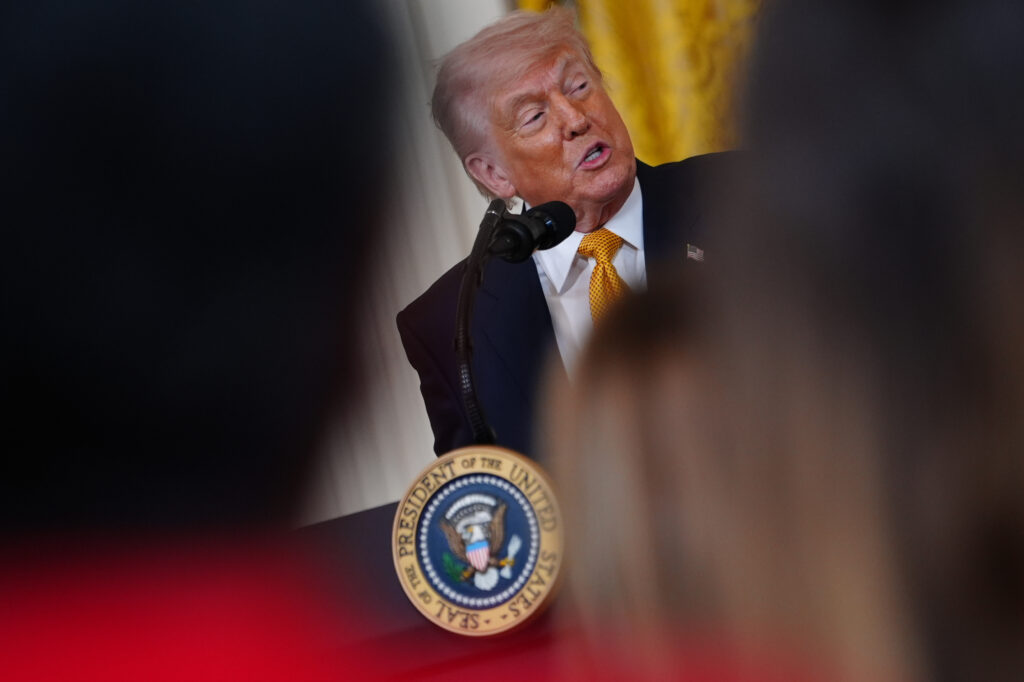
A day after announcing a pause in the military’s new operation to clear a path for commercial vessels through the Strait of Hormuz, halting a mission that had just begun, President Donald Trump on Wednesday threatened that if Iran did not agree to his latest peace plan, U.S. bombing would resume “at a much higher level.”
Trump said Iran had already accepted at least parts of the U.S. proposal as the two governments have continued to exchange documents via Pakistani mediators in recent days, expressing optimism — as he’s done several times in recent weeks — that an agreement would be reached soon.
“We have to get what we have to get,” Trump told reporters at the White House, expanding on an earlier social media post. “If we don’t do that, we’ll have to go a big step further. But … they want to make a deal. We’ve had very good talks over the last 24 hours.”
In Tehran, Foreign Ministry spokesman Esmaeil Baqaei said his government was still reviewing the U.S. “framework” transmitted Sunday in reply to Iran’s latest 14-point plan. “Once our positions are finalized,” he said in an interview with the semiofficial news agency ISNA, “they will be communicated to the Pakistani side.”
Tehran had earlier rejected U.S. assertions that it had already agreed to concessions on the dismantling and future restrictions on its nuclear program. It said its proposal dealt only with the Strait of Hormuz, where more than 1,500 commercial ships are still waiting to get through Iran’s closure of the critical waterway.
There were “absolutely no details regarding the country’s nuclear issues in this proposal,” Baqaei said Sunday as Iran began its review of the U.S. response. Iran had proposed nuclear discussions be postponed to a later date after the war was over.
A Pakistani official urged caution, saying the issues are “complicated.” The official, speaking on the condition of anonymity to discuss sensitive closed-door talks, said the two sides were discussing a deal that would include lifting the U.S. blockade in exchange for a pause in Iranian nuclear enrichment and the easing of Iranian restrictions on passage through the strait.
Pakistani mediators pressed both sides to “differentiate between what is urgent and what is important,” said Mushahid Hussain Syed, a former Pakistani senator who served on the foreign relations and defense committees.
“What is urgent is the Strait of Hormuz, because that affects international shipping, the international economy, global energy,” he said. “And what is important is the nuclear issue.”
Syed said it was “a positive sign” that the two sides appear to be considering a phased approach, concentrating first on the strait and later on thorny issues involving Iran’s nuclear program. That, he said, “shows the pragmatism and the flexibility on both sides, notwithstanding what they’ve been saying publicly.”
Amid the rapid chain of events, it was unclear which side was responding — or not responding — to what. Even as the latest U.S. missive was dispatched to Tehran, Trump announced on social media late Sunday that he was launching “Project Freedom,” in which U.S. naval vessels would “guide” commercial vessels through the strait.
Then on Tuesday night, he said he was pausing the hours-old U.S. military operation “to see whether or not the [peace] agreement can be finalized and signed.”
That announcement, in which Trump hailed “Great Progress” toward a peace deal, sent global stocks surging and oil prices falling Wednesday. S&P 500 futures closed up 1.46 percent, with gains in major European and Asian indexes as well. The price of Brent crude oil, the global benchmark, was down about 7.48 percent to just over $100 per barrel.
Trump said the pause had come “at the request of Pakistan and other countries.”
Both sides have prevented traffic through the strait. Iran has claimed complete control over the waterway, laying mines and charging tolls for passage, while the U.S. Navy has blockaded any ships trying to reach or depart from Iranian ports.
For the brief period Project Freedom was in effect, both sides exchanged fire over the strait. French firm CMA CGM confirmed Wednesday that one of its vessels, the San Antonio, was attacked while transiting the shipping route a day earlier, resulting in injuries to crew members and damage to the vessel. “The injured crew members have been evacuated and are provided with the necessary medical care,” it said in a statement to The Washington Post.
A spokesperson for U.S. Central Command, which is responsible for the transit clearing and the ongoing blockade, referred questions on the pause back to the White House.
Trump’s announced pause of the clearing operation followed two news conferences Tuesday, one at the Pentagon and one at the White House, where senior administration officials touted its effectiveness and strived to convince reporters that the mission was working — despite Iran firing missiles and drones at U.S. ships on Monday and the U.S. destroying at least six Iranian fast boats in return.
Secretary of State Marco Rubio, addressing reporters from the White House, said the administration had moved past Operation Epic Fury, the Trump administration’s name for the war that began with Iran. The White House has argued that the April ceasefire ended the war, which began Feb. 28, short of the 60-day deadline set under the War Powers Resolution, the law that aims to constrain a president’s military powers.
“We’re done with that stage of it,” Rubio said. “Okay, we’re now on to this project of freedom.”
Earlier Tuesday, Defense Secretary Pete Hegseth said that the U.S. mission to protect commercial ships in the Strait of Hormuz would be temporary and that other nations would soon have to take responsibility. He also emphasized that the fragile ceasefire with Iran remained in place despite this week’s ship attacks.
Speaking at the Pentagon alongside Hegseth, Gen. Dan Caine, chairman of the Joint Chiefs of Staff, said that since the ceasefire was announced, Iran has fired at commercial vessels nine times, seized two, and attacked U.S. forces more than 10 times, Caine said — “all below the threshold of restarting major combat operations, at this point.”
The 60-day deadline by law required the White House to seek Congress’s authorization to continue to carry out Operation Epic Fury strikes in Iran. Hegseth said that “with the ceasefire, the clock stops.”
Democrats in Congress have contested the legality of that position. It was not clear whether Trump’s Wednesday threat to restart the war would restart the clock or violate the deadline.
Despite Trump’s claims to have “already won” the war, Tehran thinks it can outlast his tolerance for high energy prices and political criticism. “We know full well that the continuation of the status quo is intolerable for America; while we have not even begun yet,” Parliamentary Speaker Mohammad Bagher Ghalibaf said Tuesday in a post on X.
Tasnim, a semiofficial Iranian news site tied to the Islamic Revolutionary Guard Corps, on Wednesday cited an “informed source” saying that U.S. reports that any final agreement was at hand were “an attempt to justify Trump’s retreat from his latest hostile move.”
Despite the ceasefire and the short-lived protection mission, both sides exchanged fire this week in and around the strait, which has remained effectively blocked to maritime traffic during the war. The U.S. said two of its destroyers, closely followed by two merchant vessels, came under attack Monday during successful transits of the strait.
Iran fired cruise missiles and drones at the U.S. naval and commercial vessels and sent fast boats after commercial ships, said Adm. Brad Cooper, head of U.S. Central Command.
The United Arab Emirates reported an Iranian assault Tuesday on an energy hub that caused a fire, while Oman’s state media reported an attack in the country but did not identify a perpetrator.
On Wednesday, Central Command said it enforced the U.S. blockade against an Iranian-flagged oil tanker attempting to reach port. After the crew of the unladen ship Hasna failed to comply with “repeated warnings,” a Centcom statement said, “U.S. forces disabled the tanker’s rudder by firing several rounds from the 20mm cannon gun of a U.S. Navy F/A-18 launched from the USS Abraham Lincoln” aircraft carrier.
“Hasna is no longer transiting to Iran,” the statement said.
At the United Nations, UAE Ambassador Mohamed Abushahab called on the Security Council to take a firmer stand against Iran or lose all credibility.
“These are not the actions of a state seeking stability,” he said of the new Iranian attacks on his country, “they are the action of regime escalation over diplomacy and coercion over peace.” Abushahab spoke as the council moved into a closed session to discuss the latest events in the region.
The U.S., along with Persian Gulf nations, has circulated a draft resolution among council members demanding that Iran cease all attacks, mining and tolls in the strait and calling on all nations to aid the effort to restrain it.
While it expresses support for ongoing peace efforts, the draft makes no mention of the U.S. naval blockade. The U.S. mission at the U.N. did not respond to requests for comment on when the resolution would be introduced for a vote or whether breaking events had overtaken it.
Michael Birnbaum, Tara Copp, Victoria Craw, Dan Lamothe, Cleve R. Wootson Jr. and Cat Zakrzewski contributed to this report.
The post Trump threatens intense bombing if Iran peace deal is not reached appeared first on Washington Post.