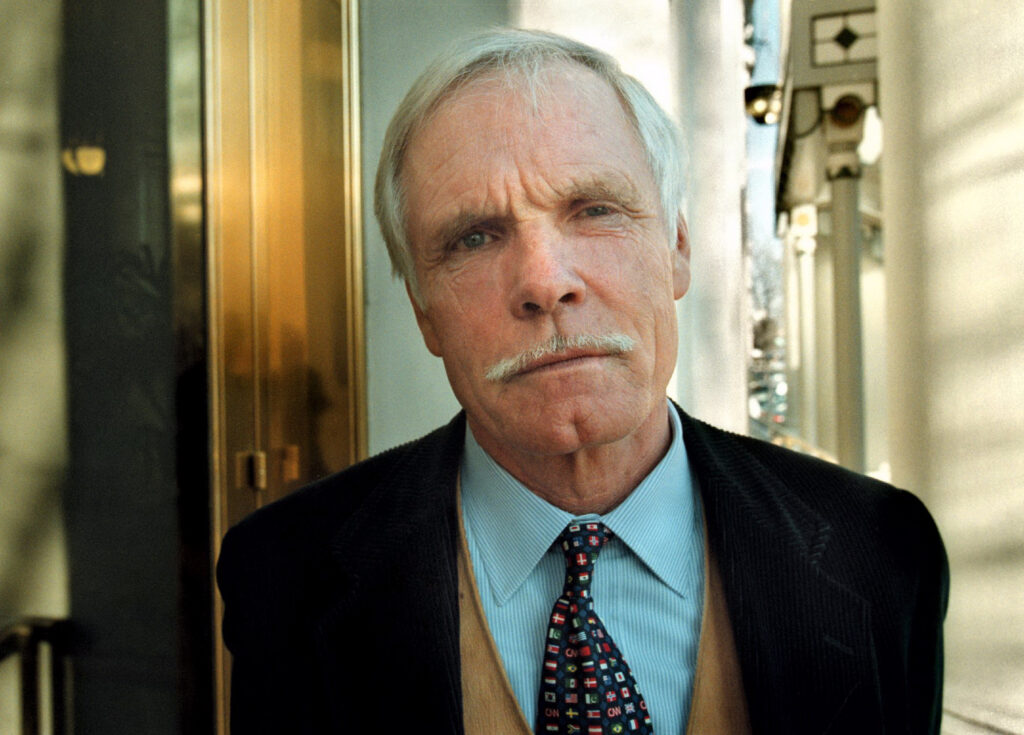
Ted Turner, a mercurial tycoon and gadfly visionary whose “superstation” TBS was a cornerstone of cable TV’s early success, whose 24-hour news channel CNN revolutionized TV journalism, and whose sprawling legacy encompassed conservation, philanthropy and professional sports, died Wednesday. He was 87.
His death was first reported by CNN, the news channel he founded, which cited a statement from Turner Enterprises. Additional details were not immediately available. Mr. Turner had revealed in 2018 that he had Lewy body dementia, a progressive brain disorder.
A serial entrepreneur known as “the Mouth of the South” for his bellicosity and bravado, Mr. Turner took over his family’s Georgia-based billboard company at 24, after his father’s suicide, and transformed the business into a media juggernaut that would forever alter broadcasting.
“CNN really heralds the world of Twitter and social networks and interactivity,” said Ken Auletta, a Turner biographer and media writer for the New Yorker. “During the Persian Gulf War, you had a live war for the first time, without commercial breaks. You’d see bombs dropping and people screaming and fire engines roaring. Everything is immediate. It’s the world we live in today. He’s the father of that world.”
Mr. Turner’s achievements transcended journalism and business, and his much-publicized personality — charming, vulgar, daring, impulsive, idealistic, titanically self-regarding — made him one of the most captivating public figures of his generation.
He presented himself as a Southern gentleman. But he also boasted of being a Ferrari in the bedroom, and with his incessant philandering, he burned through three marriages, including his last, to actress Jane Fonda.
The billionaire Mr. Turner championed a world free of conflict but was on friendly terms with dictators and despots, including Saddam Hussein and Vladimir Putin. A Goldwater Republican turned unabashed liberal, he had friends running the political gamut — from former president Jimmy Carter to Sen. Jesse Helms (R-North Carolina), from televangelist Jerry Falwell to communist Cuban leader Fidel Castro, who became a duck-hunting companion.
On his cable channels TBS and TNT, Mr. Turner delivered wholesome family fare, including sports and black-and-white reruns. But in his prime, he was a self-confessed absentee husband and father, with family below business and sailing on his list of priorities.
As skipper of the yacht Courageous in 1977, Mr. Turner won the America’s Cup, sailing’s most prestigious trophy. He also brought his competitive drive to ownership of the Atlanta Braves, the long-hapless baseball team he bought in 1976. The team rewarded his vigorous support and patience with a World Series victory in 1995 over the Cleveland Indians.
His interests and ambitions seemingly boundless, Mr. Turner became one of the largest private landowners in the Western Hemisphere, and he used his more than 2 million acres, from Montana to Argentina, to preserve endangered flora and fauna. He underwrote foundations that campaigned against nuclear arms proliferation and for such causes as population control, solar energy and debt forgiveness for developing countries.
In 1986, he created the Goodwill Games to foster brotherhood among athletes after the two world superpowers — the United States and Soviet Union — traded boycotts of the Summer Olympics in Moscow (1980) and Los Angeles (1984) during a surge in Cold War tensions. He lavished hundreds of millions of dollars on the venture before it was shuttered in 2001 because of low television ratings.
Years before Microsoft co-founder Bill Gates rose to the top of world philanthropy, Mr. Turner donated $1 billion to start a foundation to support United Nations projects in developing countries.
In business, as in all his undertakings, Mr. Turner cultivated a renegade persona. The bad boy yachtsman, who galled the elite gatekeepers of sailing in New York and Newport, Rhode Island, was also the Atlanta David battling the media Goliaths of New York. “I was cable,” he once quipped, “when cable wasn’t cool.”
Mr. Turner thrived on the role of buccaneer, and he looked the part with his rugged 6-foot-3 frame, square jaw, cleft chin and tidy mustache. A cigar, a beer can and a quip were ever at the ready. “If I only had a little humility,” he once joked in his booming Southern drawl, “I’d be perfect.”
He came across to many business associates as alarmingly uncontainable. At meetings, he would stand on desks or get down on all fours — anything, no matter how outrageous, blunt or profane to make his presence known and his will be done. He said he never forgot that he was in show business and that controversy served the purpose of keeping attention on him and, by extension, his networks.
He managed to outrage just about everyone at one point or another. “Christianity is a religion for losers,” he once said. Abortion opponents were “idiots” and “bozos.” He once called the hijackers of Sept. 11, 2001, “brave.”
“Ted is a complicated guy, but he is part genius,” Fay Vincent, the former baseball commissioner, told the New York Times in 2001. “Ted doesn’t mean the harm he causes; he just cannot shut up.”
Making cable a force
From the start, Mr. Turner showed an insatiable appetite for business and risk. He began to diversify his father’s billboard company by gobbling up advertising competitors in radio and television. He bought Atlanta’s basketball and hockey teams, as well as its baseball franchise, putting himself in debt to have reliable and relatively cheap programming for his TV stations.
In 1976, with rented satellite capacity, he turned a puny Atlanta UHF station into a superstation that would be able to transmit a lineup of old movies, reruns of “Lassie” and “I Love Lucy,” and games played by his sports teams to cable systems across the country. That station, now known as TBS, bolstered the foundation of cable TV when it was desperate for programming to satisfy its monthly subscribers.
Another major gamble came in 1980, with CNN and his move into 24-hour news. He envisioned viewers, long limited to the networks’ half-hour evening newscasts, flocking to wall-to-wall coverage of global events.
CNN was initially laughed off as the “Chicken Noodle Network,” in part because of its conspicuously low-budget look and its headquarters in the distinctly non-media capital of Atlanta. In CNN’s first five years, it hemorrhaged tens of millions of dollars.
Gradually, CNN upended the way news was consumed, riveting audiences by covering historic events and dramatic human-interest stories as they unfolded: the space shuttle Challenger explosion in 1986; the 58-hour rescue of a toddler from a well in Midland, Texas, in 1987; the Chinese government’s massacre of pro-democracy student demonstrators in Beijing’s Tiananmen Square in spring 1989; and the demolition of the Berlin Wall — amid the dissolution of the Soviet bloc — in fall 1989. (The network also introduced a stable of popular talk and public affairs shows, among them “Larry King Live” and “Crossfire.”)
CNN and its Headline News sister station, which launched in 1982, paved the way for cable ventures by CBS, NBC, ABC and Fox and served, in the view of CNN admirers, as a constant visual watchdog.
“The idea of 24-hour news and global news is his creation,” Christiane Amanpour, who became the network’s chief international correspondent, told the New Yorker. “That’s changed the world. It’s changed people’s relations with their governments. It’s meant that governments can no longer crack down with impunity on protests.”
Mr. Turner, who was treated for bipolar disorder, was powered by hasty enthusiasms and a tolerance for high-wire risk.
In 1986, he took on potentially crushing debt to finance the takeover of MGM/UA Entertainment Co., whose largest shareholder was billionaire investor Kirk Kerkorian. The initial deal called for Kerkorian to buy back UA and for Mr. Turner to keep MGM. But desperate for cash, Mr. Turner sold most of MGM — to Kerkorian and a TV-production company — and ended up paying about $1 billion for MGM’s trove of films and cartoons.
The archive Mr. Turner retained, however, would feed his superstation and the other networks he formed in subsequent years, including Turner Network Television (TNT), Turner Classic Movies and Cartoon Network.
After CNN’s distinguished Persian Gulf War coverage in 1990-1991 and its high ratings during the 1995 O.J. Simpson murder trial, Mr. Turner seemed to be at his career apogee when he sold Turner Broadcasting System to Time Warner in 1996 for nearly $7.5 billion.
He took the title of vice chairman, with a nominal role overseeing TV programming. For the first time in more than 30 years, he was not his own boss, and he quickly bristled at the button-down corporate ownership. He was further marginalized after AOL bought Time Warner in 2001 for more than $160 billion, creating the world’s largest media company.
Mr. Turner, the biggest individual shareholder, saw his personal wealth soar to $9 billion. But behind the scenes, he seethed. After the dot-com bubble burst, AOL’s value plunged amid government investigations into its opaque accounting practices. Mr. Turner publicly lambasted the company’s stewardship, and he resigned from the board in 2003.
Biographers observed that, in work or in play, Mr. Turner strove to disprove his father’s dim view of him when he was a young man. The elder Turner was said to have disparaged his son, then a sailing-obsessed, girl-chasing college dropout, as a wastrel and an unworthy heir to the family business.
In 1984, having landed on Forbes magazine’s list of the richest people in America, Mr. Turner was speaking to Georgetown University undergraduates when he held aloft a copy of Success magazine with his picture on the cover.
His voice, according to biographer Porter Bibb, trailed off into an eerie whisper, and his eyes searched somewhere above the crowd. “Is this enough?” he asked. “Is this enough for you, Dad?”
A lonely child, and a rebel
Robert Edward Turner III was born in Cincinnati on Nov. 19, 1938, and grew up mostly in Savannah, Georgia. His father, known as Ed, came from a family of Mississippi sharecroppers who had lost their farm during the Depression.
Ed Turner was a charming and successful salesman but ruled over his family with domineering cruelty. Mean when drunk, he exhibited signs of what would now be diagnosed as bipolar disorder.
Mr. Turner described himself as a lonely child whose ordinary mischief was punished by his father with beatings. In a disturbing reversal, his father also ordered Ted to lash him with a razor strap. “He laid down on the bed and … said, ‘Hit me harder,” Mr. Turner told TV host David Frost. “And that hurt me more than getting the beating myself. I couldn’t do it. I just broke down and cried.”
He was sent to a military school in Chattanooga, Tennessee, where he initially rebelled against the rigid structure. But he said the slow and excruciating death of a beloved younger sister, from the autoimmune disease lupus and encephalitis, sparked a gradual transformation. He lost his religious faith but grew determined to reverse his reputation as the worst cadet on campus.
He became an academic overachiever and showed promise as a boxer — “not because I had great reflexes, but because I could take a lot of punishment,” he recalled in his memoir, “Call Me Ted.” He also became a champion debater and excelled at sailing.
After high school graduation in 1956, he enrolled at Brown University. He joined the sailing team and was named the best freshman sailor in New England, but he was suspended from school for six months for rowdy behavior involving alcohol.
Back on campus, inspired by a charismatic teacher, he declared the classics as his major. “I almost puked on the way home today,” his father wrote to him after hearing of his decision. “I am a practical man, and for the life of me I cannot possibly understand why you should wish to speak Greek. With whom will you communicate in Greek? … I think you are rapidly becoming a jackass.” (Mr. Turner responded to the letter’s almost comical viciousness by having it published in the school paper, without attribution.)
After a brief stint in the Coast Guard, he joined the family business — Savannah-based Turner Advertising — where, over many summers, he had worked his way from the construction crew to the leasing office. He was soon advising his father as the company became one of the largest billboard operations in the Southeast.
But Ed Turner, anguished over debt he had taken on to finance a major acquisition, set in motion plans to sell a large part of the company. Then he suffered a mental breakdown, exacerbated by drinking and abuse of prescription drugs, that culminated in his suicide in 1963.
Working through his despondency, Ted Turner managed to halt the sale of a sizable chunk of the company and drew up an aggressive growth plan.
The foundation of his broadcasting empire was a money-bleeding UHF station, then WTCG, in Atlanta, which he bought in 1970 for $2.5 million. As he acquired rights to show sporting events — wrestling matches, as well as Atlanta Braves, Hawks and Flames games — revenue soared, putting the company’s broadcasting wing well in the black by 1973.
As owner of the Braves, which he bought for $10 million in 1976, he played an active role in personnel changes. He plowed resources into the team and aggressively recruited other teams’ players, leading baseball commissioner Bowie Kuhn, in once case, to suspend him for one year.
He engaged in promotional stunts, staging motorized bathtub and ostrich races on the field. To some, he was a civic-minded character, to others a nuisance. But he sought a national profile and saw sports and broadcasting as providing a platform on which to achieve it.
Mr. Turner’s incursion into television and related interests provoked a powerful backlash from film companies, sports teams, the networks and local network affiliates, all of which argued that Mr. Turner was squatting on their turf.
He played the combative underdog as he went before the Federal Communications Commission and Congress. He called the Big Three networks and their affiliates “thieves” that had essentially paid nothing for their broadcast licenses and were raking in fortunes at the public’s expense.
To garner support from powerful conservative members of Congress, he painted the networks as bastions of licentious programming, accusing them of “polluting the minds of the American people” with shows that glorified sex and violence.
Ultimately, the FCC sided with Mr. Turner, allowing his superstation — which became TBS — to operate unimpeded, beginning in December 1976.
Victory at sea
Less than a year later, the fame Mr. Turner achieved by his successful challenge to network primacy was amplified by a stunning demonstration of his seamanship. In the 1960s and early ’70s, he had won a shelf of sailing trophies but not the America’s Cup. And his first America’s campaign, in 1974, had not gone well.
The second time around, he bought the Courageous from Ted Hood, who had sailed the 12-meter yacht to victory in 1974, and he assembled a topflight crew in the hope of defending the trophy for the United States in the 1977 races.
Members of the venerable New York Yacht Club decreed who would defend the cup, and many were skeptical that Mr. Turner had the skill or the temperament to win. He came close to being disqualified for his behavior at soirees, including his drinking and crude sexual advances.
But at sea, Mr. Turner displayed grit and finesse. Courageous decisively beat its American competitors, including Hood’s boat, in the trials, and swept the yacht Australia, 4-0, to defend the Cup in September.
When he was eliminated in the 1980 America’s Cup trials, he called it “almost a relief” because he was by then immersed in his next mission: bringing news to cable.
He said he began planning CNN with low expectations. Its budget was $30 million, a fraction of the what the networks spent on newscasts. But it was enough that he was forced to sell much of his billboard business, his radio stations and a UHF station in Charlotte.
CNN, then headquartered at a former country club in Atlanta, made a boastful debut: “The news,” co-anchor Lois Hart told viewers, “continues from now on, and forever.” But the channel’s operations were distinctly unpolished, with an ever-shifting roster of executives and on-air talent.
Desperate to fill 24 hours of airtime, Mr. Turner went on a hiring spree, tapping people across the political spectrum, from Robert Novak to Bella Abzug, as pundits. The network also signed local TV news anchors who went on to notable careers, among them Lou Dobbs, who was hired away from a station in Seattle.
After being denied access to the White House press room and pool reports, Mr. Turner sued the Reagan administration, as well as the networks. The case was settled a year later in CNN’s favor.
Mr. Turner and top news executives traveled from Havana to Moscow to Baghdad, forging connections and building infrastructure that made possible the network’s growth into an international news operation.
Under the guidance of CNN’s president, Tom Johnson, the network had Peter Arnett and other reporters in Baghdad in late 1990 during the buildup to hostilities in the Persian Gulf War. CNN went on to deliver gripping coverage from behind the lines while the Big Three provided official accounts issued far from the battlefield.
“Even people in government offices were watching CNN to find out what was going on,” Auletta said.
CNN won a Peabody Award, and the citation declared that the network had “matured from a cable curiosity to become an international service of inestimable importance.” Mr. Turner was named Time magazine’s 1991 man of the year.
During CNN’s rise, Mr. Turner made an unsuccessful attempt to buy CBS in 1985. That he had once called CBS a “whorehouse” didn’t improve his chances. Then came the purchase of the MGM film library, which owned not only “Gone With the Wind” and “The Wizard of Oz,” but also the pre-1948 Warner Bros. catalogue, including such classics as “Casablanca” and “The Maltese Falcon” and Looney Tunes cartoon shorts.
In 1991, he bought the animation studio Hanna-Barbera Productions for $320 million. Two years later, he took over New Line Cinema Corp. and Castle Rock Entertainment for more than $667 million in stock and cash.
In one of many intentionally provocative moves, Mr. Turner embraced a controversial technology that enabled him to colorize black-and-white film classics now among his holdings. Venerated directors and actors, including Billy Wilder and James Stewart, accused him of desecrating the films.
His attempt to colorize “Citizen Kane,” the 1941 drama considered one of the greatest films ever made, was blocked by the estate of director Orson Welles. Mr. Turner confessed to The Washington Post that he had no intention to colorize the film but wanted to “get one last hurrah out of the publicity” as the fad died off.
And Jane Fonda, too
Mr. Turner maintained a majority stake in Turner Broadcasting, but his authority was increasingly challenged by the consortium of cable operators (including Time Warner) that helped bail him out after the MGM/UA purchase. They received seats on his board and had the power to veto any decision that cost the company more than $2 million.
Mr. Turner, worn down by decades of punishing hours and disagreements with the board, agreed to a merger with Time Warner in 1995. He would later call the decision the worst of his life.
Untethered from daily operations, Mr. Turner said he battled “bouts of anxiety and frustration.” He searched for ways to combat his restlessness, offering to go to Afghanistan as a military correspondent for CNN. He tried to turn America into a nation of bison eaters with a restaurant chain, Ted’s Montana Grill. And he tackled the world’s biggest concerns, lavishly funding programs such as his Nuclear Threat Initiative, which became one of the world’s leading nuclear nonproliferation watchdog groups.
Another humanitarian venture was his U.N. Foundation, whose $1 billion in seed money supported U.N. environmental and health projects, such as building solar-powered irrigation systems in Zambia and providing nutrition instruction to young women in Guatemala.
Mr. Turner did not like being alone and seldom wanted for companionship. His marriages to Julia “Judy” Nye and Jane Smith, a former Delta Air Lines flight attendant, ended in divorce. He avidly courted Fonda after her divorce from the erstwhile student radical Tom Hayden. He told her that they had a lot in common, from a suicidal parent (his father, Fonda’s mother) to friendships with left-wing leaders such as Castro.
In her memoir, Fonda called him “a 3-D stereophonic, Shakespearean-level, sound-and-light show” whose pluses included “fountains-of-Versailles-and-fireworks sex.” But she said his cheating and childlike neediness, as well as her yearning for deeper spirituality, doomed the relationship. They divorced in 2001 after a decade of marriage.
Mr. Turner had two children from his first marriage, Teddy and Laura; and three children from his second marriage, Rhett, Beauregard and Jennie. In addition to his five children, survivors include 14 grandchildren and two great-grandchildren, according to CNN.
Frequently, when asked how his epitaph would read, the always questing and swaggering Mr. Turner lapsed into a favorite passage from Thomas Babington Macaulay’s 19th-century poem “Horatius”:
To every man upon this earth
Death cometh soon or late.
And how can man die better
Than facing fearful odds,
For the ashes of his fathers,
And the temples of his Gods.
The post Ted Turner, cable TV visionary who created CNN, dies at 87 appeared first on Washington Post.