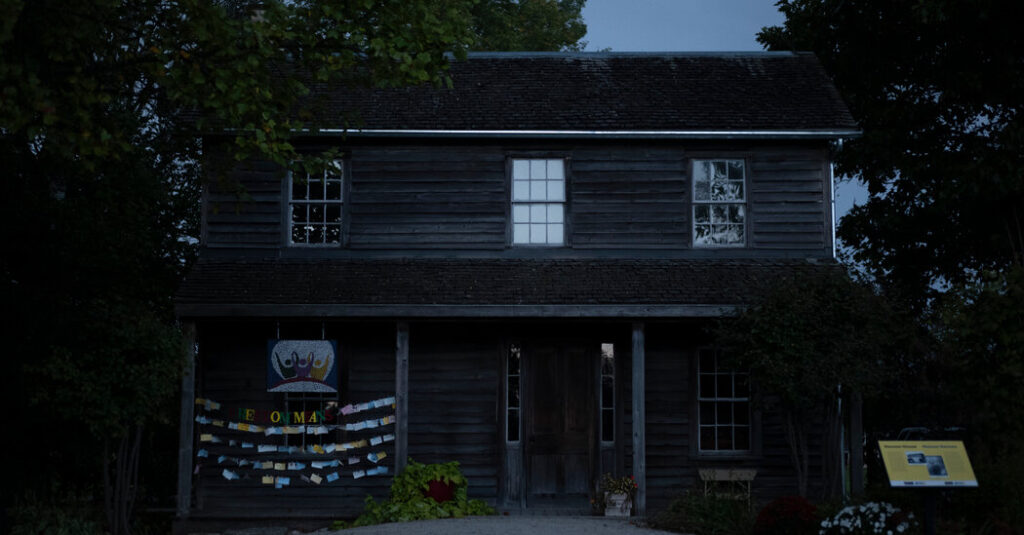
Sometime in the late 1940s, Bill Chapple hung a sign on a small building on his farm with words that would draw visitors and prove controversial and painful for decades to come: “Uncle Tom’s Home.”
The sign referred, of course, to the fictional protagonist of Harriet Beecher Stowe’s 1852 novel “Uncle Tom’s Cabin; or, Life Among the Lowly.”
But the small unpainted building had been the home of a real person: Josiah Henson, whose memoir of his life while enslaved for 42 years in Maryland and Kentucky Stowe used to inform her best seller, which became a powerful force for abolition and a national lightning rod in the years leading to the Civil War.
Henson first arrived in Canada in 1841 by way of the Underground Railroad. But, being one of the “conductors” on this route to freedom, he returned repeatedly to the United States, freeing 118 people from bondage.
A minister, Henson was among the founders of a settlement, Dawn, of once-enslaved people in this part of southwestern Ontario, about 70 miles from Detroit, where he also established Canada’s first Black educational institution.
After the success of “Uncle Tom” — the book sold 300,000 copies within weeks of publication — Henson became a celebrity, going on speaking tours of the United States and Britain, where he met Queen Victoria.
Despite Henson’s accomplishments, his legacy faded into near obscurity. Not so the name Uncle Tom, which underwent a drastic change in meaning, from Stowe’s intended symbol of quiet, Christian fortitude against slavery to a slur.
Copycat books that followed soon twisted Stowe’s story into a defense of slavery, and traveling stage shows, many featuring white actors in blackface, turned the Uncle Tom character into a cowering, feeble and simple-minded servant who — unlike Stowe’s Tom — happily acceded to his master’s orders.
Given this history, the Uncle Tom name had become derogatory long before the cabin was turned into a small, for-profit museum by Chapple, who had acquired the building when he bought the land it stood on. The house, nevertheless, kept the name for decades.
During much of that time, members of the local Black community were fighting not only to change the name and to honor Henson. They were also battling to eliminate anti-Black discrimination and segregation that weren’t limited to the United States.
Growing up in a family of 14 children on a farm near Chapple’s, Barbara Carter, 92, Henson’s great-great-granddaughter, said there was bitterness within the family that their ancestor’s home bore the name of a fictional character.
In the first decades of Ms. Carter’s life, Dresden, which now encompasses what had been the Dawn settlement, was a segregated community. Some restaurants had separate entrances for patrons who weren’t white. Other businesses simply refused to serve Black customers.
“I could say it was brutal,” Ms. Carter recalled. “I’d be coming home with my friends and they’re going to stop at the drugstore and go to the back of the drugstore where they used to have soda bars. I could never do that.”
Beauty salons, too, discriminated, Ms. Carter recalled. “I could never call and say, I’d like my hair done. ‘No, sorry, we don’t do that.’”
Ontario passed laws banning segregation and discrimination in 1961 and set up a human rights commission to enforce them, in part because of civil rights actions in Dresden.
Motivated in part by her family connection, Ms. Carter began working at the museum, first in a part-time job and then, in the early 1980s, as its director.
By the time she began working there full time, the local government had bought the once-private museum. She stayed on after the local government was unable to afford its operations, and it passed onto a regional parks commission.
Under both operators, she said, she found little openness to adopting her ancestor’s name for the site — and little appreciation of how offensive many Black visitors found the name Uncle Tom.
Some of the resistance to change seemed to be about branding. There were fears that replacing the name from the title of one of history’s most famous books with Henson’s name would lead to a collapse of visitors.
But the decades-long fight to change the name was finally won when the Ontario Heritage Trust, a provincial government agency that owns museums and historic properties, took it over. The site officially became known as the Josiah Henson Museum of African-Canadian History in July 2022. Ms. Carter, long retired, was among the guests at the ceremony.
Not everyone in Dresden was happy with the new name.
Jackie Bernard, one of the Henson site’s staff members, said she had been approached in a grocery store by a woman upset about the change.
“She said, ‘Because Uncle Tom lived on that road, Uncle Tom lived in that house; you’re rewriting history,’” Ms. Bernard said.
The incident still disturbs Ms. Bernard.
“They believe that it’s real,” she said. “That there really is Uncle Tom and that it’s such an endearing term.”
The name of Uncle Tom Road, which passed by the museum, was also changed, but not without pushback.
During the debate at the local council to change the name to Freedom Road, one councilor raised concerns about “revisionist history” and “political correctness,” according to news reports.
The museum has grown beyond the original cabin to now include a small complex of buildings that tell both Henson’s story and a broader one of the community, an important terminus of the Underground Railroad, a secret network of guides and safe houses that helped runaway enslaved people reach freedom.
The 200-acre settlement Henson and others established took a name that reflected the optimism of its members: Dawn.
It prospered initially. From 1834, when Britain’s abolition of slavery took effect, until the late 1860s, about 30,000 formerly enslaved people migrated into the British colony that would become Canada, with most eventually settling in Dawn or two nearby settlements. Lumbering, and then farming, let the communities flourish.
When slavery was abolished in the United States, some settlers returned there. Younger generations gradually left farming for opportunities in cities. The Black community’s prominence was further diminished after World War II, after a surge of immigrants from Europe to the area.
Dresden today remains farm country. In late fall, the sweet smell of boiling tomatoes being turned into pasta sauce in a processing plant fills the air.
There are still racial tensions, some involving the temporary workers from overseas who work at the tomato plant.
Steven Cook, who succeeded Ms. Carter in managing the museum, said it had an important role in dealing with growing racism within area schools, a sharp contrast with his past.
“When I grew up here, I didn’t experience racism,” Mr. Cook, 56, said. “But here it’s really reared its ugly head again.”
In the 1970s, interest in Black history rose, and bus tours from Detroit stopped at the Henson house, which is near a cemetery that includes Dawn settlers. But some passengers refused to get off, deeply offended by the name. “‘I’m not Uncle Tom’; that’s what I got all the time,” Ms. Carter said.
So she would take it upon herself to persuade them to disembark by telling them about Henson’s life and that the site, however people felt about its name, was a place to learn about a real-life hero.
Asked about her great-great-grandfather’s legacy, Ms. Carter referred to a book in which he had written religious passages and other sayings that inspired him.
“He quoted there from the Book of Acts that all men should be treated equal,” Ms. Carter said. “And I think he said, ‘I’m going to do that if I have to die doing it.’ I don’t know where he got all of that fortitude. I don’t know.”
Ian Austen reports on Canada for The Times. A Windsor, Ontario, native now based in Ottawa, he has reported on the country for two decades. He can be reached at [email protected].
The post Reclaiming the Name of the Black Hero Who Inspired ‘Uncle Tom’s Cabin’ appeared first on New York Times.