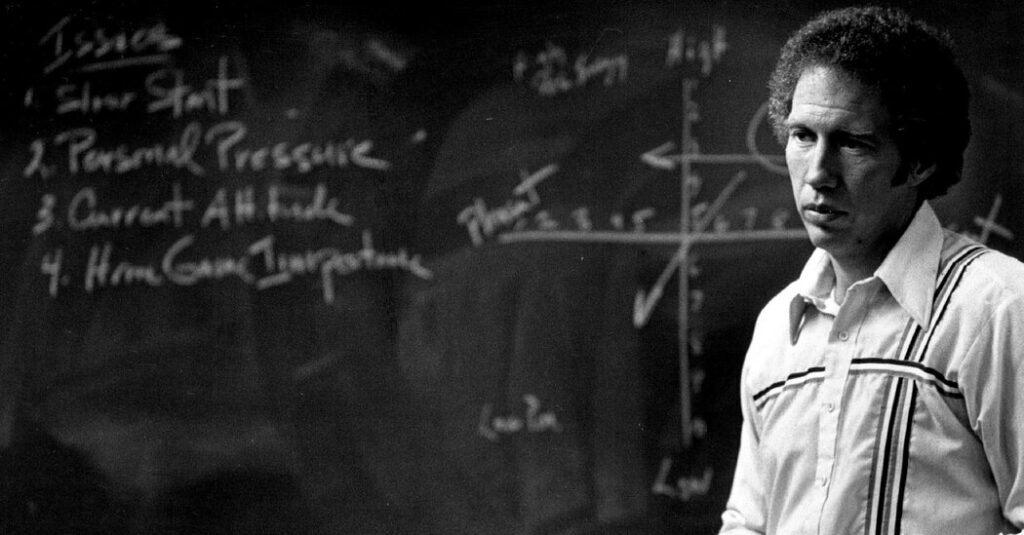
James Loehr, who was among the first psychologists to bring counseling to sports, coaxing emotions, negative thoughts and self-doubt out of the mental locker room and teaching a generation of athletes the fundamentals of mental toughness, died on April 20 at his home in Golden, Colo. He was 83.
The cause was idiopathic peripheral neuropathy, a disease of the nervous system, his family said.
In the late 1970s, when Dr. Loehr began focusing on a crucial but overlooked soft tissue in athletes — the brain — it was an idea that, at least in the United States, was as welcome as a torn hamstring.
“Sports psychology was pretty much nonexistent,” Monica Seles, the former No. 1 women’s tennis player and a student of Dr. Loehr’s, said in an interview. “Nobody wanted to talk about the mental side of anything. Coaches would say, ‘Just deal with it.’”
This was in stark contrast to the approach in the Soviet Union, where a propaganda-fueled determination to build invincible Olympic athletes underpinned a state-run training program in sports psychology and mental toughness.
For U.S. athletes, the subject was sidelined by a pernicious form of stigma.
“It was an admission of weakness,” Jim Courier, a former tennis star who worked with Dr. Loehr during his athletic career, said in an interview. “The Russians didn’t care about that. They were willing to do whatever it took to win.”
Dr. Loehr worked with athletes in just about every sport — among them, the golfers John Daly, Mark O’Meara and Nick Faldo; the N.B.A. stars Grant Hill, Penny Hardaway and Jason Williams; the boxer Ray Mancini, known as Boom Boom; and, perhaps most famously, the speedskater Dan Jansen, who fell multiple times at the Olympics.
He was especially popular in tennis, a sport he played with a fierce temper and lack of self-control, bringing to mind the axiom that those who can’t, teach.
His clients, who called him Doc, regarded him as a wizard who could vanquish an unseen and unrelenting opponent.
“It is one thing to possess the physical skills and yet another to be able to use them when it counts,” Dr. Loehr wrote in “Mental Toughness Training for Sports: Achieving Athletic Excellence” (1986). “In the final analysis, every athletic contest is a contest of control, control of the delicate mind-body connection.”
Sports psychology, as a profession, did not exist in the early 1970s when Dr. Loehr was getting started in mental health, working as a psychologist at a community health in Colorado. One day, Joe Vigil, a friend who coached the track team at Adams State University in Alamosa, Colo., asked if Dr. Loehr could help his athletes perform better.
Dr. Loehr later recalled telling him that he could “help people struggling with mental health issues, but helping healthy people become extraordinary was completely beyond the scope of my knowledge.”
Mr. Vigil kept pestering him. “Applying psychology to human performance is going to be an explosive new area of application,” Dr. Loehr recalled him saying. “You should consider being a pioneer in this emerging specialty.”
After pondering it for several years, he quit his job and gambled on himself, opening a sports psychology practice in Denver in 1978.
“There was no career path, no private-practice colleagues to share ideas with, and few relevant training models available to follow,” Dr. Loehr wrote in The Sport Psychologist, an academic journal, in 2000. “I had no idea how difficult it would be to launch a successful career in this area.”
His breakthrough came in 1982, when Tom Gullikson, a professional tennis player, contacted him after struggling on the court. Dr. Loehr agreed to take Gullikson on for free if he talked to sportswriters about their sessions.
With Gullikson, Dr. Loehr homed in on what would become a key component of his mental coaching of athletes: the moments between points or plays, when they were derailed by negative or misleading thoughts, causing physiological stress responses like an elevated heart rate.
In what he would later call the “16-second cure,” Dr. Loehr instructed Gullikson on a series of steps to take after every point. First, thrust his shoulders back, standing tall and confident; then fix his eyes on his racket strings and breathe deeply, lowering his heart rate; next, walk toward the base line, planning his strategy for the upcoming point rather than dwelling on the previous one; and, finally, engage in a ritual like bouncing the ball a certain number of times before serving.
“That became a template for managing the time that is a critical factor in whether you will be successful on the next point,” Gullikson, whose twin brother, Tim Gullikson, another professional tennis player, also worked with Dr. Loehr, said in an interview. “In the pros, the margins between winning and losing are really small, so you have a better chance if your mind is right.”
James Edward Loehr was born on March 26, 1943, in Denver. His father, Cornelius Loehr, was a civil and petroleum engineer. His mother, Mary (Carlon) Loehr, was a teacher.
A talented athlete, he played tennis at Regis University in Denver, graduating in 1964 with a degree in psychology. He went on to earn a master’s degree in education and a doctorate in counseling psychology from the University of Northern Colorado, in Greeley.
After working with Gullikson, Dr. Loehr moved to Fort Myers, Fla., opening a mental-performance practice in 1983 at a tennis center owned by Jimmy Connors. Two years later, the celebrated tennis coach Nick Bollettieri hired him to work with players at his academy in Bradenton, Fla.
There, Dr. Loehr instructed Seles and Courier on the art of what he called the “matador walk,” a method of strutting confidently that he had devised while studying the habits of bullfighters in Spain.
“They thought it was a little weird in the beginning,” Dr. Loehr recalled on “The Knowledge Project” podcast in 2024. “But they saw the results.”
His best-known triumph with was Jansen, the U.S. speedskater who, competing at the 1988 Winter Olympics shortly after his sister Jane had died of leukemia, fell twice. Four years later, at the 1992 Games, he faltered again.
Jansen worked with Dr. Loehr to get himself across the finish line, both literally and otherwise, at the 1994 Games.
“Every interview I did was asking me, ‘When you get to the next Olympics, are you going to be thinking about falling?’ ‘Are you going to be thinking about your sister?’’’ he recalled. “I wanted to get those thoughts out of my head.”
Dr. Loehr instructed him to keep a daily journal, jotting down the smallest details of his day, including how long he slept, what he ate and what he thought about during training. They worked together on reframing the past, so he could skate for himself — and not for his sister or for Wisconsin, a state where speedskating is a religion and Jansen was already a legend.
“Dan learned to stand up for Dan. He’s the nicest guy in the world, always thinking of other people,” his wife, Robin Jansen, told the New York Times sports columnist George Vecsey in 1994. “We wanted him to win one for himself.”
Dr. Loehr also played Jedi mind tricks on him.
Jansen, a sprinter, skated in the 500-meter and 1,000-meter races, but he preferred the shorter one. Dr. Loehr told him to write “I love the 1,000-meter” on just about every surface he could find, including his bathroom mirror.
One day, Jansen caught himself thinking that he really did love the 1,000-meter race. “I had to sit down,” he said. “I’m like, OK, something is really up.”
At his final Olympics, Jansen slipped again in the 500-meter. The 1,000-meter was his last chance at a medal. He won gold.
Jansen skated a victory lap holding his baby daughter, who was named after his sister.
“This is the story of Dan Jansen, I think one of the greatest stories in sports history because it’s such a tribute to his dedication and the power of the human spirit,” Dr. Loehr said on the “The Tim Ferriss Show.” “He deserved to finish that story the way it was finished.”
Dr. Loehr’s marriage to Connie Schadegg ended in divorce. He is survived by his sons, Michael, Patrick and Jeffrey Loehr, and seven grandchildren.
Today, many professional athletes travel with their own Dr. Loehrs, as well as nutritionists and even sleep consultants. College athletic departments employ sports psychologists. Instagram is teeming with mental performance influencers.
“Athletes need a team around them in order to ignite extraordinary performances,” Dr. Loehr told The Times in 2022. “The healthier and happier you are, the more you light it up on the court.”
The post James Loehr, Who Showed Athletes the Power of the Mind, Dies at 83 appeared first on New York Times.