Iran said on Wednesday that it was reviewing an American proposal to end the war, a day after President Trump abruptly paused a new U.S. military effort to protect ships in the Strait of Hormuz, citing “great progress” in talks with Tehran.
Iran’s foreign ministry spokesman, Esmail Baghaei, said that his government had not yet given its response to Pakistan, which has been acting as a mediator between Tehran and Washington. Neither he nor Mr. Trump said what the U.S. proposal contained.
“After finalizing its considerations, Iran will convey its views to the Pakistani side,” Mr. Baghaei told the semiofficial Iranian news agency ISNA.
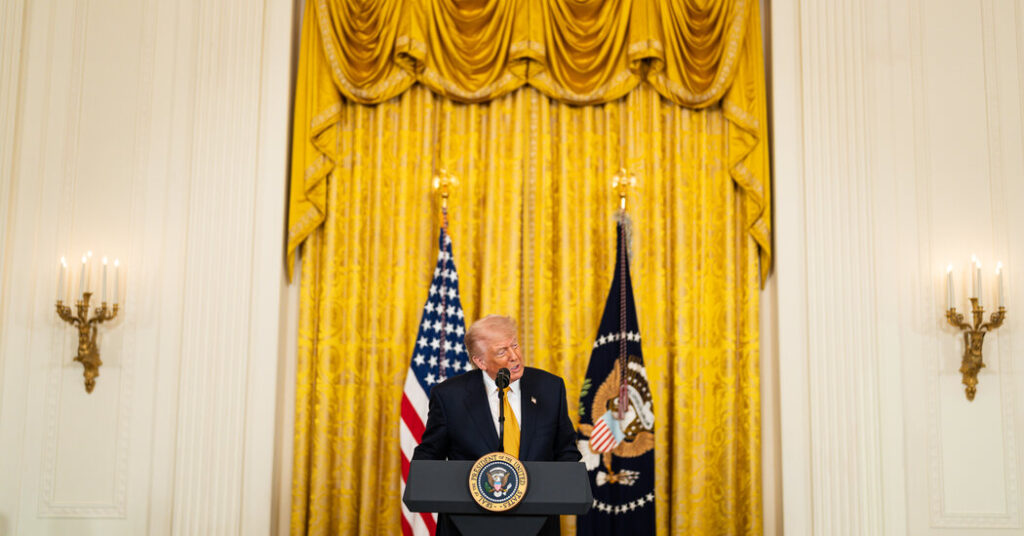
Mr. Trump, speaking at a Mother’s Day event at the White House, said the Iranians “want to make a deal; they want to negotiate.”
“We’re not going to let Iran have a nuclear weapon, and we’re not going to let that happen, and we won’t let that happen,” Mr. Trump said. “So we’re dealing with people that want to make a deal very much, and we’ll see whether or not they can make a deal that’s satisfactory to us.”
Though Mr. Trump said he was pausing the effort to safeguard ships in the Strait of Hormuz, the U.S. military was continuing to enforce a blockade on Iranian ports aimed at strangling the Iranian economy.
On Wednesday, a U.S. Navy warplane disabled an Iranian-flagged oil tanker that had ignored “repeated warnings” not to cross the blockade, according to U.S. Central Command, which oversees American forces in the Middle East.
An F/A-18 Super Hornet launched from the aircraft carrier Abraham Lincoln fired several rounds of 20-millimeter ammunition from its cannon, striking the rudder of the ship, the Hasna, Central Command said. The vessel was headed to an Iranian port on the Gulf of Oman, but was “no longer transiting to Iran,” the U.S. military said.
In a social media post earlier in the day, Mr. Trump said that the war would end, and vessels would be able to pass safely through the Strait of Hormuz — the vital shipping route Iran has effectively closed — if Tehran “agrees to give what has been agreed.” He did not elaborate on what those terms were.
“If they don’t agree, the bombing starts, and it will be, sadly, at a much higher level and intensity than it was before,” Mr. Trump wrote.
The threat added to contradictory messages from the administration about the status of the war, which Mr. Trump has lately taken to calling a “skirmish.”
Just a day earlier, Secretary of State Marco Rubio declared that the active phase of the war was over, though the United Arab Emirates said it continued to face Iranian missiles and drones. The United States, Mr. Rubio said, was now focused on a new, defensive mission aimed at reopening the Strait of Hormuz. He said U.S. forces would open fire on the Iranians only if they threatened commercial ships or the American military.
Hours after Mr. Rubio spoke at the White House, Mr. Trump, in a social media post, said the effort to protect ships in the strait “will be paused for a short period of time to see whether or not the Agreement can be finalized and signed.”
Mr. Trump said he was pausing the operation at the request of Pakistan and other countries, which he did not name. Prime Minister Shehbaz Sharif of Pakistan, in a social media post on Wednesday, said the request had also been made by Saudi Arabia, and he thanked Mr. Trump for his “gracious response.”
“We are very hopeful that the current momentum will lead to a lasting agreement that secures durable peace and stability for the region and beyond,” Mr. Sharif said.
In public, there has been little sign of progress in the diplomatic push to end the war, which began when the United States and Israel started bombing Iran in late February. Iran retaliated by closing the strait and firing on the U.S. military and Israel, as well as on its Gulf neighbors.
On Wednesday, Prime Minister Benjamin Netanyahu’s office said in a statement that Israel’s security cabinet had convened and that he was planning to speak with Mr. Trump in the coming hours. The statement said that Israel and the United States shared the goal of removing enriched uranium from Iran, and that Mr. Trump believed that objective was achievable “one way or another.”
Earlier on Wednesday, a spokesman for Iran’s parliamentary national security committee pushed back against a report in Axios that the United States and Iran were close to agreeing to a one-page memorandum to end the war, calling it “more a list of American wishes than a reality.” The spokesman, Ebrahim Rezaei, warned that Iran was ready to respond if the United States did not grant what he called the “necessary concessions.”
The Navy of Iran’s Islamic Revolutionary Guards Corps suggested on Wednesday that it expected to retain control over the Strait of Hormuz. In a social media post, the navy said that it would be able to guarantee safe passage to vessels complying with its rules when the American threat was “neutralized.”
Seeking to break the deadlock over the strait, President Emmanuel Macron of France is hoping to persuade the United States and Iran to reopen the contested waterway even before they agree on a deal to end the war, two senior French officials said on Wednesday.
Mr. Macron has proposed that the two sides remove the status of the strait from broader negotiations over Iran’s nuclear program, ballistic missiles and support for militia groups in the region, the officials said. They spoke on the condition of anonymity to discuss a sensitive diplomatic matter.
Such a compromise, these officials said, could allow a multinational force that France is marshaling, along with Britain and other European countries, to begin escorting commercial ships through the strait relatively quickly, restoring a semblance of normalcy to a gravely disrupted global economy.
On Wednesday, the French military said it had deployed an aircraft carrier, the Charles de Gaulle, to the Red Sea to prepare for the peacekeeping mission “as soon as circumstances permit.”
Iran is likely to balk at Mr. Macron’s proposal because it would remove much of its leverage in the broader negotiations with the United States.
It’s also unclear where Mr. Macron’s idea would fit within the overall state of negotiations between Washington and Tehran. Nor was it clear if Mr. Macron had sounded out Mr. Trump or Iran’s leaders about his proposal. The officials said Mr. Macron spoke regularly with Mr. Trump and planned a call soon with Iran’s president, Masoud Pezeshkian, though they offered no sign of how either leader might respond.
A parallel effort to end the fighting in Lebanon between Israel and Hezbollah, an Iranian-backed militant group, has also come under intense strain. Despite a cease-fire brokered by the White House, Israel carried out an airstrike in Beirut’s southern suburbs on Wednesday, the first such attack in the Lebanese capital since the truce took effect last month.
In a statement, Israel said it had targeted the commander of Hezbollah’s Radwan force, the group’s elite fighting unit. There was no immediate comment from Hezbollah.
Reporting was contributed by John Ismay, Anushka Patil, Johnatan Reiss and Euan Ward.
Qasim Nauman is a Times editor in Seoul, covering breaking news from around the world.
The post Iran Says It Is Reviewing a U.S. Proposal to End the War appeared first on New York Times.