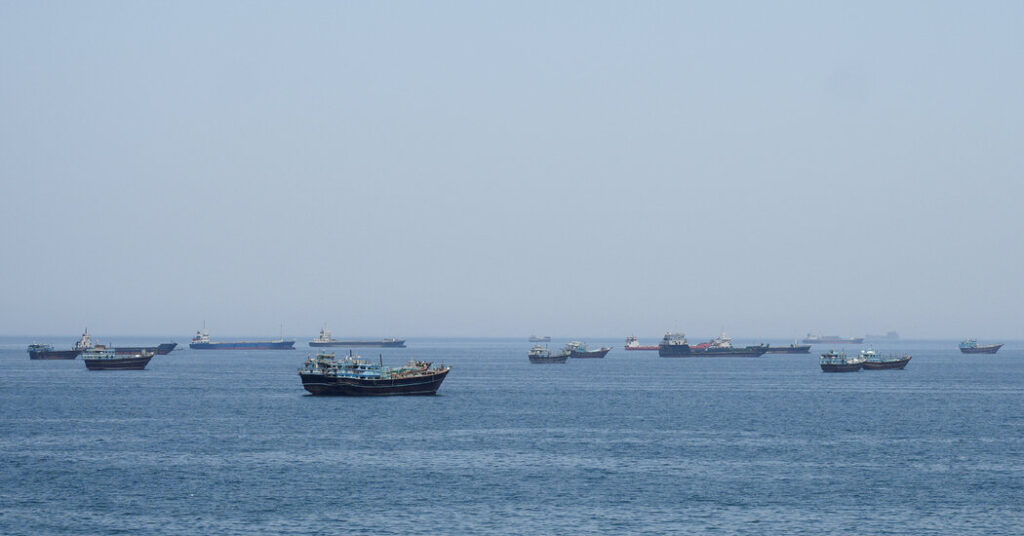
The attack on a French cargo ship in the Strait of Hormuz on Tuesday was a stark reminder that crossing the waterway remains a risky endeavor with potentially high human costs.
The International Maritime Organization, a part of the United Nations, said the strike injured eight crew members on the San Antonio, a container ship belonging to CMA CGM, a large French shipping company. Iran has attacked ships attempting to cross the strait without its permission.
The strike on the San Antonio occurred before President Trump paused a large-scale military effort, called Project Freedom, that began this week to protect commercial ships that want to go through the strait.
The U.S. military and CMA CGM disagreed over whether the San Antonio had coordinated with Project Freedom.
A U.S. military official said the French ship did not follow specific Project Freedom guidelines and check-in procedures, adding that when the vessel came under fire, it asked Oman for help, not the United States.
But CMA CGM said in a statement that the ship’s transit through the strait “was carried out as part of” Project Freedom. It added that the voyage was done “in coordination” with the U.S. Naval Cooperation and Guidance for Shipping and “in strict accordance with the required guidelines and procedures.”
The Naval Cooperation and Guidance for Shipping is a U.S. Navy entity that monitors and coordinates with commercial ships.
CMA CGM said that the injured crew members had been evacuated and provided with medical care.
Iran’s attacks on shipping have led to a sharp reduction in the number of tankers and other vessels going through the strait. This has cut the supply of oil and natural gas to the world, leading to sharply higher prices for gasoline, diesel and jet fuel.
Iran has used its stranglehold on the strait as a strategic card in its negotiations with the United States. An end to the conflict would most likely include steps to quickly reopen the strait, to get the oil and gas flowing again.
Iran’s foreign ministry spokesman, Esmail Baghaei, said Wednesday that his government was reviewing an American plan to end the war, hours after President Trump put pressure on Iran to agree to a deal to end the war by renewing the threat of taking military action against the country.
U.S. Central Command said two commercial ships flying the American maritime flag made it through the strait on Monday under Project Freedom, which started the same day. But Mr. Trump said Tuesday evening in a social media post that he was pausing protection for a short time to see whether an agreement to end the war could be reached.
Rosemary Kelanic, a director at Defense Priorities, a research organization focused on foreign affairs, said Project Freedom sought to convince shipping companies that it was now safer to go through the strait. “Then Iran immediately disproved that notion by attacking the ship,” she said, referring to the San Antonio.
The International Maritime Organization said 32 ships have been attacked since the war began, leading to the deaths of 10 seafarers.
CMA CGM, based in Marseilles, France, has more than 650 ships in its fleet and had over $50 billion in revenue last year. Another company vessel, the Everglade, was attacked last month, according to the maritime organization.
Jacqueline Smith, a maritime coordinator at the International Transport Workers’ Federation, a union that represents mariners, said the San Antonio should not have attempted to cross the strait because of the risks to its crew. Ms. Smith said the union’s position was that “no seafarer, no vessel, should be asked to transit the Strait of Hormuz without a full guarantee of safety.”
France’s defense ministry said on Wednesday that it was sending an aircraft carrier strike group to the Red Sea ahead of a potential deal to reopen the Strait of Hormuz. The Charles de Gaulle, an aircraft carrier that is the French Navy’s flagship vessel, was passing through the Suez Canal, the ministry said in a statement, to be able to help secure freedom of navigation if a deal is reached.
Before the war, ships could sail through the Strait of Hormuz without permission of any country. During the conflict, Iran has sought to project itself as a controller of which vessels can make the passage. This week, Iran attempted to formalize that role by telling shipping companies that they had to fulfill requirements set by an Iranian agency called the Persian Gulf Strait Authority.
On Wednesday, Iran’s Islamic Revolutionary Guards Corps Navy suggested in a post on X that it expected to retain control over which vessels could pass through the strait. In the post, Iran’s navy said that it would be able to guarantee safe passage to vessels complying with its rules when the American threat was “neutralized.”
Eric Schmitt contributed reporting from Miami, and Ravi Mattu and Leo Sands from London.
Peter Eavis reports on the business of moving stuff around the world.
The post Attack on French Cargo Ship Highlights Continued Risks in Strait of Hormuz appeared first on New York Times.