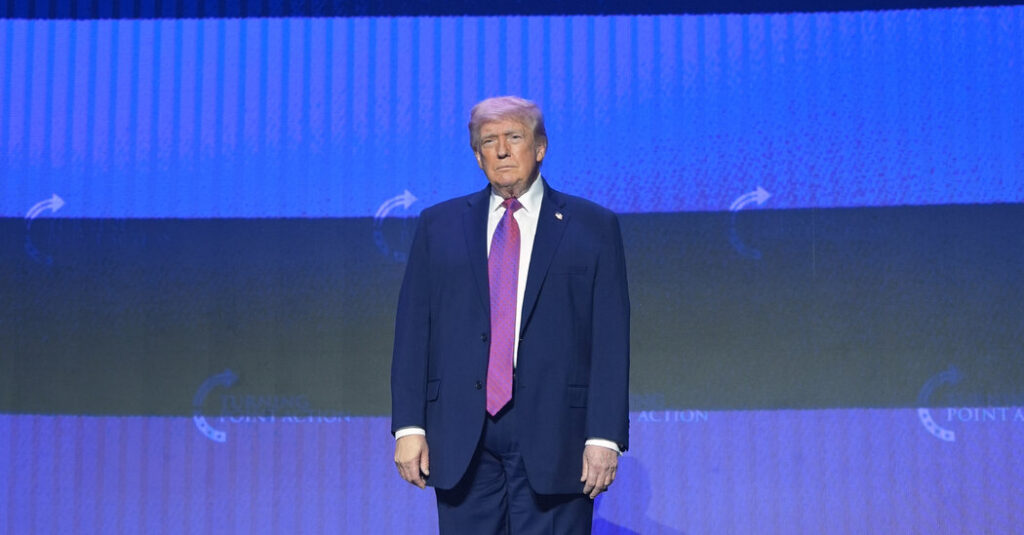
President Trump hates to lose.
Heading into the 2026 midterm elections, you can’t say that the president hasn’t warned us, over and over, that he will do all he can to prevent the congressional contests from turning into a humiliating Republican rout.
“It’s some deep psychological thing, but when you win the presidency, you don’t win the midterms,” Trump told Reuters in an interview at the beginning of the year. He claimed that his presidency had been so successful that “when you think of it, we shouldn’t even have an election.”
Trump’s comment fell right in line with his repeated claims of unlimited, unchecked power.
March 2020: “I have the right to do a lot of things that people don’t even know about.”
August 2025: “I have the right to do anything I want to do. I’m the president of the United States of America.”
January 2026: In an interview with The New York Times, Trump was asked: “Do you see any checks on your power on the world stage? Is there anything that could stop you if you wanted to?” Trump replied: “Yeah, there is one thing. My own morality. My own mind. It’s the only thing that can stop me, and that’s very good.”
In Trump, we have a president whose hatred of losing drove him to provoke the insurrection at the Capitol on Jan. 6, 2021, a president who expanded the mandate of the federal Joint Terrorism Task Force to include the investigation, arrest and prosecution of individuals engaged in “domestic terrorism” and created a multimillion-dollar domestic terrorism unit to pursue those cases.
He is a president who asserts national control over state-administered elections, a president who has overseen the seizure of ballots and federal attempts to get access to voting machines and voter lists, and a president who has gutted the institutions that are supposed to ensure a fair election process and fired the people who work for them.
This same president now faces the possibility of a mortifying defeat in November. Republicans are expected to lose control of the House as the likelihood of a Democratic takeover of the Senate reaches 50 percent or better.
Not one to keep a secret, Trump made what he would like to do very clear during a Feb. 3 bill signing ceremony at the White House:
Look at the facts that are coming out. Rigged, crooked elections. Take a look at Detroit. Take a look at Pennsylvania. Take a look at Philadelphia. You go take a look at Atlanta. Look at some of the places that … horrible corruption on elections, and the federal government should not allow that.
The federal government should get involved.
The states, Trump claimed, “are agents of the federal government to count the votes. If they can’t count the votes legally and honestly, then somebody else should take over.”
There are other factors at work pointing to an attempt by Trump to stave off defeat. At the top of the list: Trump’s National Security Presidential Memorandum 7, issued Sept. 25 last year.
The memorandum effectively grants the Department of Justice, the Treasury, the I.R.S. and other federal agencies a license to label left-wing groups as domestic terrorist organizations and directs the Department of Justice to prosecute them “to the maximum extent permissible by law.”
The memorandum claims that “heinous assassinations and other acts of political violence in the United States have dramatically increased in recent years.” These acts, in Trump’s view, are exclusively linked to the left. He does not mention right-wing extremist violence:
Common threads animating this violent conduct include anti-Americanism, anticapitalism and anti-Christianity; support for the overthrow of the United States government; extremism on migration, race and gender; and hostility toward those who hold traditional American views on family, religion and morality.
The memorandum calls on the Joint Terrorism Task Force “to investigate, prosecute and disrupt entities and individuals engaged in acts of political violence and intimidation designed to suppress lawful political activity or obstruct the rule of law.”
There are other danger signals.
One is the possibility that a majority of the Supreme Court justices would hesitate to block Trump if, just days before the election, he asserted constitutionally questionable powers to disrupt the process under the doctrine of the “unitary executive theory,” which supposedly grants the president unrestricted authority to control the executive branch.
Another is that the Republican majorities in the House and Senate would continue their passive submission to Trump and take no steps to block potentially unconstitutional actions.
The threat posed by Trump has rattled experts at the Brennan Center and Keep Our Republic, along with scholars who study Trump’s real and claimed powers.
Two of the foremost students of these powers are Joel McCleary, a founder of Keep Our Republic, and Elizabeth Goitein, senior director of the liberty and national security program at the Brennan Center. Some, but not all, of their attention has been focused on the secretive creation of presidential emergency action documents, which have come to be known as “PEADs.”
McCleary described his findings and his concerns in a series of emails, many including reports he has written. In an April 23 report, “Continuity of Government, Presidential Emergency Action Documents and the Evolution of Executive Emergency Powers,” McCleary wrote that the president “possesses emergency powers that are virtually unknown to the public, to most members of Congress and to much of the federal judiciary. These powers — codified in classified presidential emergency action documents” — allow
a single individual to suspend fundamental constitutional rights, detain civilians, seize property, impose martial law and censor communications.
They require only a presidential signature. No prior congressional approval is needed. No court reviews them before activation. No statutory mechanism exists for Congress to restrict or terminate these powers once invoked.
While PEADs were first created in the 1950s during the Eisenhower presidency to address the potential of nuclear war to create chaos, there is, McCleary wrote, “no statutory, constitutional or procedural limit on the number of PEADs a president may create, the subjects they may address or the scope of authority they may claim.”
The Brennan Center has published an article describing the history and potential use of PEADs.
I asked Goitein to explain the difference between a declaration of a national emergency and a PEAD. She replied by email:
A declaration of national emergency by the president unlocks statutory authorities contained in 137 different provisions of law. A presidential emergency action document (PEAD) is a draft executive order, directive or communication, prepared in anticipation of a particular type of emergency, that implements an emergency power or powers.
The emergency powers it implements can either be statutory powers or powers that are available to the president — or that the president claims are available — under the Constitution. These draft orders/directives/communications are often accompanied by legal analyses to justify the actions they would implement.
Are the constraints on the use of PEADs less than those on the use of declarations of national emergencies?
Goitein:
It depends. Some PEADs will actually involve a declaration of national emergency, in which case the primary constraint would be the same: Congress could vote on a resolution to terminate the national emergency declaration. This is a very weak constraint, as Congress would have to muster a veto-proof supermajority.
In addition to congressional action, Goitein continued:
the courts could also serve as a check. For either a national emergency declaration or an exercise of emergency authority pursuant to a PEAD, any person adversely affected could file a lawsuit to challenge the government’s actions if those actions appeared to violate the Constitution or a law passed by Congress.
While courts in both scenarios would likely be reluctant to second-guess the president’s determination that an emergency exists, they would be much less reticent in reviewing whether the actions taken in response to the emergency were authorized by law.
While the secretiveness of PEADs prompts suspicion among those wary of the Trump administration, the National Security Presidential Memorandum 7 I mentioned earlier is raising specific fears.
As McCleary put it:
NSPM-7 is something different again. It is a national security presidential memorandum — not an executive order, which would require Federal Register publication. Presidential memoranda have the same legal force as executive orders but less transparency.
NSPM-7 cites no statute and no constitutional provision. It simply directs the attorney general and other federal officials to do things — compile a secret list, investigate organizations, designate domestic terrorist groups — under the president’s claimed authority to direct the executive branch. There is no statutory category of “domestic terrorist organization” in federal law. Congress didn’t create this designation power; the president simply asserted it. The differences in constraint are where it gets dangerous.
For the NSPM-7 memorandum, McCleary argued,
the constraint picture is arguably the worst of all three, because it operates in plain sight but outside any legal framework. Unlike a national emergency declaration, it doesn’t activate defined statutory powers — it asserts authority that no statute grants. Unlike PEADs, it isn’t waiting for a catastrophic trigger — it’s already operational.
The memorandum, in McCleary’s view,
has the operational immediacy that PEADs lack (it’s running now, not waiting for a crisis) and the legal unaccountability that national emergencies lack (no statutory framework, no public declaration, no termination mechanism).
The three together form a layered system: NSPM-7 operates day-to-day, building the infrastructure and the target lists. National emergency declarations provide the escalation mechanism — broadening executive power under statutory cover. And PEADs sit at the top of the pyramid, ready for the moment when the constitutional order itself is suspended. Each layer normalizes the next.
In an April 29 essay in The Washington Spectator, “Emergency Planning: The President Is Preparing to Challenge 2026 Midterms. The Country Can Still Act to Protect Them,” Jonathan Winer, a former U.S. special envoy for Libya and a deputy assistant secretary of state for international law enforcement during the Clinton presidency, described the following hypothetical sequence of events.
“The scenario would likely begin by Trump declaring that the election results were rigged, as he has in the past,” Winer wrote, and then compliant federal authorities would “require investigation of those results before they were finalized.”
The president could “then call on congressional leadership to proceed as if the announced results are invalid, urging the speaker of the House to organize the chamber on the basis of a Republican majority, and encouraging similar action in the Senate, urging them to ignore any jurisdictions in which the federal government was still undertaking its review.”
Protests of Trump’s actions would provide him with fresh opportunities to exercise autocratic power. Trump would then
direct the attorney general to treat coordinated demonstrations as organized political violence. He could instruct the F.B.I. and Joint Terrorism Task Force to identify organizers, map funding sources and examine any connections — real or alleged — to foreign actors.
Federal agents would then make arrests. They would arrest individuals at protests, whether or not violence has occurred.
In order to conduct mass arrests, Winer pointed out, “the largest existing detention infrastructure is operated by the Department of Homeland Security, particularly Immigration and Customs Enforcement, which maintains a large paramilitary force and a nationwide network of facilities.”
At the same time, Winer noted, the president could take over communication systems, including “internet service providers, social media platforms and communications infrastructure”; seize property; and freeze bank accounts.
“These actions could be taken broadly at the outset, before courts rule on their legality, preceding any form of judicial review,” Winer said.
In other words, time would be on Trump’s side, with the likelihood that Congress and the courts would be slow to react, and both might well passively accede to Trump’s effective cancellation of an election.
McCleary elaborated on Winer’s suggestion that the Department of Homeland Security’s detention facilities could be used for jailing protesters: “The FY2025 budget appropriated $45 billion for immigration enforcement, including $38.3 billion for ICE facility construction — a 265 percent increase over the previous fiscal year.”
The money, McCleary argued, far exceeds the needs of the department, raising the question of “whether this scale is proportionate to its stated purpose.” McCleary contended that this over-the-top budgeting means either that
the administration plans extrajudicial removal without hearings — which requires emergency authority to bypass due process protections; or
the infrastructure is being built for a purpose or scale beyond what immigration enforcement alone would justify.
McCleary argued that his analysis is more substantial that a conspiracy theory:
We do not allege secret coordination. We observe public convergence. Each instrument was enacted openly. Their combined effect — mass detention capacity plus terrorism designation of political opposition plus criminal prosecution of association — has no precedent in American law outside wartime.
Would the courts intervene?
The Supreme Court’s exceptional deference to Trump is the subject of “President Trump in the Era of Exclusive Powers,” an April 2025 paper by Shalev Gad Roisman, a law professor at the University of Arizona. It says:
The defining doctrinal innovation of the second Trump administration has been to take the Supreme Court at its word. In recent years, the court has embraced an extremely broad view of the president’s “exclusive” powers that cannot be regulated by Congress. The Trump administration is now showing what it might mean to take the court’s statements literally.
“The second Trump administration has exercised executive power in ways unparalleled in modern history,” Roisman continued, adding,
I do not think the Roberts court ever planned, or even considered, taking its own separation of powers doctrine quite this far. But, while the regime of full executive control that the Trump administration is striving to create might be beyond what the court foresaw, it is not necessarily beyond what it said.
When I first queried Kenneth Mayer, a political scientist at the University of Wisconsin-Madison, he replied by email with a largely technical examination of presidential powers. A few days later he added to his comments, writing:
What I did not accurately convey is how Trump has obliterated the boundaries and guardrails that we had long thought would serve as meaningful constraints on presidential extremism.
He is acting as if his will is law, the government and everything in it belongs to him, and everyone owes their allegiance to him, to the Constitution, the law or the public good.
What we are seeing now, Mayer concluded, “is not normal, is utterly corrosive to principles of constitutional and democratic governance and is extremely dangerous.”
The Times is committed to publishing a diversity of letters to the editor. We’d like to hear what you think about this or any of our articles. Here are some tips. And here’s our email: [email protected].
Follow the New York Times Opinion section on Facebook, Instagram, TikTok, Bluesky, WhatsApp and Threads.
The post ‘When You Think of It, We Shouldn’t Even Have an Election’ appeared first on New York Times.