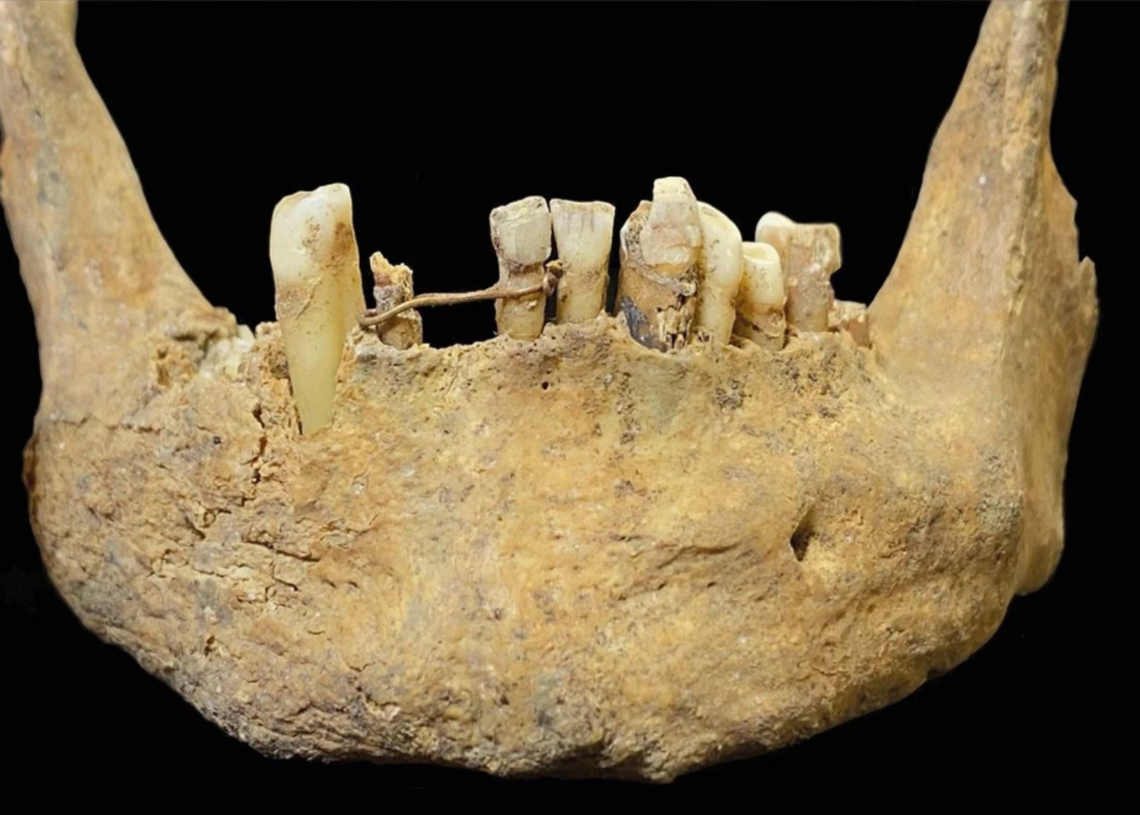
Gold grills that make people look like the Bond villain Jaws if he were a gaudy millionaire feel new, but the practice of putting gold in your teeth is ancient. According to a new study published in the British Dental Journal, it wasn’t just decoration; it functioned as a surprisingly advanced form of dental treatment centuries before modern dentistry figured out how to bridge a gap between teeth.
Researchers examining remains from a medieval burial site in Aberdeen, Scotland, found a thin wire, mostly gold, wrapped around two teeth. It was surprisingly advanced for the era it was created in and was built with an intention, engineered to either stabilize a loose tooth or serve as a framework for a replacement, basically an early version of a dental bridge.
Today’s dental bridges are false teeth that fill the gap left by a missing tooth, with an additional pair of fake teeth on either end that slide over and are securely fastened by small pegs or screws, giving the appearance of teeth where there were none before.
This is, of course, a much more advanced version than what the researchers found, which was a thin, high-quality wire that would be the rough modern equivalent of 20 carat gold, immediately letting you know this wasn’t a common procedure that everyone had access to, likely serving as a dental treatment for only the upper crust.
The Medieval Rich Guy Had Surprisingly Fancy Dental Work
The man it belonged to likely lived between the late 1400s and 1600s, a time when dentistry had more in common with modern back-alley dentistry than actual professional dentistry. It was a bit barbaric, and likely had more negative consequences than the initial procedure was meant to patch up, but no matter the era of human civilization, people make do with what they have.
One thing the researchers are fairly sure of is that whoever this belonged to was definitely wealthy or in a position of power, as it was essentially the medieval equivalent of bling mixed with a bit of brutal yet clever dentistry.
There’s other evidence indicating that the person with the gold-wire dental bridge was wealthy, such as being buried in an affluent parish and having access to trained practitioners known at the time as “dentatores,” who used durable metals like gold in their dental repairs.
Where the average person just had to deal with a toothache until it drove them out of their mind, potentially leading to fatal conditions like sepsis, the wealthy could have the tooth extracted, and the gap bridged with a fancy, show-off-y metal, amounting to a procedure that was a little bit medically necessary, a little bit unnecessary cosmetic procedure.
The more things change, the more they stay the same.
The post Archaeologists Found a Medieval Skeleton With Something Strange in Its Jaws appeared first on VICE.