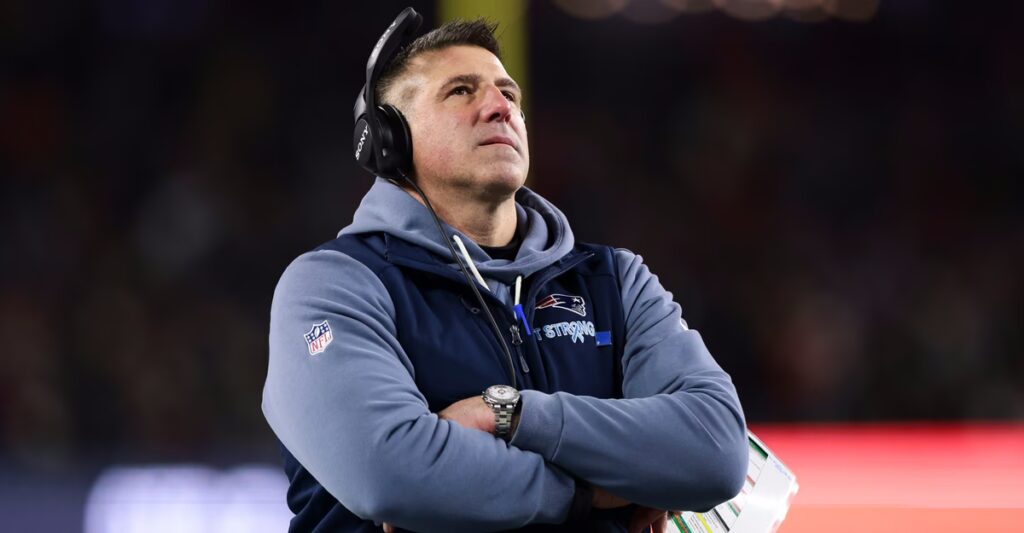
Just a few months ago, the New England Patriots coach Mike Vrabel was experiencing a special kind of celebrity. Across the sports world, Vrabel was widely praised for becoming one of eight coaches in NFL history to take his team to the Super Bowl in his very first season as head coach. Built like an oak tree, the former linebacker (he spent eight seasons with the Patriots) is known for his no-nonsense demeanor, and has even put on football pads to mix it up with his players—all part of the tough persona that endeared him to fans.
Though the Patriots lost the Super Bowl, many still believed that Vrabel was perfectly positioned to return the franchise to the upper tier of the NFL, where it has lived for the majority of the 21st century. For the past few weeks, however, Vrabel’s reputation has shifted as he’s become a fixture in the gossip pages. On April 7, the New York Post published photos of him and the NFL reporter Dianna Russini together at an Arizona resort. Both Russini and Vrabel, who are married to other people, initially denied having any personal involvement beyond their professional capacity.
But as Russini’s then-employer The Athletic (which is owned by the New York Times Company) began an internal investigation into their relationship, Russini resigned from her position. (In her statement, she didn’t explicitly deny the allegations, but said she had “no interest in submitting to a public inquiry that has already caused far more damage than I am willing to accept.”) A week later, Vrabel told reporters: “I’ve had some difficult conversations with people I care about—with my family, the organization, the coaches, the players.” He didn’t confirm or deny the rumors, but called the issue a “personal and private matter.”
Shortly thereafter, Vrabel issued a statement announcing he would be missing part of the upcoming NFL draft to seek counseling. For the head coach to be away from the team during the draft is highly unusual; even under these circumstances, the announcement seemed to come out of nowhere. But just before the draft began, the Post published photos of Vrabel and Russini kissing and holding hands at a New York bar in 2020, furthering speculation about their personal relationship. (At the time, Russini was working for ESPN and Vrabel was the head coach of the Tennessee Titans. I should mention that I used to work at ESPN, but didn’t work with Russini.) Now Vrabel is being regularly hounded by paparazzi at the airport, while facing accusations that he’s a philanderer.
The violation of journalistic ethics is obvious: Married or not, reporters should never develop intimate relationships with their sources. (It’s explicitly banned in the Times’ code of conduct, though not in The Athletic’s.) For some women in sports journalism, the situation resurfaces misogynistic assumptions that women reporters sleep with sources for information or that they use their access like a personal dating app.
But even absent a flagrant ethical transgression, the relationship between coaches and journalists can be tricky to navigate. Sports journalists are expected to get close to coaches, players, and members of a team’s front office. In the process, some journalists wind up developing buddy-buddy relationships with their sources that go beyond basic professional obligation. Proving it from the outside is hard, but some sports fans are used to noticing—and speculating—when a journalist appears to be getting a lot of information from the same source, or when their objectivity seems to bend toward supporting a particular agenda.
Putting aside the tabloid nature of the situation, it’s fair to wonder how Vrabel and Russini’s relationship—whatever it entailed—could have influenced Russini’s reporting, which in turn influences real people’s lives and livelihoods. For example, throughout this past NFL season Russini reported that the Philadelphia Eagles wide receiver A. J. Brown was unhappy with his role on the team. Vrabel had coached Brown for three seasons in Tennessee, and Russini noted in later, co-bylined reports that the Patriots were a possible destination for the disgruntled player. Could Russini have reported on Brown’s discontent in order to help facilitate a trade to New England? Maybe, maybe not—but we might never know, as the league dismissed the idea of conducting any investigation into Vrabel’s behavior.
Vrabel has often spoken passionately about accountability being a core principle of his football team, but in providing vague answers about his relationship with Russini, he seems to be dodging what he’s preaching. Russini’s career might be over. And perhaps that’s appropriate: Her job is different than his, including the professional ethics and standards required to perform it. Meanwhile, Vrabel may be allowed to move on to the new NFL season, and in the process offer all the right platitudes about getting back to business. There’s a gap between what he said when he was being praised and what he’s done under fire.
But even if Vrabel stays with the team, things won’t be business as usual anytime soon. He now faces a new level of scrutiny on top of the demands and pressure that automatically come with trying to be a winning NFL coach. It’s a new reality that he completely earned.
The post Why One Coach’s Personal Life Is a Sports-Wide Scandal appeared first on The Atlantic.