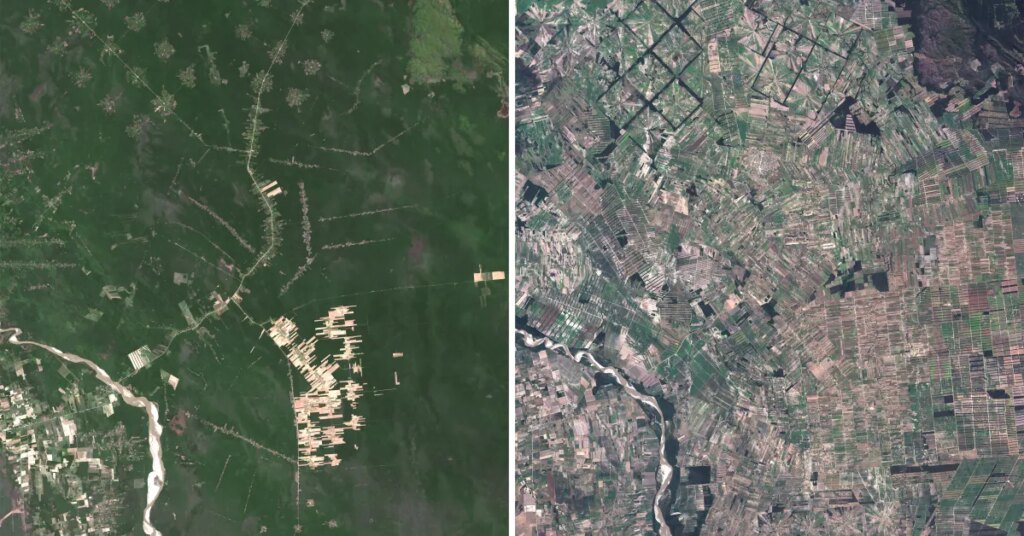
Over the last few decades, wildfires, farmers, and cattle ranchers have razed millions of acres of tropical forests across the planet. Much of that deforestation has occurred in three countries: Brazil, Democratic Republic of the Congo, and Indonesia.
But in the last few years, another, smaller nation has risen in the ranks of nations with the most severe forest loss — Bolivia.
Situated just west of Brazil, Bolivia lost 1.5 million acres of primary forest in 2025 alone, more than any other country aside from Brazil, according to a new analysis by the University of Maryland and the World Resources Institute (WRI), a research group. That’s just shy of the surface area of Delaware.
Those lost acres in Bolivia are part of threatened and globally important ecosystems, including the Amazon rainforest and the Chiquitano dry forests. They are rich not only in wildlife — including the elusive maned wolf, a long-legged canine that is actually not a wolf — but also in carbon. After trees are cleared, much of the carbon they store returns quickly to the atmosphere, accelerating climate change. (Not-so-fun fact: Yearly carbon emissions from deforestation in the tropics are greater than the output from the entire European Union.)
On the surface, the story of deforestation in Bolivia mirrors that of other tropical countries: People are knocking down trees there to make way for cattle ranches and farms, the two leading drivers of tropical forest loss. Often, people clear land with fire. And as climate change makes droughts more severe in places like Bolivia, those fires more easily spread out of control and into areas that weren’t meant to burn, taking out even larger stretches of primary forest.
But when you look more closely at who, exactly, is fueling much of the recent deforestation, Bolivia starts to stand out — thanks to an unexpected player.

The white religious sect cutting down Bolivia’s trees
The main reason people clear forests in Bolivia is to make way for cattle. It’s typically cheaper to buy forested land and remove the trees than to acquire existing pasture, says Daniel Larrea, science and technology program director at Conservación Amazónica, a Bolivian NGO. Plus, under the country’s legal system, landowners risk losing their land in Bolivia if they don’t demonstrate that they’re using it “productively,” such as by raising cattle for beef, effectively creating an incentive for deforestation.
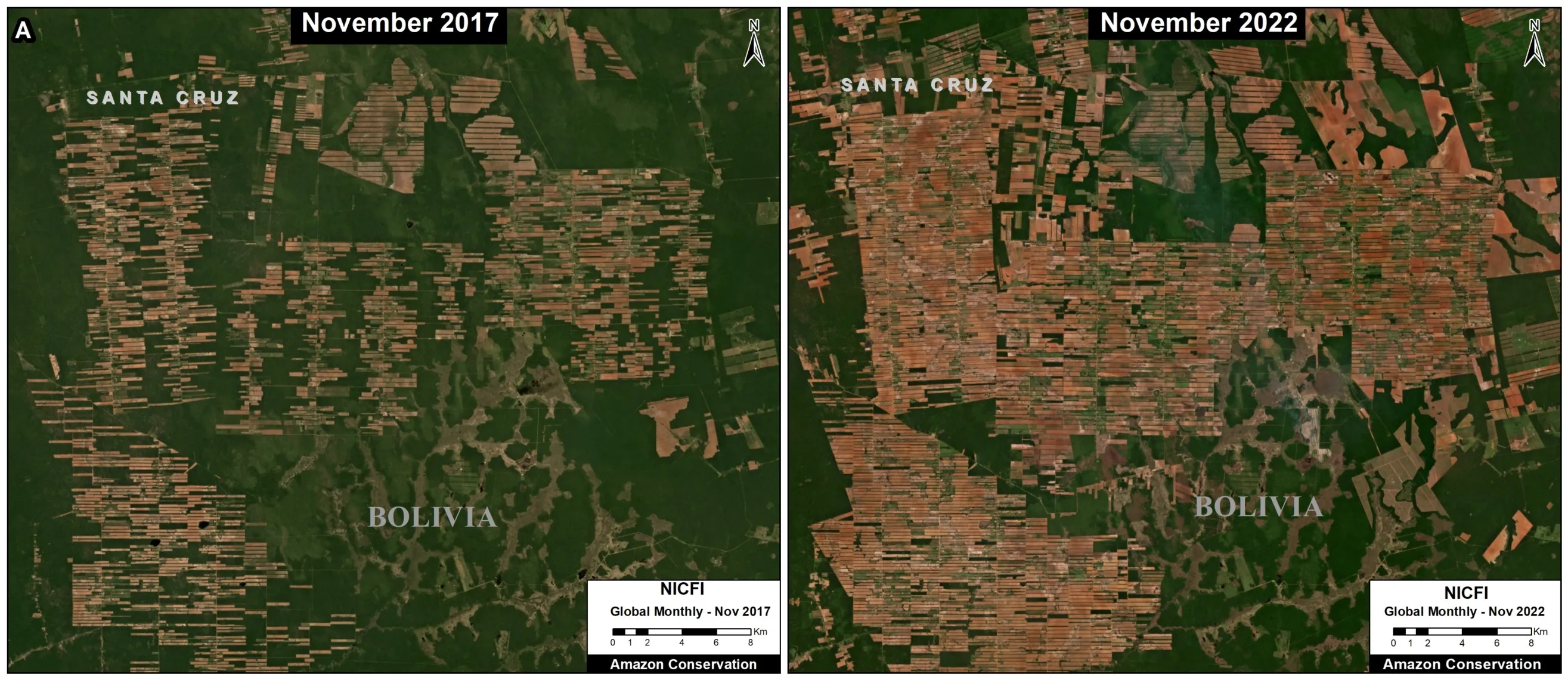
The other major source of forest loss in Bolivia is the rapid expansion of soy farms, the nation’s top export crop, by weight. Between 2001 and 2021, soy farms in Bolivia — which feed global demand for animal feed and soybean oil — destroyed some 2.2 million acres of forests, according to a 2023 report by the nonprofit Amazon Conservation Association (affiliated with Conservación Amazónica). That’s roughly the size of Puerto Rico.
Soy farming is among the leading causes of deforestation across the tropics, in places like Brazil, Argentina, and parts of Africa. What makes it more unusual in Bolivia is the people behind much of its production and related environmental harm: Mennonites.
A mostly white Christian group, Mennonites — who have similar origins to the Amish — started migrating to Latin America from Canada in the early 1900s. They first settled in Mexico and Paraguay and then later expanded into a number of other South American countries, including Peru and Bolivia, in the mid-20th century. Bolivia is now home to the largest and fastest-growing community of Mennonites in Latin America, says Yann le Polain de Waroux, a geographer at McGill University, who has studied Mennonites.
As they spread across Latin America, Mennonites typically made a living by farming, which they’ve done for centuries. And in Bolivia, one of the main crops they grew — and still grow — is soy. In fact, Mennonites were among the first groups to introduce commercial soy farming to Bolivia, helping turn the country into a top-10 soy producer globally, according to Susanna Hecht, a researcher at the University of California Los Angeles. While Mennonite colonies often eschew modern household technologies, like smartphones and TVs, their farms typically use the same machinery as any modern farm, including large tractors and herbicide-tolerant seeds, Hecht told Vox.
In the last few decades, Mennonites have produced between about 20 percent and 40 percent of Bolivia’s soy, according to different studies and reports. And much of that production came at the expense of Bolivia’s tropical and dry forests, which stood in the places where fields of soy now grow. Researchers estimate that Mennonites caused nearly a quarter of the soy-related deforestation in Bolivia over the last two decades — and that share has risen in more recent years, according to Amazon Conservation Association’s Monitoring of the Andes Amazon Program.
To be clear, it’s not that Mennonites operate their farms in an especially destructive way; you can’t farm soy in forest habitats without first clearing trees. Blame for surging deforestation more fairly lies on the government — which has, over the years, made expanding agricultural production a state policy and allowed people to clear forests without penalty. Mennonites have, for example, “been able to capitalize on government incentives through the duty-free import of heavy machinery for mechanized agriculture,” Larrea said.
Food companies and consumers also play a large role in driving this deforestation: Demand for soybeans has skyrocketed in the last few decades, in step with a rise in the demand for meat and the soy-based livestock feed — yet another reminder that meat production destroys tropical forests.
One 2023 report by the advocacy group Global Witness linked Cargill — the largest private company in the US, which sells animal feed, beef, and a wide range of other food and pharmaceutical products — to soy grown by Mennonites on land that was recently deforested. (Cargill told Vox that it did not find evidence that the soy it sourced from Bolivia, referenced in the Global Witness report, came from areas that were recently deforested.)
Is there an alternative path for Bolivia?
Slowing deforestation globally remains one of the most challenging and complex environmental problems of our time. In each year of the last two decades, millions of acres of tropical forest — among the world’s most important regions for biodiversity and carbon sequestration — have vanished. Though global deforestation dipped in 2025, it still consumed 10.6 million acres, according to WRI’s analysis, equivalent to more than 11 soccer fields per minute.
If there’s one way to distill the problem, it’s that forests today are not as valuable standing as they are cut down. Absent strong markets for carbon and biodiversity — which can make intact trees more valuable — well-enforced government regulations are among the only measures that work to cut deforestation rates.
And that brings us to a rare bit of good news: Last year, Brazil — which contains about 60 percent of the Amazon rainforest — saw a 42 percent drop in forest loss compared to 2024, according to WRI’s recent analysis. That drop is part of a larger trend over the past few years of declining deforestation in Brazil, the analysis shows.
WRI researchers attribute Brazil’s success to stronger environmental policies and enforcement that were put in place by President Luiz Inácio Lula da Silva (“Lula”). Lula stepped into power in 2023, following the rule of Jair Bolsonaro, who showed wanton disregard for environmental laws and oversaw a spike in deforestation during his tenure. Lula, for example, relaunched a comprehensive anti-deforestation framework — known as the Action Plan for the Prevention and Control of Deforestation in the Legal Amazon — that includes establishing new parks and bulking up environmental enforcement, among other measures.
WRI similarly links a recent deforestation slump in a few other countries, including Colombia and Malaysia, to stronger environmental policies. Early last year, for example, the government of Colombia put in place a regulation that grants rural communities the rights to use forests on the condition that they keep them standing.
These positive outcomes for forests hold important lessons for curbing deforestation in Bolivia. They show that attaining such a goal is possible. And that good governance works. “A shift in the country’s development vision is necessary,” Larrea said of Bolivia — “a vision based on the sustainable use of the forest, not its destruction.”
In a paper published early last year, a group of mostly academic researchers made a number of recommendations for Bolivia’s new center-right government that was elected last year. They urged the new administration of Rodrigo Paz to make a number of changes, including strengthening environmental agencies, halting permits for farming and ranching in critical ecosystems, and helping Indigenous communities secure ownership over their lands.
“By placing nature at the heart of its agenda, Bolivia can stem the loss of species and habitats, honour its international commitments, and forge a legacy of social–ecological resilience,” the authors wrote. “The world will be watching whether Bolivia chooses to continue down a path of extractive depletion or to lead a just and sustainable transformation worthy of its extraordinary biological and cultural wealth.”
The post These tropical forests are critically important. Why is this religious sect cutting them down? appeared first on Vox.