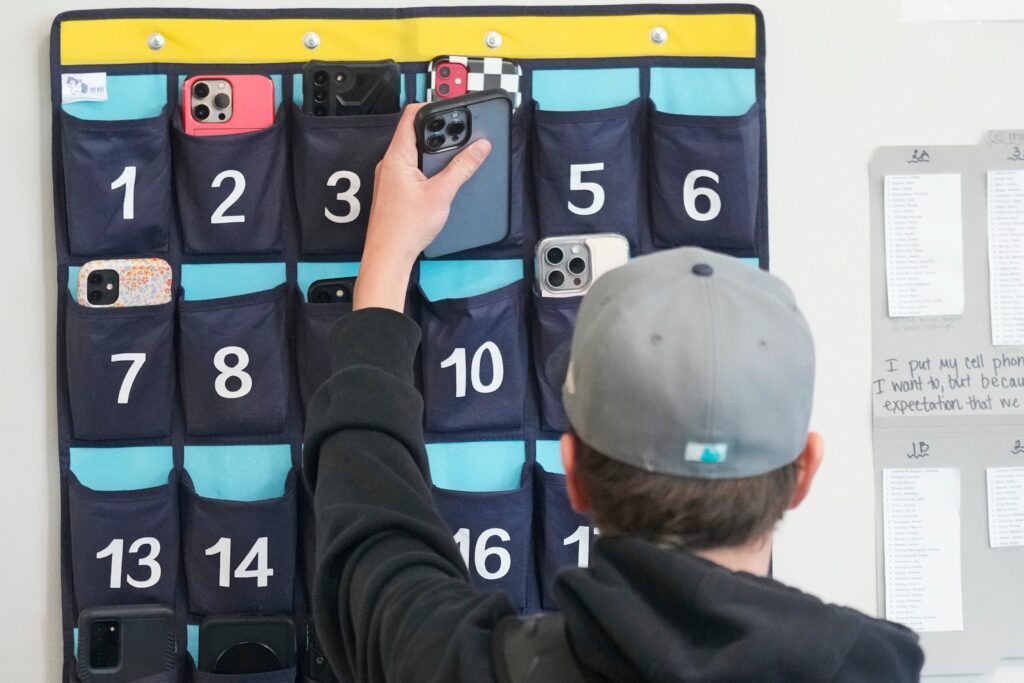
Most states have attempted to curb cellphone use in schools in recent years. Parents and educators hoped decreased usage would improve test scores, boost mental health and help students pay more attention in class.
The results, however, have been mixed.
While cellphone bans have reduced unauthorized usage in schools, there has been little academic benefit, according to a study released by the National Bureau of Economic Research on Monday. The average effect on test scores is “consistently close to zero,” researchers said in a working paper.
The study — conducted by researchers from Stanford University, the University of Pennsylvania, Duke University and the University of Michigan — also found that cellphone bans do not have much of an effect on attendance, perceptions of online bullying or in-class engagement.
“I think what our study is useful in suggesting is, a lot of times, easy solutions seem like they might work really well,” said E. Jason Baron, an assistant professor of economics at Duke University and one of the paper’s authors. But “it’s hard to move outcomes like test scores.”
Teachers noted that strict cellphone bans led to less phone usage during class. In surveys, they said they were happier in their jobs.
The paper relies on test scores, school records, GPS data, survey findings and figures from Yondr, a company that creates magnetic lockable pouches for cellphones. Researchers examined data collected between 2018 and 2025 at more than 41,000 schools.
Two-thirds of states have implemented rules that limit or outright ban cellphones on school grounds.
Nearly 5,000 schools use lockable pouches to reduce cellphone usage during school hours. Students are typically required to lock their devices in the pouches when they arrive at school and are not able to use them until the final bell rings.
The researchers surveyed teachers who said the share of students using phones in class dropped by roughly 80 percent — from 61 percent to 13 percent — following the introduction of the Yondr pouches.
Within the first year of using the pouches, schools also noticed an uptick in disciplinary incidents — probably related to factors including enforcement of the new phone policy. There was also a dip in student well-being, perhaps due to frustration with the new rule or increased monitoring from teachers, researchers noted.
But those trends fade the longer the rules stay in place, researchers found. By the second year of a cellphone ban, the number of disciplinary incidents had ticked downward, and students reported feeling better.
“This could be for all kinds of reasons,” Baron said. “The most obvious one, of course, is that [students] are now talking more to their peers. They might not be doomscrolling all day.”
The cellphone bans had the most dramatic effect on usage. By year three of a ban, the number of cellphone pings — recorded when a device interacts with an app or website — dropped by roughly 30 percent, GPS data showed.
Adults were still able to use their devices at school, and locked phones can still receive pings, such as from emails or text messages. But the figure “confirms that the impact on student use is substantial,” according to the researchers.
Cellphone bans have found bipartisan support in recent years amid growing concerns over children’s mental health and test scores that plummeted when they returned from pandemic-era virtual learning. They also have broad support among educators — 90 percent of teachers supported cellphone restrictions during instructional hours, according to the National Education Association.
Recently, Michigan passed a law that restricts students’ cellphone use during class. Lawmakers pointed to research that indicates teens with higher non-schoolwork-related screen time were more likely to have anxiety and depression symptoms.
“These bills will help keep kids focused in the classroom and break their growing dependency on screens and social media,” Gov. Gretchen Whitmer (D) said in a statement. “We could all benefit from looking up at the world instead of down at our phones.”
The post School cellphone bans don’t affect test scores or attendance, study finds appeared first on Washington Post.