When the Korean artist and philosopher Lee Ufan turns 90 in June, he plans to be in Paris, where he lives part time, fresh off a star turn in Venice and a visit to upstate New York to see a concise display of his historical work.
It will be a brief break. Before long, Lee will be back on the road, headed to Porto, Portugal, for an exhibition of his paintings and sculptures, pairings of metal and stone, at the Serralves Museum of Contemporary Art. Scheduled to open in September, it will be his third institutional solo show this year.
A few weeks ago, just before departing for Venice, Lee was in Paris fielding a question about how he manages to remain so active and focused, which are characteristics that his admirers often note about him — along with his humor and his passion for great wine.
His secret? “I have no secrets,” Lee said by phone. “I think my answer would be, it is really my work that sustains me.” He works every day, he said, speaking through an interpreter. “I am constantly trying to instill my work with this bright sense of energy. It’s an interesting energy. It’s definitely an energy that you sort of have to delve into the unknown.”
More than a dozen paintings — from 1978 to the present — and three major sculptural installations will chart that pursuit in his Venice show, which the Dia Art Foundation will open to the public at the San Marco Art Centre on Saturday, alongside the Venice Biennale.
Lee’s commitment to the experimental and unexpected has made him a revered figure, but success has not come easy. He has lived abroad most of his life and wrote in a text in the 1990s that he saw himself as a Ping-Pong ball who was “pushed back and forth with no one willing to accept me as an insider,” viewed variously as “a fugitive” or “an intruder.”
Today he has entire museums dedicated to his art in France, South Korea and Japan (his other residence is in Kamakura, south of Tokyo). In 2011, his work filled the ramps of the Guggenheim Museum, and in 2014 he situated his sculptures at Versailles, including a soaring steel arch with a boulder at each side, a typically bracing juxtaposition of the natural and man-made, prehistoric and contemporary.
In a 1970 essay, Lee wrote that his aim was to “let the world express itself by allowing ordinary objects, which are often ignored, to be set free in the vivid and expansive world of incidents.” He wants his art to awaken viewers to themselves, in time and space. “Fundamentally, I’m very much in the camp of not trying to impose, or trying to find, some sort of meaning,” he said from Paris.
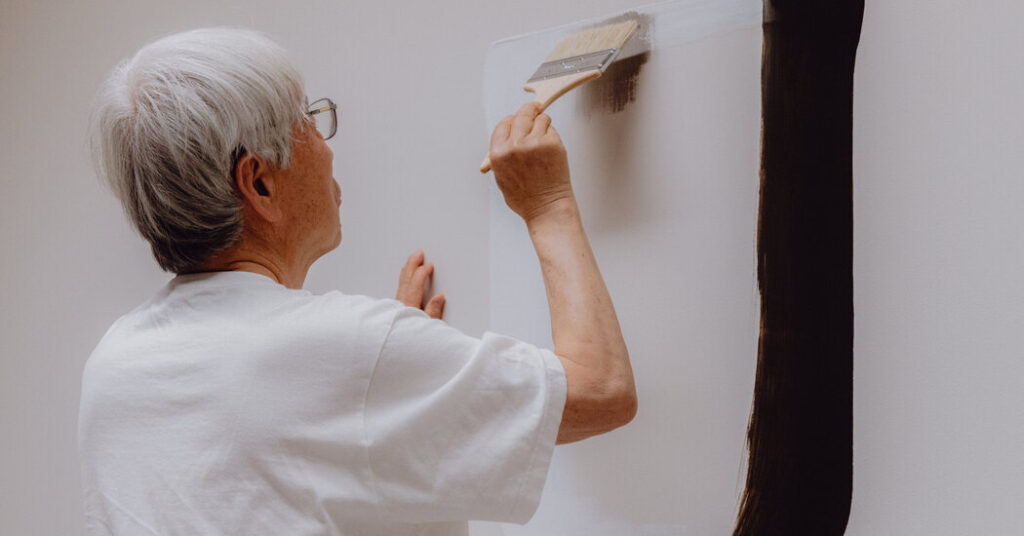
Museums covet, and collectors pay north of $1 million for, his classic paintings, which he began in the early 1970s. He would dip a brush into pigment, then make single marks or a straight line until the color expired. Then he would do it again, building rhythmic, meditative abstractions that record their production. The approach aligned with what became known as Dansaekhwa (“monochrome painting” in Korean), a movement that included his friend Park Seo-Bo, who died in 2023.
The day before Lee’s Venice show opens, more examples of these paintings — gifts from the artist — will go on view at Dia Beacon in New York, not far from his late friend Richard Serra’s gargantuan metal ellipses.
With real delight, Lee recalled Serra once telling him, “We both use steel, but the qualities of the steel we use feel so different. Mine feels very, very heavy, but yours feels very light.”
In Venice, Lee has painted two pieces on site, on a floor and a wall, that take the form of formidable, gradient-like brushstrokes. He has also produced a new installation by nesting amid pebbles long polished-steel plates “that you can walk on and have this disorienting impression of walking on water,” said Jessica Morgan, Dia’s director, who is curating the exhibition in the floating city. “I think it’s kind of beautiful in Venice, given the proximity to the water.”
Water and rocks were part of Lee’s youth. He grew up in a rural part of southern Korea, then a Japanese colony, and has recalled exploring a nearby riverbed. In 1956, three years after the Korean War ended in a tense armistice, he visited an uncle in Japan who convinced him to trade painting studies in Seoul for philosophy classes in Tokyo. He became intrigued by the German philosopher Martin Heidegger and phenomenology, a line of inquiry concerning how consciousness is experienced in the first-person, which his art would explore.
As a Korean in Japan, Lee was blocked from some opportunities, and his activism for Korean unification and against South Korea’s military dictatorship made him suspect back home. (On one trip there, he was arrested and tortured, he has said.) But as he devoted himself to art in the 1960s, he was ideally situated. Japan’s market was far larger and more international than South Korea’s.
The Venice show will also include an installation he conceived in those formative years, “Relatum” (the title Lee gives to all his sculptures, including early ones that previously had other names). It’s a thick forest of steel wires in a field of sand, from 1969. Lee was in his early 30s then, in a loose movement known as Mono-ha — “School of Things” in Japanese. Its members were intent on redefining art, using industrial and natural materials — soil, paper, rope, cotton — with a minimum amount of intervention. For one major “Relatum” (1969), Lee placed a stone atop glass, cracking it.
Mono-ha sculptures offer up the real stuff of the world, while at the same time rendering it strange and poetic, even uncanny. Lee tries “to debase our understanding of superiority as a human over things,” said Matilde Guidelli-Guidi, the curator at Dia, who organized the Beacon show with Min Sun Jeon, an assistant curator. As she sees it, in Lee’s Mono-ha work, “There’s a questioning of what is the object of art, what is the role of the artist in composing it?”
In Portugal, Lee is sourcing rocks for some works locally, as he often does, hunting for just the right ones. After all these years, they still fascinate him.
We live “in a deluge of information,” Lee said. “I feel like rocks still retain a sense of the unknown that you can’t quite grasp with A.I. or even with the most advanced technological tools.”
The stones are “frozen time,” Philippe Vergne, Serralves’s director, said over breakfast in New York. Vergne added that Lee has “invented forms that didn’t exist before,” and hinted that the artist may offer something new in the Porto show, which Vergne is curating.
“I’m always in process,” Lee said, as he considered what has kept him so vital. “I’m trying this, I’m trying that. I think maybe constantly being in process is one of the secrets of maintaining that energy that I have.”
This aesthetic method has broader import for Lee. “We can’t ignore the fact that there are dark things that are happening in the world we live in today,” he said. “But despite that, I think my question has always been, how do I still instill a sense of hope and strength through the work that I do?”
The post ‘I Have No Secrets’: At 90, a Revered Artist Finds Energy in His Art appeared first on New York Times.