When the Chinese standup comedian Chizi decided this year to go on tour for the first time since he got into trouble with his government three years ago, he was certain about just one thing: Some people would come to the shows — in Japan, Taiwan, Malaysia and Singapore — to see a “rebel comedian.”
He knew he could play up that image, pulling jokes from a folder on his phone labeled “Cannot Say” — material sure to enrage Chinese censors. He had done exactly that during a tour in Canada and the United States three years earlier, when he mocked the country’s zero-Covid policies, its censorship and the prejudices faced by ethnic minorities.
Or he could make the show more personal, introducing himself to a new audience of Mandarin Chinese speakers in other parts of Asia. Steering away from the obviously political was a choice he knew would not please members of the Chinese diaspora who are critical of the current government.
His North America tour in 2023 had cost him. All references to him were deleted from the Chinese internet, he became toxic in his industry and he was unable to practice his craft in China, losing his core audience and his income. Now doing shows in total freedom, he finds himself resisting a different sort of constraint: the expectation that he will perform the role of rebel.
It is an expectation that offends his sense of artistic integrity. He is not an ideologue. He wants to tell stories and let people think for themselves rather than imposing a conclusion. Doing anything else, he said, would be the mirror image of the Chinese propaganda he grew up with.
He just wants to be a comedian. For a Chinese performer, that turns out to be a radical enough ambition.
Laughter as an Outlet
Chizi, a nickname that means “pond,” was born in 1995 in central Henan Province. His real name is Wang Yuechi. The given name Yuechi comes from a Chinese idiom: Never go beyond prescribed limits. His parents chose it hoping he would do the opposite.
His family moved to Beijing when he was 8 years old, hoping to provide better schools and opportunities for their son. He was the kind of restless, funny kid who made his classmates laugh and frequently got into trouble for it.
As a teenager, he watched American standup online — George Carlin, Dave Chappelle, Chris Rock — and thought China could never produce anything like it. “It’s too sharp, too dangerous,” he said. But in 2015, he came across an advertisement for a small outfit holding open-mic standup nights. For his first performance, he scribbled jokes on bits of paper. He was a natural.
In its early years in China, standup comedy was performed exclusively in small bars with little interference. Comics even made fun of the Chinese leader, Xi Jinping, Chizi told me. In the late 2010s, as the government tightened controls over personal expression — banning male earrings, tattoos and flamboyant hair colors on TV — standup comedy, somewhat paradoxically, became one of the most popular forms of entertainment.
“The more pressure there is, the more people need laughter as an outlet,” Chizi said.
In 2017, the same year his mother died from brain cancer, Chizi became a regular on “Roast,” a new television show featuring comics that attracted nearly 1.4 billion views during its first season.
But as standup gained popularity, government oversight arrived with it. Writers had to submit their material to censors and were not allowed to go off script. Taboo topics included national leaders, homosexuality, gambling, poverty and the pandemic.
Chizi responded by writing down everything he wasn’t allowed to say. Over time, this became his “Cannot Say” folder: jokes he had written but could never perform in China.
But he found other ways to publicly defy the system. He mailed his social media followers physical copies of the Chinese Constitution with the clause protecting freedom of speech highlighted. When regulators issued an official document labeling his dreadlocks “strange,” he daringly posted a screenshot on Weibo, a popular social media platform, and wore the most ridiculous hats he could find at subsequent shows, turning the censorship itself into the joke.
At 23, at the height of his fame, Chizi quit “Roast.” The work, he said, had grown too commercial for his tastes, and the studio that had signed him wanted control of his social media account, calling the things he said “too dangerous.”
Then came the North America tour and the ban. He returned to China, keeping a low profile, but, unable to perform, he left at the end of 2024 in self-imposed exile.
The industry he left behind has been facing an existential crisis as censorship has intensified. In mid-2023, Beijing fined Chizi’s former employer around $2 million for a joke that compared China’s military to stray dogs. A few months ago, a female standup comedian joked on Weibo that she felt fortunate not to have a husband and children she would have to cook for while she was sick with a fever. Her account was suspended for “causing anxiety about marriage and childbirth” and for “provoking gender antagonism.”
A Nervous Return
For the past year and a half, Chizi has been traveling the world and not doing much, which his savings make possible, he said. He’s learning to meditate and cook — his favorite dish is eggs and tomatoes — and tracks what is and isn’t allowed on Chinese social media. He said he was still enraged by injustice back home. Now he posts photos of clouds on Instagram.
His return to the stage began with a plan to do only one show, in Taiwan. Then word spread. Tokyo, Kuala Lumpur and Singapore were added to the tour. To his surprise, all but one show sold out. (He now has shows planned for North America and Australia.)
Half an hour before his first show, in front of 1,000 people, in Tokyo in April, he was still rewriting jokes. He had not tested his material at an open mic. Rather, he practiced in front of an imaginary audience, holding a plastic bottle as a microphone. He had no idea whether his jokes would land.
The people who stood in line outside the theater had come to hear a rebel. “If he’s not saying things that can’t be said, why would I come?” said Jason Li, a 39-year-old I.T. worker who moved to Japan from China in 2022. “Otherwise, I might as well watch Chinese television.” Most of the people I interviewed, like Mr. Li, were Chinese immigrants who recently moved to Japan, part of a wave leaving China after the pandemic. Backstage, Chizi stretched, squatted and jumped to calm his nerves.
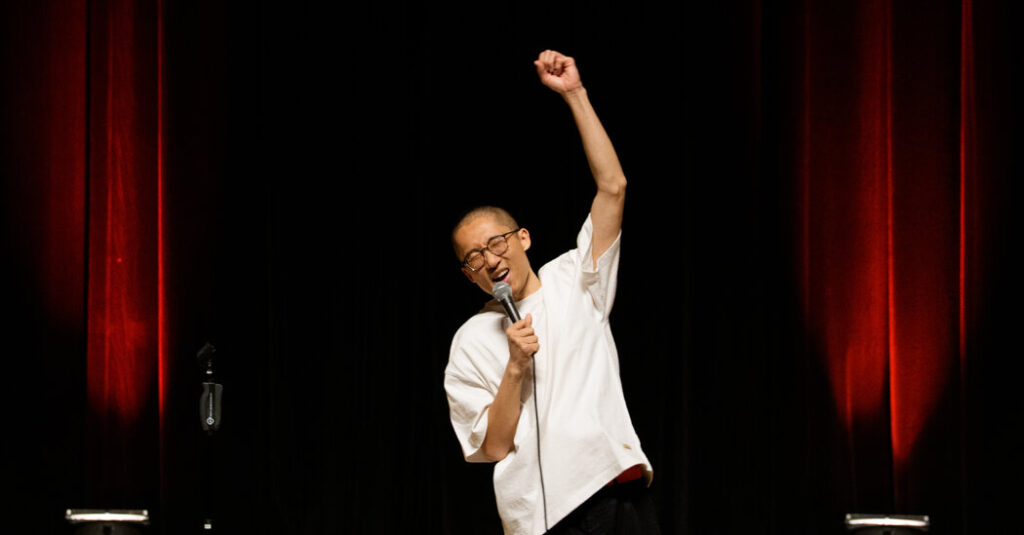
Wide-shouldered and lanky, Chizi makes a dramatic impression. A few days before the show, he shaved his famous dreadlocks. But when he walked onstage in an oversize white T-shirt, a pair of black pants, and white and red Nike sneakers, the nerves were still visible. He forgot a few lines. He paused awkwardly a couple of times. Later, on social media, he would offer an apology for what he considered his poor performance. “I could do better,” he wrote. The audience didn’t seem to mind. The people chuckled, laughed and applauded.
He riffed mostly about his childhood — teachers who humiliated him for disrupting class, a mother who loved and hit him, being an outlier in a country that didn’t tolerate curiosity and individuality. The material was personal, even tender at moments. Political references were sprinkled throughout, but they were subtle.
Then, near the end of the set, he referred to Mr. Xi, China’s paramount leader, obliquely as “the husband of Peng Liyuan,” the folk singer who was once far more famous than her husband. Several women in front of me who had been laughing and clapping went suddenly still. Talking about Mr. Xi in an unfavorable fashion is the ultimate taboo in China. Reducing him to his domestic relationship in a public event was shocking.
After the show, we sat down to talk. He chose his words carefully. When I relayed a friend’s criticism — similar to others’ online — that he seemed to have pulled his punches on Xi Jinping, he laughed. “It’s not meant to satisfy you,” he said. The choice he made onstage was deliberate.
Free speech is a tool, he told me. The temptation is to use it simply because you can. “It’s exhilarating,” he said. But that, he added, can be a trap, and chasing approval is its own form of corruption, as dangerous to comedy as censorship itself.
“It’s easy to be a rebel,” he said. “It’s much harder to be a good comedian.”
An Artful Detour
The next morning, we met for breakfast and talked again about why he didn’t make more political jokes the night before. Geography played a role, he admitted. Standup depends on shared context. Audiences in the tour’s cities do not always share the same references, he said, but they would understand childhood, family and school.
He also thought his reference to Mr. Xi merely as a husband was an artful detour, more sophisticated than calling out his name.
Since his childhood, he always liked a detour. If he needed to get from A to B, he said, “I’d always climb to the highest spot, jump down, hop over a few railings, spin around and only then get where I was going.”
“It’s simply more fun,” he said.
He liked the comedian Trevor Noah, whose stories about his mother and his South African childhood reveal themselves as a portrait of a society. As he was working on the material for the tour, he discovered that his own childhood stories, too, kept emerging with sharp edges, textured with pain, anger and absurdity. He hoped the audience would feel that, too.
I asked Chizi whether he considered himself an exile. “Absolutely,” he said. He knew he could not return to China if he didn’t censor himself.
After the show in Tokyo, I talked to a member of the audience, Ms. Zhou, a 59-year-old freelance translator who left China in late 2023, around the time Chizi was barred. She told me that she laughed harder than she had in years at the performance, but she also felt something heavier beneath it.
“Freedom feels so good,” she blurted out as she walked out the theater. Then she caught herself. That this kind of enjoyment could happen only outside China, she said, left her fighting back tears.
Li Yuan writes The New New World column, which focuses on China’s growing influence on the world by examining its businesses, politics and society.
The post Defying the Censors Was Easy. Being a Good Comedian Is Harder. appeared first on New York Times.