THE UKRAINIAN SOLDIER is lying on a cold cement floor.
His beard is long, his hair matted. His fingers are broken. His teeth ache with rot.
He is in the ruins of a factory in the northeastern city of Vovchansk. He is hungry and tired. His head throbs from untreated concussions.
The soldier strains to make out Russian voices on the other side of the wall. He hopes they cannot hear his friend moaning just a few yards away. He wants nothing more than to help him survive.
There is no escape. The phone networks and roads are destroyed. The fields are mined. The closest Ukrainian command point is miles away. Russian drones hunt anything that moves.
The soldier is named Roman Mongold. He is 38.
It is late August 2025 and he has been trapped since March, deep inside what Ukrainian troops call “the kill zone,” a no-man’s-land between the lines that reeks of death. His friend, Andrii, is 28 and dying from a treatable wound — a Russian bullet lodged in his right knee.
Roman hides in a corner. By radio, he asks his commander to drop more medicine from a drone. Each week, he also asks him to pass a message to his wife, Halyna.
ROMAN AND ANDRII WERE SENT to Vovchansk, a small city on Ukraine’s border with Russia, to try to hold off Russian forces advancing on Ukraine’s second-largest city, Kharkiv, 45 miles to the southwest.
The men arrived separately — Roman in March 2025, Andrii in July. They came the same way, crossing the narrow Vovcha river that runs through Vovchansk and then spent days trying to reach frontline positions farther north in the city.
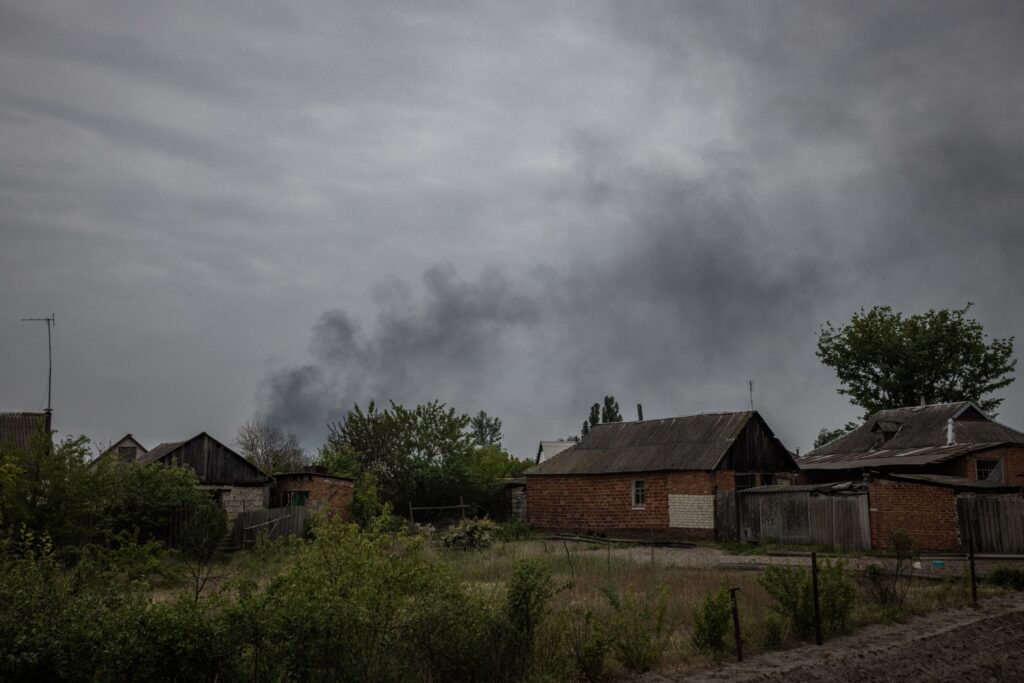
A fierce, ceaseless battle for this former industrial and rail hub has been underway since May 2024, when Russian troops launched a surprise attack. Slowly, Vovchansk has been destroyed.
Unlike other stretches of battlefield, where soldiers hold trenches and dugouts in fields and along tree lines, the fight for Vovchansk has unfolded in abandoned apartment blocks and rubbled factories, the same type of brutal urban warfare that demolished the eastern cities of Bakhmut and Avdiivka. That often means fighting building to building, sometimes room to room.
These troops survive because commanders in the rear use drones to drop packages from the sky: food, water, batteries, power banks, hand warmers, wet wipes, ammunition — sometimes even letters from home. Russia and Ukraine try to disrupt each other’s resupply drones, or wait for soldiers to retrieve the supplies and then target them. It was while out collecting one airdrop that Andrii took the bullet to his knee.
As risky as they are, the supply drones are the soldiers’ lifeline. They keep them fed and their radios charged, allowing them to stay in communication with their base across the river.
Each week, Roman’s wife sends his commander a voice note from home. His commander then plays it through his radio to Roman. Roman recites a message back that his commander records and forwards to Halyna. She saves them all and listens again and again, analyzing his tone, his breath, his cadence, trying to parse some kernel of reality from his claims that everything is okay.
She knows he doesn’t tell her what’s happening. He doesn’t describe the hellscape around him or his fear. He doesn’t say he can sometimes hear the Russians through the walls. He never reveals that his comrade Andrii is probably doomed.
The wheeled land drones Ukraine uses to move the wounded on other stretches of the front line are too heavy to cross the water. Banding a group of soldiers together to carry Andrii to safety would instantly draw the attention of Russian drones.
ALL THE UKRAINIAN SOLDIERS holding the line in Vovchansk know the only way out is the way they came in — a treacherous journey back to the river, and one that is impossible for a soldier unable to walk. All bridges over the river are impassable. Soldiers can only cross by swimming or by inflatable raft. Many Russian drones have thermal imaging to kill at night.
Four years into Russia’s full-scale invasion of Ukraine, the battlefield is more treacherous than ever. Soldiers face constant gun and artillery fire, but it’s the small armed drones that have transformed the front into a kill zone.
Troop shortages make rotations rare, and the ubiquitous, low-flying drones see targets in anything that moves. Commanders are reluctant to order retreat when each lost yard could be used against Ukraine at the negotiating table and when moving out can be more dangerous than staying put.
This means that across the entire front line, soldiers like Andrii and Roman who deploy with enough supplies for a few days are increasingly stuck for weeks or months at a time.
Ukraine’s commander in chief Gen. Oleksandr Syrskyi signed an order last week barring troops from staying in combat positions for more than two months at a time — but conditions on the front can make that order difficult to enforce.
So many Ukrainian troops were stranded, wounded or killed in Vovchansk that by late last summer, Roman’s brigade stopped sending new soldiers to positions near the factory.
But Roman was still there.
A YEAR EARLIER, draft officers confronted Roman on a street in the western city of Truskavets, some 700 miles from the front line. He was helping Halyna carry home groceries. It was their daughter’s 13th birthday.
In summer 2024, Ukraine, perpetually outmanned and outgunned, was desperate for more troops. Two and a half years had passed since Russia’s full-scale invasion. Many of Ukraine’s most skilled soldiers had been wounded or killed. Others were in desperate need of rotation off the front line.
To fill the gaps, Kyiv began conscripting 30,000 new soldiers each month.
Roman was one of them.
He was fitted for a camouflage uniform and adopted the call sign Rohan, a reference to a valiant kingdom of horse riders in The Lord of the Rings.
The month he spent in basic training was one of the longest times he had been away from Halyna, or their children, Artur and Valeriia. He longed for their cozy sixth-floor apartment and the way their fluffy Pomeranian, Bonnie, always met him right as he got home from work in the family business. He built kitchen cabinets and doors.
It was a relief when he avoided immediate deployment to the front and was chosen to join a course on Bradleys, the U.S. fighting vehicles that are among the safest and most effective in the war.
As autumn set in, Roman was selected to be an instructor on the Bradleys, keeping him far from active fighting. Then in March 2025, he was abruptly ordered to join Ukraine’s 57th Motorized Infantry Brigade and report to the front in the Kharkiv region.
The brigade was one of several tasked with defending Vovchansk.
ON THE EVENING OF MARCH 24, a pickup truck drops Roman and three other soldiers — call signs Hunter, Sniper and Boxer — on the outskirts of Vovchansk.
Roman is carrying four bottles of water, several cans of food, a first aid kit, a few chocolate bars, 10 boxes of cigarettes, two lighters, a few grenades, a multi-tool, rosary beads and extra ammo for his rifle.
A handwritten prayer from his wife is tucked into his vest, and he asks God to return safely to her, with her long blond hair and blue eyes, which haven’t changed since they met as teenagers 21 years ago. He remembers how his friend got to her first but how Roman eventually stole her heart and married her at 18.
After crossing the river, heart thumping out of his chest, he walks into his first fight.
The men follow orders to split off into different positions within this small section of the city. Roman pictures the battlefield like a clock. Ukrainian positions are behind him, from 7:30 to 5:30. The Russians are everywhere else.
He is stationed in an abandoned apartment building, in a half-destroyed kitchen, with a soldier named Zhora.
They take turns watching Russians move through the park and factory outside, occasionally firing at them. They report the movements over the radio. They cover the window with a fishing net to catch enemy drones.
On April 3, Roman turns 38. From Truskavets, Halyna writes to Roman’s commander and asks him to play a birthday message for Roman over the radio.
That morning, the first Russian drone flies into the net. Roman and Zhora grab their bags and run for the basement. A second drone slams into the window, then a third and a fourth. The kitchen floor collapses. They are covered in debris.
In the basement, Roman and Zhora find jugs of water, a chisel and a piece of pipe. They dig a hole in the remaining wall and climb through to find another. They take it apart brick by brick. They learn from the radio that the soldier Boxer was assigned to has been wounded.
On the night of April 6, they climb outside and move in different directions: Zhora to help Boxer treat his wounded comrade, Roman to help Hunter hold his position nearby.
The wounded soldier dies the next day. Soon, Zhora is killed too.
ROMAN IS SENT BACK into the damaged apartment building to find a new position to hold. He finds an abandoned living room and fortifies it with sandbags, bricks and concrete slabs.
He digs a hole through the floor for easy access to the basement. He watches Russian troops from his perch by the window. He reports their movements to his commander on the south side of the river, to get drone fire support from the rear. Enemy is 30 to 40 yards out at 1 o’clock, 2 o’clock, 3 o’clock.
At dusk, he moves to Hunter’s position in another building nearby. Ukrainian drones drop food and ammo from the sky. Roman and Hunter sort the cans — eating from the burst ones first, saving the others for later. They rummage through the bullets, tossing crooked ones to the side.
Before sunrise each day, Roman returns to his desolate living room position to keep fortifying it. The work gets less lonely when a soldier who goes by the call sign Medic joins him.
The men clean themselves with wet wipes. Drones drop trash bags for them to use as toilets. The weather warms. Flowers bloom. Artillery bangs.
Six weeks pass like this.
Every Sunday, Roman holds the radio to his ear and listens as his commander plays a message from Halyna. Her voice feels like a miracle.
It is late May. Roman looks out the window. Russian troops are at 3 o’clock. They are sneaking toward Hunter’s position.
Roman and Medic open fire. The Russians now understand where they are.
A drone comes crashing in. The floor collapses.
Roman and Medic hide in the rubble. Ukrainian drones are watching from above, the battlefield live-streamed onto commanders’ computer screens. Orders come barking through the radio: Get to the factory!
IN PEACETIME, civilians used the factory to build airplane motors and other machinery. The battle for Vovchansk has turned it into a vast ruin of brick buildings that both sides claim as their own.
Here, Roman’s mental clock is harder to read. He thinks of the mixed-up lines of control as a chessboard: Russian, Ukrainian, Russian, Ukrainian.
The Russians dig foxholes into the rubble. Ukrainians try to station themselves in parts of the factory complex that are still standing.
Roman and Medic find a hiding place under a set of stairs. A soldier named Pchola, or “Bumblebee,” joins them.
Each day, Roman watches through a hole in the wall as Russian troops charge through a park below, preparing to throw anti-tank mines at Ukrainian positions.
Roman shoots some of them. Others explode as the mines they are holding detonate before reaching him.
He hears on the radio that Sniper and Hunter are under constant attack. They are both wounded. The commander finds them a route out. Messages on the radio tell him they both survive. But the Russians take their old position, at 5 on Roman’s battlefield clock.
He is almost surrounded.
A Russian tank fires several dozen shells a day. Roman moves constantly within the factory. Staying still is how others die.
Debris from a drone strike breaks Roman’s fingers. Medic is rotated out, but a drone hits him on his way, just as he is close to safety. His leg shatters, but he survives.
In the factory, the days start to blur. Roman’s hands shake; he hyperventilates.
A SOLDIER NAMED YAROMA is sent to replace Medic. He and Roman take turns keeping watch at night. They tell Pchola to keep himself busy making them coffee over the small gas stove since he is always the first to fall asleep.
They talk about their families. They share cigarettes. They dream of showers and warm meals and going home. They jump when they see stray cats stalking the halls, their eyes wide and glowing in the dark.
Roman misses his daughter’s 14th birthday, then his son’s 18th three days later.
Their voices crackle through the radio. In a small notebook, he scribbles messages he hopes to share with them. He runs his hands over his wife’s handwritten prayer so many times it starts to fade.
The Russians are so close he shouts at them. “Come here, and I’ll kill you!” Sometimes they shout back.
Roman kills and kills and kills. The factory fills with Russian bodies. He asks God for forgiveness. He goes outside only at night to collect supplies dropped by drone, stepping over dead Russians.
The Russians lob anti-tank mines at their position. Roman is crouched behind a wall. The blast wave dislodges his shoulder.
Yaroma and Pchola are buried under the rubble. Yaroma frees himself and runs for help. Roman shouts that he will follow with Pchola.
Yaroma is outside, running. Roman hears a flurry of gunfire, then silence. Yaroma is dead.
Another boom. Something has landed nearby. Roman is dizzy and concussed. He calls for Pchola. He hears nothing. He believes that he too must be dead.
Roman thinks of Halyna. He thinks of Artur and Valeriia and Bonnie waiting for him by the door.
He needs to survive. He finds an empty room, and two abandoned Russian anti-drone cloaks — ponchos designed to hide a human’s thermal image. He covers himself and falls asleep.
In early August, Roman’s sister opens her apartment door in Truskavets to two men dressed in olive fatigues. They hand her a letter stating that Roman is officially missing in action on the front line.
He is in fact alive. Roman eventually finds Ukrainian troops and makes contact with commanders. He learns that Pchola survived and freed himself from the ruins. He is flooded with relief — “If I knew you were alive, I wouldn’t have wasted my tears on you,” he thinks.
The commanders identify a route out for Pchola, whose arms are badly wounded, but he doesn’t make it. He hits a mine on the way to the river and bleeds to death alone.
The brigade sends a new soldier, a 28-year-old former marine named Andrii, to join Roman.
THE RUSSIANS BOMB the factory day and night and hunt for the remaining Ukrainian troops.
The routes out narrow. There is only one way left, at 7 on Roman’s mental clock.
Roman and Andrii beg to retreat, to move anywhere else. They tell their commanders they might not survive.
But the feeds from the Ukrainian drones tell their commanders that there is nowhere for them to go. The Russians and their drones are everywhere.
Several days pass. A drone drops supplies. Andrii goes outside to collect them. A Russian soldier spots him. A bullet ricochets off the factory wall and into his knee.
Roman hears Andrii’s cries. He is screaming Roman’s name.
Roman ties tourniquets around Andrii’s thigh to stop the bleeding. He understands he is now holding the position alone. He watches for Russians and nurses Andrii. He uses the Russian anti-drone cloaks to cover his friend.
Roman radios his commanders and pleads again for a way out. Andrii needs to survive. He is supposed to get married this year. His family is waiting at home.
Roman has survived this long by stealing weapons off dead Russians and stockpiling the rations Ukrainians drop from the sky.
To escape with Andrii, he will need to sneak out of the factory he now shares with enemy troops, move between bombed-out buildings and minefields, then swim or board an inflatable raft to cross the narrow river separating them from their base — all undetected by the Russian drones fitted with thermal cameras clogging the sky above.
Roman knows this journey is impossible. Andrii cannot walk, let alone run. Roman is smaller than Andrii, and too weak to carry him.
Still, he whispers for Andrii to stay strong. He tells him about others who have made it out alive.
He tightens the tourniquets he tied around Andrii’s thigh. He picks maggots out of Andrii’s swollen knee. He spoon-feeds him painkillers.
Andrii grows weaker. He burns with fever and is pale from blood loss. The infection in his knee spreads. Each time Roman turns around, he sees that Andrii — writhing from pain — has loosened his tourniquets. Roman scolds him, tightening them again.
Roman peers outside and watches Russian troops moving in the park below.
IN LATE AUGUST, Andrii dies in Roman’s arms.
Roman weeps and prays over his body. He curses Russia and the war and their factory prison. He pleads for God to welcome Andrii to heaven — he tells him that unlike Roman, Andrii didn’t even shoot anyone in Vovchansk.
Then he radios his commander and asks for a drone to drop a body bag from the sky.
He slides Andrii’s olive green helmet off his head. Roman lost his own long ago. If he makes it out, he promises himself that he will return the helmet to Andrii’s family.
He drags Andrii’s body into the bag, scribbles his name and call sign on a slip of paper, and carefully tucks it inside. He writes his name on the outside of the bag too, then covers it with rocks, piling Andrii’s body armor on top to make him easy to find in case help ever comes.
Roman buckles Andrii’s helmet under his own chin and returns to his surveillance point, where he stays several days in the summer heat.
He gets orders to defend a new position in the factory. He stays there for two weeks, still fighting but numb with grief.
Then another order comes through the radio: It’s his turn. He can leave.
IT’S 4:30 IN THE MORNING. It has been 177 days. Roman is wearing Andrii’s helmet and holding Andrii’s gun.
He is running south.
Away from what’s left of the factory. Away from the bodies of the Russians he killed and the Ukrainians they killed. Away from glide bombs and mortar fire and big-eyed cats and tins of rotten food. Away from the guilt he feels for killing.
He is running home. Home to Halyna and her voice that has kept him alive. Home to Artur and Valeriia — and Bonnie, waiting by the door.
A Ukrainian drone is following him overhead. His commander, watching its feed, barks orders over the radio, guiding Roman stride by stride.
He is wrapped in the anti-drone cloak he stole from the Russians, the same one he draped over Andrii before he died.
He reaches the river. He dives in. His rifle catches on a rock. He feels it dragging his body down.
He refuses to let this be the way everything ends. He untangles the rifle and forces himself up. He gasps for air. He swims and climbs up the south side of the river bank.
Russian artillery spots him. Mortars fly in.
He runs from the shelling to an abandoned village house and waits for someone to find him. He asks to send one last message to Halyna.
ROMAN IS HOME on the sixth floor. His beard is gone, his hair cut short.
It’s November.
It’s been more than 30 days since he left the hospital in Kharkiv, boarded the long train to Lviv and drove home to Truskavets. He can still feel those first hugs, taste the pizzas they ordered that night, hear Bonnie’s excited yelps.
He has told Halyna everything. They stay up late, foreheads pressed together.
He has been to the dentist 16 times. His back still aches. But the nightmares have subsided. Confession in his local parish helped stem his shame — for the Russians he killed and the Ukrainians he couldn’t save.
Tomorrow, he will board a train back east. He does not know when he will be home again. Bad news has continued to trickle in: More friends are dead and wounded.
He knows he will not return to Vovchansk, but he watches the map and understands there are other places like it. Some might even be worse.
He thinks, as he does most days, of Andrii and his helmet. How it still sits on a shelf in his apartment. How he couldn’t find the nerve to return it. Not yet.
He picks the helmet up. He looks at his own family. He imagines if it were him who never came home.
He sees Andrii, tall and broad-shouldered, dark blond and very much alive. He pictures him ringing the doorbell on the sixth floor and handing Halyna a helmet, telling her he did everything he could.
Roman is not ready to meet Andrii’s family. He might never be. He puts the helmet back on the shelf.
About this story
Reporting by Siobhán O’Grady, Serhii Korolchuk and Anastacia Galouchka. Photography by Carolyn Van Houten and Ed Ram. Editing by Peter Finn and David M. Herszenhorn. Additional editing by Shay Quillen. Design by Emma Kumer. Additional design by Yutao Chen and Jose Soto. Design editing by Virginia Singarayar and Joe Moore. Photo editing by Natalia Jimenez. Audio editing by Bishop Sand. Additional support from Reem Akkad and Paul Schemm.
The post Trapped in a kill zone for 177 days, his wife’s voice was his lifeline appeared first on Washington Post.