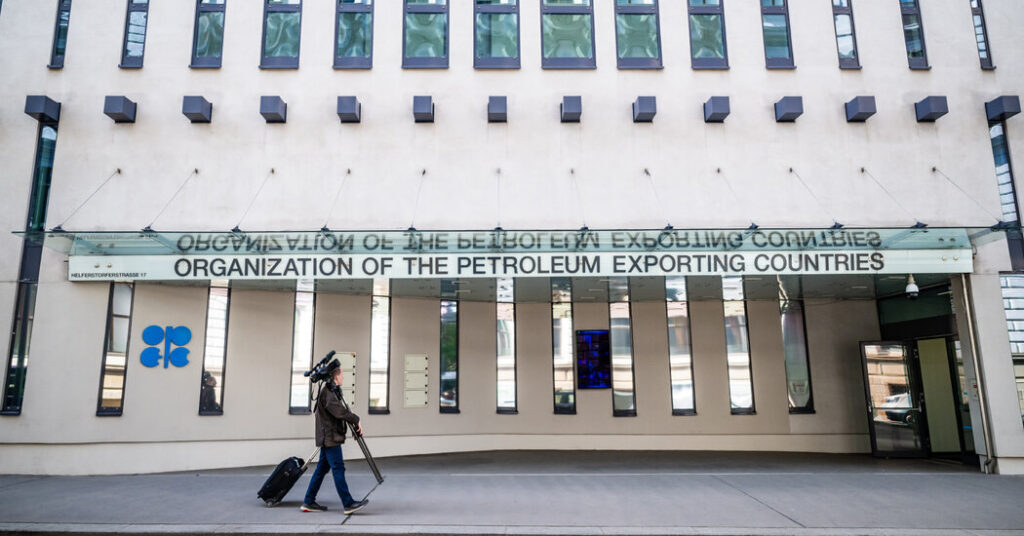
The oil cartel known as OPEC Plus agreed on Sunday to step up output next month by a modest 188,000 barrels a day, in a move meant to send a signal that it was conducting business as usual. The group met days after the abrupt departure of one of its key members, the United Arab Emirates.
The decision — the latest in a series of production increases announced by the Organization of the Petroleum Exporting Countries — was largely symbolic since much of the world’s oil supply is choked off by the war in Iran.
In a statement announcing the planned production increase for June, seven of the members of the consortium of oil producing nations noted “the importance of adopting a cautious approach.”
The announcement did not mention the Emirates, which had long complained that the group’s quotas had unfairly limited its exports. Analysts said the lack of acknowledgment could be seen as a sign that the group is unbothered by the move.
Shortly before the OPEC Plus statement, the Emirates’ national oil company, Adnoc, issued its own statement announcing that it planned to spend roughly $55 billion to “support upcoming projects” that it said would help it meet rising global demand.
The Adnoc statement “is a definite message,” Joe DeLaura, a global energy strategist at Rabobank, said on Sunday. “The U.A.E. has said we are no longer part of OPEC.”
The Emirates could now be pushing to align with the United States or Western allies, he added, to shore up their global standing and attract more investment from those countries.
“They don’t have the kind of regional or cultural power of Saudi Arabia,” Mr. DeLaura said. “What they had was the allure of financial capital and a Western focus through Dubai.”
Before the war, the Emirates was one of OPEC’s largest producers, after Saudi Arabia — the group’s de facto leader — Iraq and Iran, pumping around 3.6 million barrels a day of oil, or some 3 percent of global supply.
In April, members of OPEC Plus said they would raise oil production quotas by 206,000 barrels a day, in a similarly symbolic move, as the Strait of Hormuz, a vital oil shipping route for oil and gas, has been effectively closed since the start of the Iran war on Feb. 28.
Before the war, OPEC countries supplied more than a quarter of the world’s oil. The consequences of the Emirates’ departure will be hard to determine until the Strait of Hormuz reopens.
In the long term, the country’s withdrawal could cause greater volatility in oil markets, with less coordination on supply levels.
Last week, the price of Brent crude, the international benchmark, surged in response to possible escalations in the war, reaching a four-year high on Thursday, rising above $120 a barrel. It was trading around $72 barrel just before the U.S.-Israeli attacks on Iran began.
The seven members of OPEC Plus involved in Sunday’s decision were Saudi Arabia, Russia, Iraq, Kuwait, Kazakhstan, Algeria, and Oman. With the Emirates’ withdrawal, the group includes 21 members, but recently only the seven countries and the Emirates have decided on monthly production levels.
Emmett Lindner is a business reporter for The Times.
The post OPEC Plus, in Symbolic Gesture, to Increase Oil Production appeared first on New York Times.