Jack Thornell, an Associated Press photographer who won a Pulitzer Prize for capturing James Meredith’s agony after being shot on a Mississippi highway in the spring of 1966, died on April 23 in Metairie, La. He was 86.
His death, in a hospital, was confirmed by his son, Jay.
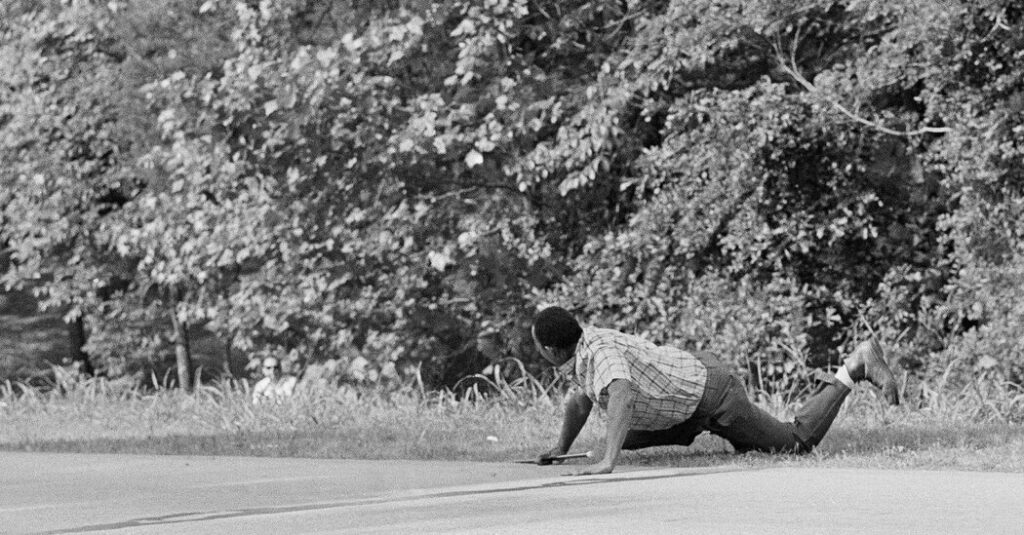
Mr. Thornell’s image of Mr. Meredith, the integration pioneer who had broken the color line at the University of Mississippi, sprawled on U.S. Highway 51, summed up an era’s brutal racial confrontations.
With remarkable precision Mr. Thornell’s camera caught a moment, one of the most wrenching among many, when the violent white South tried to stop the tide of integration.
Mr. Thornell was just yards away when Aubrey James Norvell, an unemployed Memphis store clerk, tried to kill Mr. Meredith near the start of his one-man march across Mississippi. It was Mr. Meredith’s risky bid to highlight the persistence of discrimination in what had been segregation’s stronghold.
Mr. Thornell recalled hearing a warning shot, and then, “Boom! The shotgun sounds again,” he wrote, in an unpublished manuscript, years later.
“The pellets tear into Meredith’s back, spinning him around to face his attacker,” he wrote.
“Click! Click! Click! sounds my Nikon.
“I’m under-lensed,’’ he recalled saying to himself, cursing. He was referring to the photographer’s worry that his subjects will appear too small in the frame.
Mr. Thornell was only 26, but he was already a veteran of civil rights coverage when he shot the famous picture. Still, he was insecure, haunted by fear of failure, of being fired by penny-pinching A.P. editors who sent him out alone on assignments, and of being forced to return to his impoverished Mississippi roots.
He was on more solid footing than he imagined.
Mr. Thornell had captured the only images of the governor of Mississippi, Ross Barnett, blocking Mr. Meredith’s university enrollment in 1962. With a daring sleight-of-hand he got the only shot of a Ku Klux Klan-allied sheriff, Lawrence Rainey, as he was arrested by the F.B.I. in the killing of three civil rights workers in Philadelphia, Miss., in 1964. He had photographed the Rev. Dr. Martin Luther King Jr. at the Selma-to-Montgomery March in 1965; Black children integrating Mississippi schools; and rioting whites at the University of Mississippi after Mr. Meredith, protected by federal troops, finally entered.
But it was the image of Mr. Meredith on June 6, 1966, outside Hernando, Miss., that made his career.
Mr. Thornell was certain he had blown the shot.
After a frantic drive back to the Memphis darkroom, he began examining his negatives one by one as editors in New York pressed for an image, any image.
He cursed to himself. Mr. Meredith wasn’t big enough, and Mr. Norvell, the would-be assassin, was nowhere visible.
“And then, as I move to the next frame, from the bushes, a face pops up. Not believing my eyes and before taking a second look, my mind flashes back to my youth,” he wrote in the unpublished manuscript — a youth of poverty, despair and fear.
“I look back to the negative and I see Meredith sprawling in the foreground. I see the gunman’s face in the background.
“‘Oh my God!’” he recalled exclaiming. “In minutes, ‘THE PICTURE’ of Meredith and the gunman facing off is on the transmitter and spinning into newspapers around the world.” Mr. Meredith survived the shooting; Mr. Norvell served 18 months of a five-year sentence.
Mr. Thornell had gone through similar agony less than two years before in Philadelphia, Miss. The world was awaiting a photo of Sheriff Rainey’s arrest by the F.B.I.; the sheriff’s associates were arrayed to make sure Mr. Thornell didn’t get it. With ingenuity Mr. Thornell met the moment.
One of the men, pointing a knife at Mr. Thornell, warned, “Boy! Don’t you touch that camera,” just as the sheriff was being escorted into a car by the F.B.I.
If he was seen raising his Leica, he risked the same fate as the three young men.
“Just as the agent to Rainey’s right reaches to open the back door,” Mr. Thornell recalled in the manuscript, “I begin dragging the bottom of my right hand across the top of my Leica still dangling from my right shoulder until finding and triggering the shutter button. CLICK!”
The chief of A.P. photographers in New York was not impressed by Mr. Thornell’s anxious explanation that he may not have gotten the crucial shot.
“The whole damn world is screaming for an arrest photo,” Al Resch told him. In the darkroom, “the magnifier with my right eye pressing against it, inches to the left to see Frame 1 …‘Oh my God! Oh my God! Thank you! Thank you! It’s The Picture.’”
Mr. Thornell, shooting from his hip, had captured Sheriff Rainey between two F.B.I. agents, “perfectly framed as if God had raised the camera for me.”
Jack Randolph Thornell was born on Aug. 29, 1939, in Vicksburg, Miss., the youngest of three sons of Benjamin Thornell and Myrtis (Jones) Thornell.
His father, he wrote, was “a failure at farming, at river boating, at fathering and everything else,” and the young Jack Thornell grew up in extreme poverty, his first years “in a one-room shack with the toilet the whole outback. It’s electricity free. Even running water is provided, pouring through holes in the roof that we sometimes catch in cans for drinking.”
He was, Mr. Thornell wrote poignantly in his memoir, “Nothing, coming from nothings.”
He picked cotton as a boy, worked the ticket stand at the Joy Theater, attended Vicksburg High School and was so ashamed of where he lived that he had the school bus stop blocks away, his son, Jay, said in an interview.
He left high school in his senior year because “he couldn’t take the life and shame anymore,” Jay said, joined the Army, received training in photography and a high school equivalency diploma, and in Germany was assigned to take pictures of a new recruit, Elvis Presley.
He joined The Jackson Daily News, the evening newspaper in the state capital, in 1960, just as Mississippi was becoming the crucible of civil rights, and soon made a name for himself. “With my pictures being printed in Time, Newsweek and U.S. News, my reputation as Jackson’s ‘Action Jack’ was growing.”
The A.P.’s New Orleans bureau hired him in the summer of 1964 and, on his first day, he was assigned to cover the integration of a school in Biloxi, Miss. The local authorities had blocked all journalists, but Mr. Thornell managed to get his picture, of one of the new Black students, anyway: “The image that no one down in Mississippi wanted recorded, much less seen, finds its way to page one of THE BIBLE, The New York Times.”
After the famous Meredith photograph in 1966 he went on to shoot Dr. King’s funeral, photographing the family viewing his body, at Sisters Chapel at Spelman College by clambering over the pews (“I knew everyone was looking at me for my despicable behavior,” he told the A.P. in a 2018 interview).
He photographed Robert F. Kennedy in the Mississippi Delta, Mayor Richard J. Daley at the 1968 Democratic Convention in Chicago, and Jimmy Carter on the campaign trail in 1976.
Mr. Thornell went on full-time disability leave from the news agency in 1986-7, his son said, his back ruined from years of carrying around heavy equipment.
Besides his son, Mr. Thornell is survived by a daughter, Candice, and a granddaughter.
In an era of riveting images that still shock, Mr. Thornell captured more than a few. But he was never at ease with his accomplishments.
“Doesn’t ignorance and incompetence — without education in between — breed ignorance and incompetence?” he wrote in his memoir. “And soon, after turning in an inferior picture or two, won’t the powers that be see that, too, and then send me packing, and back to where I belong?”
Adam Nossiter has been bureau chief in Kabul, Paris, West Africa and New Orleans and is now a writer on the Obituaries desk.
The post Jack Thornell, Pulitzer Winning A.P. Photographer, Dies at 86 appeared first on New York Times.