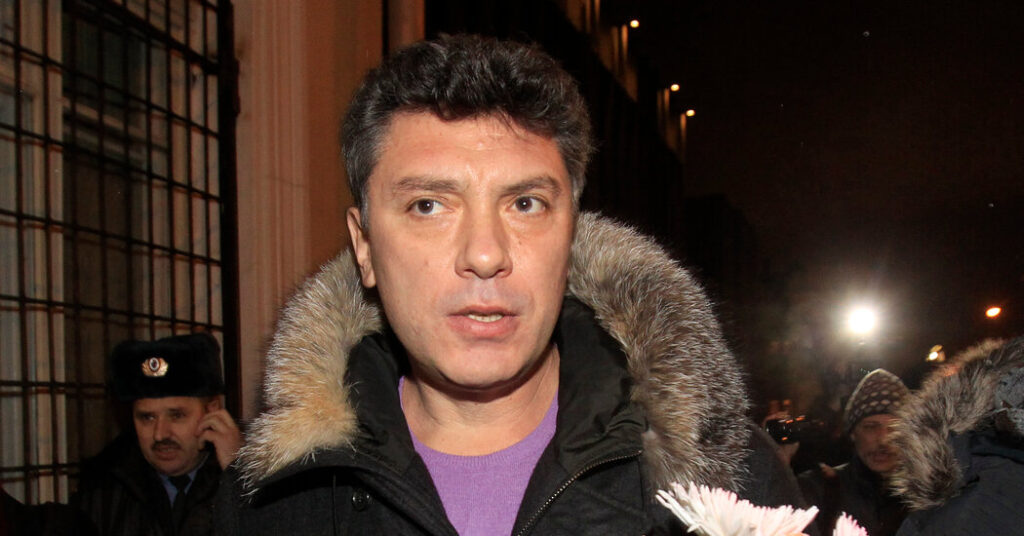
THE SUCCESSOR: Boris Nemtsov, Vladimir Putin and the Decline of Modern Russia, by Mikhail Fishman; translated by Michele A. Berdy
The lurking question behind this searching, propulsive, 778-page biography of an internationally obscure Russian politician is this: What kind of world would exist today if the cosmopolitan liberal democrat Boris Nemtsov, and not Vladimir Putin, had succeeded Boris Yeltsin to run the country? More specifically, would liberal democracy have continued its inexorable march into the 21st century, free from the pull of Soviet nostalgia and the allure of neo-imperialism?
These are the stakes set out by the veteran Russian journalist Mikhail Fishman in “The Successor,” translated into English with a new prologue. “When was the moment that Russia lost its freedom?” he writes. “Was the abhorrent war that Putin began unavoidable? Was the disaster that he led Russia into predetermined?”
For Fishman, Nemtsov embodies the promise of the free, democratic Russia that was beginning to emerge in the early 1990s. Had he fulfilled his destiny, there might not be fighting in Ukraine, with its hundreds of thousands of dead soldiers, 10 million displaced civilians, fears of a nuclear showdown and the specter of World War III.
Nemtsov was “a tall, sexy, curly-haired, handsome playboy,” Fishman writes, seven years younger than Putin and a physicist by training. He developed a taste for politics in the 1980s when his mother began attending antinuclear protests in the aftermath of the Chernobyl disaster.
He remade himself, in the space of a few years, as the golden boy of Russian reform. By 1991, he had become the 32-year-old governor of Nizhny Novgorod, transforming the province by privatizing collective farms, giving free rein to reporters and spurring a boom in new housing and road construction.
By 37, he was one of Yeltsin’s first deputy prime ministers and an heir apparent to the presidency. At one point, Yeltsin even presented Nemtsov with a photograph of the two of them inscribed: “Top Secret: I pass the baton.”
Several factors converged to check Nemtsov’s ascent, but the main reason was the 1998 financial crisis, when the Russian state, unable to collect taxes to offset a drop in oil revenues, defaulted on its debt. Inflation devastated the country and brought ’90s optimism to a screeching halt. “People were nostalgic and on edge,” Fishman writes.
Facing empty coffers, a public disillusioned with reforms and a resurgent Communist Party, Yeltsin changed direction. With two years until the presidential election, he sought out a different kind of successor, someone seen as tough and untainted by the policy missteps of the “wild ’90s.” The very conditions that pushed Nemtsov out of the limelight drew in a little-known bureaucrat and former K.G.B. officer named Vladimir Putin.
When Yeltsin appointed Putin prime minister, scarcely one in four Russians had heard of him. “It was easy to project any and all hopes and interests onto him,” Fishman writes. Some, including Nemtsov, initially believed that he would stay the course, toward Europe and the West.
Many more viewed Putin through the prism of national redemption, the iron hand that would restore the country to greatness. “The majority of Russians would be happy with an aggressive leader, not a caring one,” a sociologist told a respected weekly magazine in 1999. “People prefer force and brutality, expecting these qualities will help establish order.”
Nemtsov never again found his footing in national politics, except as a thorn in Putin’s side. He started a reformist electoral bloc that never quite took off, organized rallies, documented the Kremlin’s crimes, filed complaints with the European Court of Human Rights and lobbied Western governments to sanction Russian propagandists.
When, in 2013, he ran for a seat in a provincial legislature, his friend and occasional collaborator Alexei Navalny mocked him. “You and your privatization and your white trousers, your Moscow face,” he said. “You’ll never get anywhere.” Nemtsov won the seat, a modest perch for a former deputy prime minister, kindling the dying embers of liberalism in Russia. Against all odds, he still harbored hopes of seeing a member of the opposition, like Navalny, win the presidency in 2018.
For his impudence, state media insinuated that Nemtsov was an agent of the U.S. State Department and a “schizo-dem,” a pejorative meaning “a democratic activist who had lost touch with reality and had gone mad fighting the regime.” Pro-Kremlin youth activists pelted his car with dildos, stink-bombed his public appearances and threw Coke mixed with ammonia in his face. The authorities detained him repeatedly, and Putin’s allies subjected him to spurious lawsuits.
All the while, Nemtsov watched in mounting horror as his fellow citizens grew ever more “aggressive, zombified, intoxicated.” In 2014, he felt so dejected that he abandoned Russia for Israel, only to return after a few weeks. His drive to fight it out in the opposition was like a drug habit he couldn’t kick, a friend recalled. The next year, Nemtsov was murdered at the hands of assassins with ties to Ramzan Kadyrov, the Chechen leader and Putin loyalist.
So what of our venture down Russia’s road not taken? Had Yeltsin kept his nerve and stood by Nemtsov, a protégé he once regarded “like a son,” would Russia now be a fully fledged liberal democracy, a normal European country on good terms with its neighbors?
Almost certainly not. Of course, the psychology of individual leaders matters; it’s hard to imagine a President Nemtsov ordering the assassinations of political opponents, branding independent journalists as “foreign agents” and starting the bloodiest war in Europe since 1945. But it’s the larger forces that propel individuals to positions of power, and the currents of history favored a despot.
Even if Nemtsov had managed to secure Yeltsin’s endorsement and win the 2000 presidential election, he would in all likelihood have been out of office before long. Fishman, who is now living in exile in the Netherlands, concedes as much. “Nemtsov probably would not have become president of Russia,” he writes. “He was carried aloft by the revolution at the end of the 1980s and early 1990s. A few years later, he was already too free and too idealistic for the times.”
Until Russia’s full-scale invasion of Ukraine in 2022, Fishman hadn’t given up on his motherland. He ended the Russian edition of “The Successor,” which was published two weeks before the war, on an optimistic note. “Heroes do not die, and neither do values,” he wrote. “The ideals underpinning Nemtsov’s Russia will be in demand at the next turn of history — and they will help ensure that the story has a good ending.”
That hopeful coda has been struck from the English edition. “Is this other future still possible?” Fishman writes in a new prologue. “I still believe that today, although I am not sure that I will still be here when it happens.”
After a quarter-century of escalating repression, any democratic alternative to Putin has been jailed, killed or hounded out of the country. And the Russian public, subjected to relentless propaganda, doesn’t appear to think a different kind of politics is possible, or even desirable. According to the Levada Center, Russia’s only remaining independent polling agency, even after years of war and economic malaise, Putin’s approval rating is currently 80 percent.
And yet, as Russians know well, political change often happens gradually, and then all at once. In the end, “The Successor” justifies its sweeping treatment of a relatively minor figure because it offers a glimpse of the open, pluralist Russia that almost was — and may yet be. Unable to ignore the world as it is, Fishman struggles to conjure his brighter counterfactual, even as a fantasy. Still, he was right before: Putin can physically rid the country of Nemtsov, Navalny and indeed Fishman, but ideas can’t be shot, poisoned or forced into exile. The seeds Nemtsov and Navalny planted may yet mature, in their own time.
THE SUCCESSOR: Boris Nemtsov, Vladimir Putin and the Decline of Modern Russia | By Mikhail Fishman | Translated by Michele A. Berdy | Pushkin Press | 778 pp. | $40
The post Putin’s Rise Seems Inevitable. Could This Guy Have Stopped It? appeared first on New York Times.