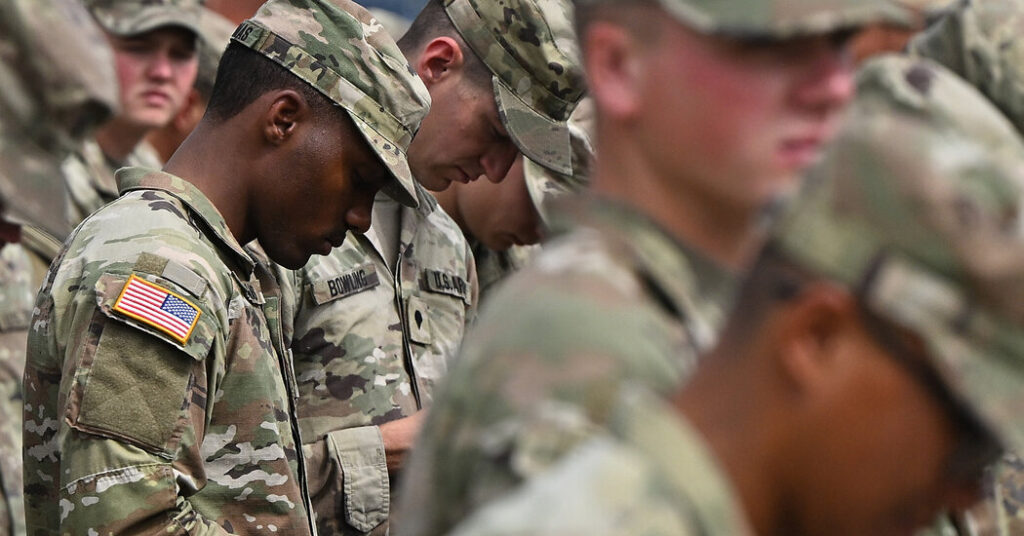
President Trump is right to demand that Europe spend more on its own defense. But the Trump administration’s announcement on Friday that it would pull 5,000 U.S. troops out of Germany risks weakening one of America’s best strategic investments: a military presence that deters Russia and keeps Europe’s old rivalries from becoming America’s problem again.
NATO has never been only about Russia. Lord Ismay, the alliance’s first secretary general, is said to have stated that its founding purpose in 1949 was “to keep the Russians out, the Americans in and the Germans down.” Germany clearly should not be “kept down” anymore: Germany is democratic, responsible and indispensable. Europe needs its money, industry and political will. For NATO’s frontline states, Germany’s decision in 2023 to gradually deploy a 5,000-strong brigade in Lithuania, where I live, was one of the most important deterrent moves on the eastern flank since the Cold War.
Yet the past does not disappear because Europe wishes it away. Germany recently made a historic turn in defense policy. Defense Minister Boris Pistorius stated that the German armed forces should become “the strongest conventional army in Europe.” Germany’s defense budget, already the fourth largest in the world, is on track to approach the combined military spending of Britain and France by the end of the decade. A few years ago, such ambition would have been almost unimaginable.
Some in Europe are already uneasy. In conversations with European leaders and officials, one senses that Germany’s current trajectory — its economic scale, population size and military ambitions — is already changing the continent’s internal balance. Europe’s conventional center of gravity is clearly moving away from France and Britain and toward Berlin. The fact that the Alternative for Germany, a far-right political party, is already the second-largest faction in Parliament and continues to rise in the polls only adds to the apprehension.
All of this has revived arguments thought to belong to history. In January 1990, as German reunification accelerated, President François Mitterrand of France told Britain’s prime minister, Margaret Thatcher, according to notes of the meeting, that Germany had the right to self-determination but not the right to “upset the political realities of Europe.”
His concern was not Germany alone. It was that a reunified Germany, with its renewed scale and weight at the center of Europe, could revive the old continental habit of balancing against the strongest power. Postwar Europe’s answer was not to keep Germany weak, but to bind German strength inside Europe and an American-backed NATO.
The lesson still applies. Europe needs German power. But German power remains less worrying when it is embedded in a unified Europe and anchored by the United States. And a Europe that competes within itself is not only less capable but also far easier for Russia to divide and intimidate.
The recent emphasis of the current French president, Emmanuel Macron, on his country as a nuclear power is part of this anxiety. In March, he announced plans to expand France’s nuclear arsenal and work more closely on deterrence against attacks with European partners, arguing that France’s vital interests have a European dimension but that France alone should retain authority over any use of nuclear weapons. The message was aimed at Russia and uncertainty over U.S. guarantees of protection. But it also spoke to Berlin: Europe’s strongest conventional power is not Europe’s only strategic power.
If America becomes ambivalent in its security commitments to European allies, the nuclear question will become more urgent in Europe. The U.S. nuclear umbrella removes pressure for alternative, more destabilizing arrangements on the continent, but that umbrella rests on trust. And trust is eroding. A European Council on Foreign Relations-Oxford University poll published in January found that only 16 percent of people in 10 European Union countries view the United States as an ally, though about half view it as a “necessary partner.” Twenty percent describe it as a rival or an adversary. This is the political soil in which talk of alternatives to U.S. nuclear guarantees grows.
Mr. Trump’s planned reduction of U.S. troops in Germany, which comes after the German chancellor, Friedrich Merz, said Iran had “humiliated” America, is therefore not just part of another bilateral spat. It chips away at the core of Europe’s security architecture and America’s ability to project power beyond Europe. The tens of thousands of U.S. troops that will remain stationed in Germany reassure allies, secure America’s military role on the continent and help sustain U.S. operations in the Middle East.
The same logic applies to NATO command. The supreme allied commander Europe is traditionally an American general, dual-hatted as commander of U.S. European Command. The post is currently held by Gen. Alexus Grynkewich, who leads Allied Command Operations and is responsible for NATO military planning and operations. The tradition keeps Europe’s most sensitive military post from becoming a contest among Berlin, Paris, Warsaw and London.
The United States remains Europe’s strategic shock absorber. It keeps Russia at bay, embeds Germany, reassures France, protects the Eastern front line and gives smaller allies confidence that their security will not be settled by continental hierarchy alone. Without America, Europe could become more national, more suspicious and more unstable.
Linas Kojala is chief executive of the Geopolitics and Security Studies Center, based in Vilnius, Lithuania.
The Times is committed to publishing a diversity of letters to the editor. We’d like to hear what you think about this or any of our articles. Here are some tips. And here’s our email: [email protected].
Follow the New York Times Opinion section on Facebook, Instagram, TikTok, Bluesky, WhatsApp and Threads.
The post It’s Only 5,000 Troops, but America Will Come to Regret Its Rash Withdrawal From Germany appeared first on New York Times.