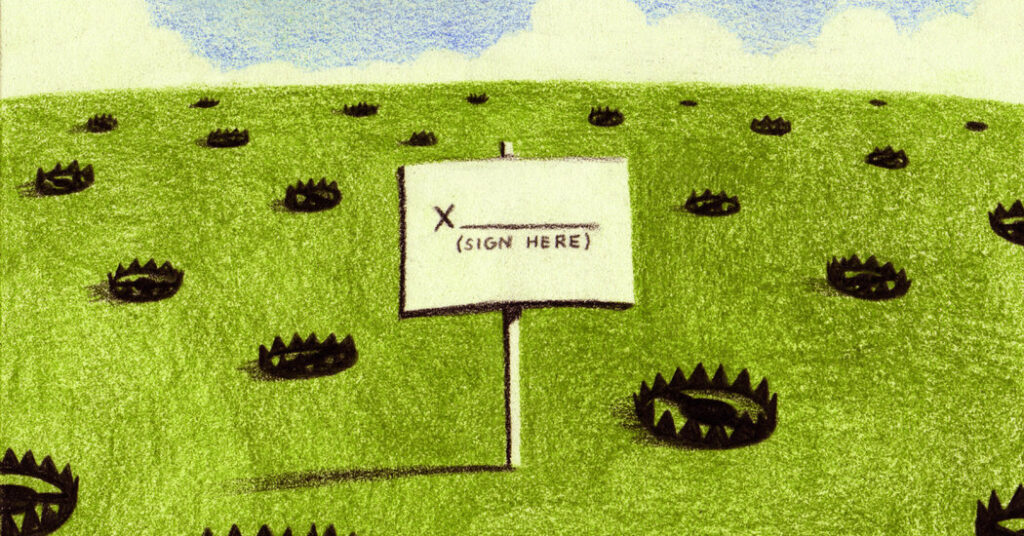
America has a hidden justice system. There, decisions are made in secret, and judges are often paid by the very companies they are supposed to judge. In any other system of justice, this would be called bribery. We call it forced arbitration, and whether you realize it or not, you are almost certainly bound by it.
Jeffrey Piccolo was. When he and his wife visited Walt Disney World, they needed to find restaurants that would accommodate her severe food allergies. According to the subsequent lawsuit filed by Mr. Piccolo, the couple were careful with what they ordered at an Irish pub and received repeated assurances from the waitstaff that their food would be safe. It wasn’t. Shortly after dinner, Mr. Piccolo’s wife began to struggle to breathe, then collapsed. She died at a nearby hospital.
When Mr. Piccolo sued Disney World’s parent company for negligence, the company tried to move the case from open court into the shadows of arbitration, where his complaint would be heard by a private judge, or arbitrator, paid for by Disney. Mr. Piccolo had apparently agreed to this system when he consented to the terms of service in his Disney+ account. Simply by subscribing to a streaming service, Disney — and the law — made clear, he could now be prevented from suing over the death of his wife in court.
People like Mr. Piccolo fight to avoid forced arbitration because it is so unlike a real court. In a real court, proceedings are almost always public, decisions can be appealed, and judges are paid for by taxpayers. In arbitration the proceedings are almost always secret, and the decisions are almost always final. Most important, when consumers and employees arbitrate against companies, it is the companies, rather than taxpayers, that often pay the costs, making arbitrators more inclined to rule for the party that is, in essence, their employer.
The statistics bear this out. In small claims courts, consumers win as often as 89 percent of the time. Before the two leading U.S. arbitration providers, consumers win just 21 percent and 33 percent of cases.
Arbitration is unfair. It is also everywhere, and it is only growing. Thanks to a series of Supreme Court decisions, nearly 80 percent of Fortune 500 companies can — and do — use forced arbitration with consumers or workers. Just last year, 580,000 cases were filed with a single arbitration provider, more than all the civil cases in the federal court system in the last fiscal year.
Perhaps the primary purpose of forced arbitration is to end class-action lawsuits. The attack on class actions took off in the 1970s, as companies claimed that an explosion of frivolous suits had forced them to settle at ruinous costs. That narrative was always false — class-action cases against companies actually declined in the late 1970s and ’80s — but over the years, it would prevent countless Americans from joining a class and sharing their legal costs with a group.
Because many companies require customers and employees to arbitrate their cases individually, businesses can make all but the most serious disputes unaffordable to most people, who must each hire a lawyer or prosecute each case separately. As one judge put it, “Only a lunatic or a fanatic sues for $30.”
Lower-court judges have despaired over this phenomenon, calling our system unconscionable and senseless and manifestly unjust. But forced arbitration was actually created by our highest court. At businesses’ behest, the Supreme Court has empowered companies to compel their customers and employees into arbitration and made it all but impossible for ordinary judges to overturn those decisions — rendering our public justice system largely powerless to stop our private one.
Most concerning, the Supreme Court is expanding the reach of forced arbitration ever outward. In recent years the court has ruled that by default, people must pursue arbitration alone, rather than in a class, that arbitrators (not courts) get to decide even “wholly groundless” arguments about their powers and that courts must stop their proceedings when parties fight over the arbitrability of their disputes.
After Kamille Smith (who is Black) and her family were falsely accused of stealing at a Virginia Walmart, the family sued the company for racial discrimination and other charges. Ms. Smith was compelled into arbitration because she’d signed up to work for Walmart’s Spark Driver delivery gig platform, which had a forced arbitration clause. Until her arbitration could be resolved, no members of her family could move forward with their suit.
Sometimes even people who don’t sign an arbitration agreement are forced into it anyway. A couple of weeks after the logistics company Sohnen Enterprises announced at a staff meeting that it would require employees to arbitrate disputes, one worker, Erika Diaz, told the company she would not agree to this new condition. Shortly thereafter, she filed a complaint alleging workplace discrimination at the company. But applying Supreme Court precedent, the court found that Ms. Diaz had nevertheless assented to arbitration by continuing to work at the company after she was notified of the policy, even though she specifically rejected the arbitration agreement.
Facing a Supreme Court enthusiastic to expand this private justice system, how might we slow or stop its spread? President Trump is no help here, given that in private life he frequently used arbitration against his employees and accusers. In public office, he has rolled back protections against forced arbitration with nursing homes, colleges and credit card companies. Now his administration is helping companies include forced arbitration clauses in their initial public offerings, making it functionally impossible for people to sue over corporate fraud.
Nor will people be able to protect themselves alone: We simply sign too many agreements every day, most of which are nonnegotiable, to save ourselves from forced arbitration.
But change is happening at the local level. States have passed legislation to make arbitration more transparent and fair. And workers in California increasingly use its Private Attorneys General Act to circumvent arbitration clauses by bringing cases on behalf of the state (which isn’t bound by arbitration), rather than themselves (who are). More states should follow suit.
Research shows that the Supreme Court is surprisingly responsive to public opinion on technical issues like arbitration, perhaps for fear of being ignored. Shining a light on how the court is putting big companies ever further beyond the reach of the law may force the justices to think twice before they continue down this path and may give states and cities time to act. By simply seeing our secret justice system clearly, we start to end it.
Brendan Ballou, a former federal prosecutor, is the founder of the Public Integrity Project and the author of “When Companies Run the Courts: How Forced Arbitration Became America’s Secret Justice System,” from which this essay is adapted.
The Times is committed to publishing a diversity of letters to the editor. We’d like to hear what you think about this or any of our articles. Here are some tips. And here’s our email: [email protected].
Follow the New York Times Opinion section on Facebook, Instagram, TikTok, Bluesky, WhatsApp and Threads.
The post He Signed Away His Right to Sue by Subscribing to Disney+ appeared first on New York Times.