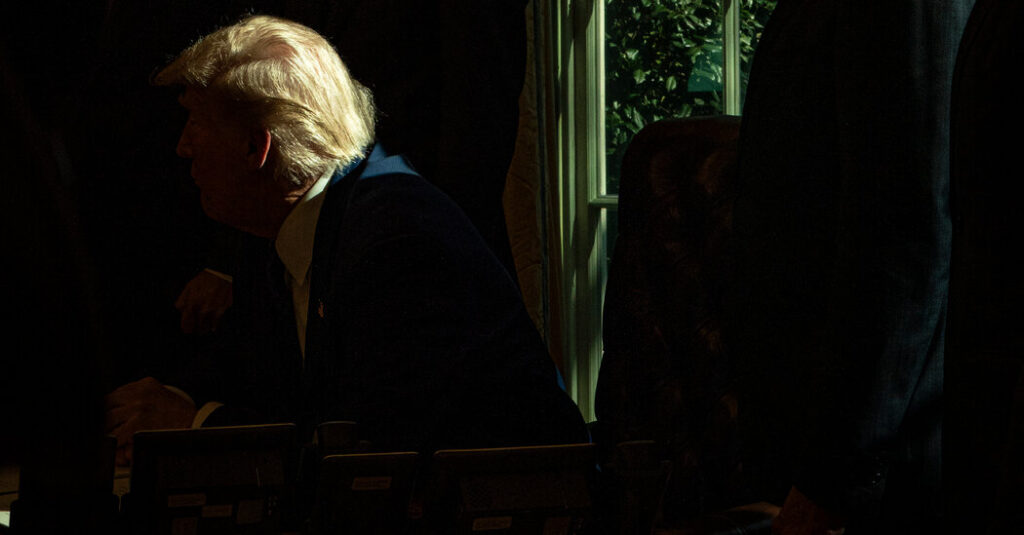
One of the great questions of our time is how to make sense of the relentlessness of the second Trump administration. The relentlessness itself may be an expression of a particular, and deeper, American cultural current. Jackson Lears, a cultural historian and the author of, among other books, “Animal Spirits: The American Pursuit of Vitality From Camp Meeting to Wall Street,” explored that topic in a written conversation with John Guida, an editor in Times Opinion. It has been edited for length and clarity.
John Guida: There has been, in Trump 2.0, a near-constant hum of activity., from the war in Iran to the tearing down and potential rebuilding of the White House ballroom. A lot has been written about the personalities and politics involved, and how it makes sense (or not) as policy. But you have often taken a different approach to culture and politics, identifying subterranean cultural influences and currents in American history going back to the 19th century. For example, you wrote a book about “animal spirits.” What do you mean by that phrase, and do you see it as an underlying source animating this style of politics?
Jackson Lears: “Animal spirits” is a phrase that captures the notion of a vital force linking matter and spirit, soul and body. It also acknowledges the role of free-flowing energy in human experience, from romantic relationships to capital investment. For the philosopher Henri Bergson, animal spirits animated a current of “élan vital”; for the economist John Maynard Keynes, they constituted “a spontaneous urge to action” that was the key to investor confidence.
For human beings in general, they constituted the core of the personal magnetism that energized successful democratic candidates. Americans in particular have been obsessed with the pursuit of vitality for centuries, often characterizing it as the expression of animal spirits, a current of energy or life force that is morally neutral. Its meanings vary with circumstances. Donald Trump’s animal spirits have been a huge part of his appeal — he has seemed to embody spontaneity and authenticity against the scripted tedium of managerial liberalism. But he scatters his energies in a hundred different directions, usually with destructive consequences — against immigrants, trading partners, foreign allies and rivals.
Guida: In terms of “destructive consequences,” you mean something like the war in Iran?
Lears: That war is the clearest example of destructive energy run out of control. Trump promised an end to endless war, but he could not resist the bipartisan imperial project that every president has pursued: the effort to regenerate animal spirits, to lift people out of stagnation, through a dark form of vitality, which is righteous war. It’s been a common reflex in the wake of the heroic role the United States played in World War II. We’ve been saving the world for a long time, first from Communism, later from terrorism. Yet the U.S. overseas military interventions have become harder and harder to see as regenerative war.
Trump’s war on Iran falls into this trap; hardly anyone can see this assault by choice on an ancient civilization as a source of vitality. The Caribbean strikes and the kidnapping of Nicolás Maduro are more Trump’s style — in, boom, out — but they are resonant with Gen. Smedley Butler’s statement that he was a “racketeer for capitalism” (for business interests) in Latin America.
Guida: So far, Wall Street has largely shrugged off most economic interventions from Trump — tariffs, the blockade of the Strait of Hormuz, etc. He is known to be a close observer of stock-market performance. How do the energy and impulses you mentioned in the political and foreign-policy realms relate to finance capitalism?
Lears: The current state of capital markets offers a clear example of John Maynard Keynes’s insight that investment is driven by animal spirits rather than rational calculation. Investors’ emotional state, their fantasies and fears are at the core of finance capitalism. Trump’s crudity and flagrancy in manipulating markets — falsely claiming, for example, that the Strait of Hormuz is open minutes before the markets open — illustrates another trend of our time: What used to be kept hidden is now paraded in public, from insider trading to the assassination of foreign leaders. That intensifies the general sense that matters are out of control, that no one responsible is really in charge.
Guida: How do you think about this type of vitality in the context of tech — particularly the people and companies making the universe of A.I.? I’m thinking of someone like Marc Andreessen, who recently said he practices introspection as little as possible and who lamented what he has seen (as he wrote in 2020) as the “failure of action” and an “inability to build.”
Lears: Once again, we are back in the realm of relentless activism, in this case under the misleading guise of technical rationality. True reason depends on reflection, judgment, wisdom — none of which have any place in the tech world of algorithmic rules-based decision making.
Guida: Are there instances where animal spirits act as a check on excesses of modernity and technocratic rule?
Lears: My scholarly career has been devoted to exploring discontent with the disenchanted universe that has accompanied modernity, and with efforts to find alternatives to it. This persistent preoccupation is rooted in my experience as a cryptographer with a top-secret clearance on a U.S. Navy cruiser that in 1969-70 carried nuclear weapons (but officially denied their existence). To complete my preparation for access to the necessary codes, I had to have an interview with the chaplain “to see if I had any ax to grind for or against nuclear war.” This was the reductio ad absurdum of the neutral technician, the “expert” who has no concern for the human meaning of his work.
The celebration of animal spirits can descend into triviality or worse — a fascist cult of violence. But it has more serious and valuable meanings as a reverence for life itself, as well as a broader connection with the recognition that the universe is alive. As a way of being in the world, vitalism has inspired thinkers from Walt Whitman to William James to Aldo Leopold. Not to mention Ludwig Wittgenstein, who sought to cultivate “the experience of seeing the world as a miracle.”
Guida: To go further back into U.S. history: President Trump has been compared to both Teddy Roosevelt and Ronald Reagan. How did Roosevelt embody both destructive and constructive versions of vitality?
Lears: Roosevelt, according to journalists during his presidency, was the quintessential embodiment of animal spirits, by which they meant boyish high jinks and perpetual activism. The epigraph for his book “The Strenuous Life” includes these lines from Tennyson’s “Ulysses”: “How dull it is to pause, to make an end, to rust unburnished, not to shine in use!”
Roosevelt combined this activist impulse with a heavily moralized commitment to the creation and expansion of the U.S. empire and a love of military combat as a source of regenerated manhood — hence the Roosevelt Corollary, which was an assertive addition to the Monroe Doctrine and declared that evidence of “chronic wrongdoing” was a blank check for American military intervention in Latin America.
Roosevelt’s conception of manliness, however mindless and militarized, was tempered by older patrician ideals of masculinity that combined physical courage with moral courage and a sense of public responsibility. This broader notion of masculinity led him to challenge the accumulation of raw, unregulated power in the monopoly corporations emerging as a major economic force in his day. His conception of service to the public good prevented him from reducing manliness to mere schoolyard bullying.
Guida: You recently wrote a review of a biography of Reagan. You explored his cinematic imagination and his forays into unreality. Did Trump and Reagan tap into something particularly American in their political appeals?
Lears: Like Trump, Reagan rode to power on the promise to make America great again — Lee Atwater and his other political handlers even used that exact phrase. Reagan, also like Trump, inhabited an alternative universe where fiction mattered more than fact. But the source of Reagan’s make- believe was radically different from Trump’s. Reagan’s animal spirits were nurtured by the Hollywood of the 1930s and 1940s, a sanitized small-town world where you could always tell the good guys from the bad guys and the good guys always won.
Trump’s alternative universe appears to be a product of the long bull market of the 1980s, 1990s and early 2000s — its worship of excess, its indifference to any values except financial ones.
Reagan brought his sunny vision to a country still reeling from the humiliating defeat in Vietnam and “made America feel good about itself again,” as the Canadian prime minister Brian Mulroney put it.
Trump’s default setting is anger, not geniality. He claimed to be addressing people who had been left behind by the technocratic neoliberal regime, its hollowed-out public sector, its forever wars. Resentment is the core of his animal spirits. The array of overseas bombings, kidnappings and assassinations, not to mention random assaults on fishing boats, is hardly the sort of righteous war making that is supposed to foster feelings of vitality in an exhausted and threatened population.
Guida: You have referred to an “old weird America.” That aspect of our history is sometimes overlooked. In looking at vitalism in the context of politics, how should Americans think about that strain of our history?
Lears: The phrase “old weird America” is from Harry Smith’s Smithsonian collection of folk music and it suggested the strangeness of rural and small-town America that was erased from the Hollywood version Reagan embraced. In fact, the woods and villages were full of clairvoyants, mental healers, believers in second sight and reincarnation, not to mention conspiracy theorists and debunkers of professional experts. None of these people are about to disappear. (One thinks of Robert F. Kennedy Jr. and the MAHA contingent.)
Trump’s campaigns have dramatized a widespread crisis of authority (scientific, governmental, parental) in this country — not the first such crisis but still devastatingly wide. The attraction to conspiracy theories and the distrust of credentialed experts have real staying power, for good reason. The misuse of technical expertise is equally pervasive; consider the resurgent argument that nuclear wars are winnable, and tactical nukes are weapons to be used like any other. Expert opinion continues to deserve skepticism — indeed, some remnants of the old weird America are worth preserving.
Jackson Lears, an emeritus professor of history at Rutgers and the former editor of Raritan, is the author of, most recently, “Conjurers, Cranks, Provincials, and Antediluvians: The Off-Modern in American History” and “Animal Spirits: The American Pursuit of Vitality From Camp Meeting to Wall Street.” John Guida is a Times Opinion editor.
The Times is committed to publishing a diversity of letters to the editor. We’d like to hear what you think about this or any of our articles. Here are some tips. And here’s our email: [email protected].
Follow the New York Times Opinion section on Facebook, Instagram, TikTok, Bluesky, WhatsApp and Threads.
The post This Is What’s Behind Trump’s Relentlessness appeared first on New York Times.