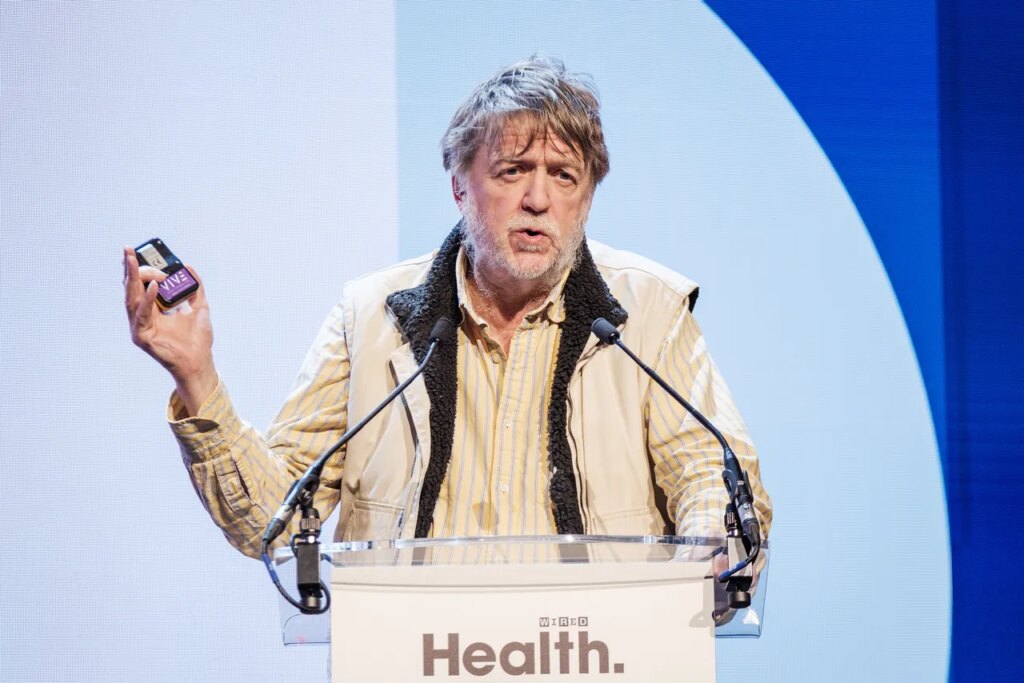
Alzheimer’s research is entering a new phase, as treatments that have taken decades to develop begin to reach patients. But getting those advances to people will depend on more than scientific progress alone, according to pioneering Alzheimer’s researcher John Hardy.
Speaking at WIRED Health in April, Hardy, chair of the Molecular Biology of Neurological Disease at University College London, said that alongside more effective drugs, better diagnosis and political will were still needed to improve treatment of Alzheimer’s disease. “We’ve got to get better,” he said.
Hardy was instrumental in identifying the central role of amyloid, a form of protein found in the brain and body, in Alzheimer’s disease in the 1990s. He and his colleagues helped establish the idea that deposits of amyloid form plaques around brain cells. These plaques are thought to disrupt normal brain function, increasing activity and triggering inflammatory responses.
At the time, he said he was “naively optimistic” about how quickly this discovery would lead to effective treatment. “But now, finally, we’ve got somewhere,” he said.
His findings led to the development of antibodies designed to prevent amyloid deposits forming. But these early approaches did not “suck amyloid out of the brain of those people who already had the disease,” he said. “That was the mistake [the scientific community] made.”
“We now know what drugs need to do,” Hardy said. In recent years, researchers have developed drugs like Donanemab and Lecanemab that can remove amyloid deposits that have already formed from the brain.
The clinical trial of Lecanemab, results of which were published in 2022, showed for the first time that a drug could slow cognitive decline in people with Alzheimer’s disease.
“The problem: It hasn’t stopped the disease, it’s slowed it,” Hardy said.
In general, Alzheimer’s disease progresses over around eight or nine years, Hardy explained. The prediction is that Lecanemab would slow that process down, increasing the time frame to about 11 or 12 years. “It makes a difference in time,” he said. “But we’ve clearly got to get better.”
The amyloid theory is often debated, with some researchers arguing that focusing too heavily on it has slowed progress. Now, most agree amyloid plays a role, though how central it is remains contested.
For Hardy, making progress toward an Alzheimer’s cure will require both scientific and political commitment.
Improving diagnosis is a key priority, particularly through the use of genetics and biomarkers, which can be used “to look at the blood chemistry of those who go on to develop the disease.”
“We can use biomarkers [for Alzheimer’s] in the same way that we use cholesterol measurements as a biomarker for heart disease,” he said.
Drugs like Lecanemab are now used for treatment, though in the UK only private patients can access them. In the US, Lecanemab has been approved by the FDA and is available on Medicare.
Trials of another anti-amyloid drug, Gantenerumab, initially failed to show strong results, but newer studies show higher and longer doses can help delay symptoms. It now “looks very hopeful for the next type of treatment for Alzheimer’s disease,” according to Hardy.
However, improving diagnosis will require investment in dementia services, in the UK and everywhere else.
Alzheimer’s disease is the most common form of dementia, but outside specialist centers, patients are often diagnosed with dementia more broadly rather than Alzheimer’s specifically. “Only about 60 percent of those people who are diagnosed as dementia actually have Alzheimer’s disease,” Hardy said. “You have to get better at making the real diagnosis. And that requires investment.”
“We scientists have things to do. We have to make more efficacious versions of these drugs, that’s in progress. We have to get earlier diagnosis,” he said. “We have to have political change to invest in dementia services.”
The post The Next Alzheimer’s Breakthrough Will Take More Than Just Science appeared first on Wired.