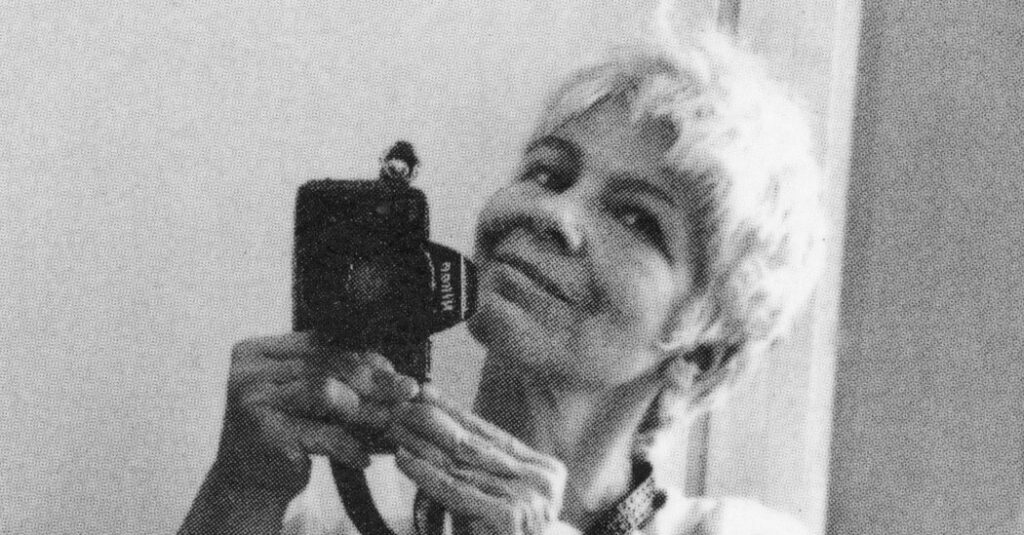
Stephanie Chernikowski, a Texas-born photographer who moved to New York City in the 1970s and quickly became a fixture at clubs like CBGB, where she captured the radiant chaos of punk as bands like the Ramones, Blondie and the Patti Smith Group refashioned the look and sound of rock, died on April 1 in Manhattan. She was 84.
Her death, in a hospital, was from throat cancer, Rob Patterson, a writer and longtime friend, said.
Over the years, Ms. Chernikowski photographed a wide array of musical stars, including rock legends like Bruce Springsteen, Bob Dylan and Mick Jagger; alternative acts like Sonic Youth and R.E.M.; country luminaries like Johnny Cash and Loretta Lynn; and early rappers like Run-DMC and Kurtis Blow.
But she made her name on the front lines of a musical revolution.
An East Texas native, Ms. Chernikowski moved to New York in 1975, during a dire period in which the beleaguered city was teetering on the edge of bankruptcy, but also attracting a new generation of musicians and artists to the cheap industrial lofts of downtown Manhattan.
“The city was broke and crumbling,” Ms. Chernikowski recalled in a 2009 interview with the culture site Pop Matters. “Sometimes it seemed there was a mass psychotic breakdown, but from the swamp arose a rough magic.”
She fit right in. She, too, found a cheap loft, in a building on the Bowery owned by Andy Warhol. (She lived there until her death.) It was across the street from CBGB, the dingy rock club that became the epicenter of punk — then a catchall term used to describe New York’s underground music — and what would come to be known as New Wave.
Before long, Ms. Chernikowski was a fixture on the scene, snapping away as bands like Talking Heads, the Cramps, Television and Richard Hell and the Voidoids emerged from the musical shadows. Her vivid, visceral photographs captured them in all their sweaty glory onstage, and in intimate, unguarded moments backstage.
“Stephanie was able to crown her cast of characters with identities that were still swirling,” Miriam Linna, a founder of the Brooklyn-based label Norton Records and the original drummer for the Cramps, said in an email. “She truly immortalized every attitudinal nobody, every confident somebody and truly anybody she pointed her lens at.”
While the punk rock credo prioritized raw energy over technique, Ms. Chernikowski took a different approach to photography. Influenced by master lensmen like Henri Cartier-Bresson, Robert Frank and Richard Avedon, she produced formal black-and-white portraits of musicians from New York’s musical vanguard, as well as luminaries like Mr. Warhol and the outré novelist William S. Burroughs.
“I’ve enjoyed being led around by my eyes,” she told Pop Matters. “Maybe you could say my goal has always been to steal souls, or touch them.”
Stephanie Chernikowski was born on Dec. 23, 1941, in Beaumont, an oil city some 80 miles east of Houston. She was the elder of two daughters of Leon and Vi Chernikowski; her father owned a jewelry store.
Seeing Elvis Presley perform in 1956 sparked a lifelong love of rock ’n’ roll, though she was equally enamored of literature.
After graduating in 1959 from Beaumont High School, the alma mater of the brothers and future blues-rock stars Johnny and Edgar Winter, she enrolled at the University of Texas at Austin, where she studied English and American literature. In her off-hours, she organized folk singalongs, where she got to know Janis Joplin, then an aspiring singer from Port Arthur, Texas.
In preparation for an academic career, she earned a master’s degree and a doctorate in literature from the University of Texas. In 1963, she began teaching freshman courses there and at Southwest Texas State College (now Texas State University) in San Marcos.
But she was simultaneously developing a keen interest in photography, shooting for local alternative newspapers and eventually magazines like Texas Monthly.
By the mid-1970s, she was ready to commit to photography full time and made the move to New York, where she was intoxicated by the gritty beauty of the city.
“I must have seen ‘Taxi Driver’ 10 times,” she told Pop Matters. “It transformed the city’s sleaze into a ballet of lights and sounds with its brilliant camerawork. The streets became my studio.”
The first time she went to CBGB, she saw Talking Heads open for Television. Her course was set.
Ms. Chernikowski leaves no immediate survivors. But her work — which appeared in The Village Voice, Rolling Stone and The New York Times, among other publications — endures.
In 1996, the Black Flag singer Henry Rollins published “Dream Baby Dream: Images From the Blank Generation,” a collection of her work, through his publishing and record company, 2.13.61.
Her photographs were featured in the 2009 exhibition “Looking at Music: Side 2,” at the Museum of Modern Art, and in “Who Shot Rock & Roll: A Photographic History, 1955 to the Present,” which opened at the Brooklyn Museum the same year.
Along the way, the CBGB scene of 1970s became the stuff of rock lore, and several of the young misfits she shot there — Debbie Harry of Blondie, David Byrne of Talking Heads — emerged as generational stars.
Ms. Chernikowski, though, never sought to portray her subjects as idols.
“I’m not interested in building monuments to the people I shoot,” she told Pop Matters, “but rather in sharing an intimacy — a look, a gesture.”
Alex Williams is a Times reporter on the Obituaries desk.
The post Stephanie Chernikowski, 84, Dies; Photographed the ‘Rough Magic’ of Punk appeared first on New York Times.