Two Southern governors on Friday said they would summon their state’s lawmakers to consider new House maps under the newly weakened Voting Rights Act, as Republicans rushed to dilute majority-Black districts before November’s midterm elections.
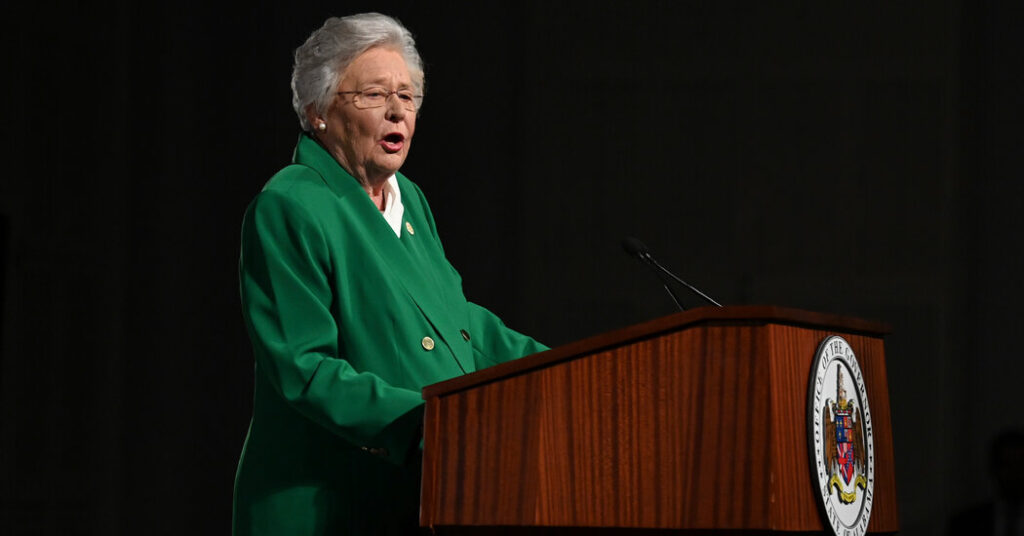
The governors, Bill Lee of Tennessee and Kay Ivey of Alabama, both Republican, moved to call special sessions next week, as the effect of this week’s Supreme Court decision began spreading beyond its immediate target, Louisiana. The court on Wednesday rejected Louisiana’s congressional map as an illegal racial gerrymander, prompting that state’s governor, the Republican Jeff Landry, to delay his state’s House primary as lawmakers considered a new congressional that would endanger at least one Democratic seat.
President Trump and other top Republicans have pressured leaders in Southern states to create more Republican House seats before the midterms, as they try to hold off political headwinds and retain control of the House. At least six majority-Black districts held by Democrats — two in Louisiana, one in Tennessee, two in Alabama and one in South Carolina — could be in play, though a clean sweep is unlikely.
On Friday, Mr. Lee made no mention of any specific district or conversation with the president, but said lawmakers have a “responsibility to review the map and ensure it remains fair, legal, and defensible.”
“We owe it to Tennesseans to ensure our congressional districts accurately reflect the will of Tennessee voters,” he said in a statement. The session is scheduled to begin on Tuesday, and Mr. Lee said any changes should be enacted as soon as possible.
Since the Supreme Court ruling, Republicans have clamored to split up Tennessee’s Ninth Congressional District, which encompasses the majority-Black city of Memphis and land between the state’s borders with Mississippi and Arkansas. With the state’s highest concentration of Black voters, the district is the only one in Tennessee history to send a Black lawmaker to the House.
“It is a political power grab, it’s voter suppression in real time and it’s an attack on Memphis Black voters and the foundation of our democracy,” said State Senator London Lamar, who was among the Democrats who assembled on Friday afternoon in front of the Lorraine Motel in Memphis, where the Rev. Dr. Martin Luther King Jr. was assassinated in 1968.
Representative Steve Cohen, a Democrat who has held the seat since 2007, called the ruling “abominable.”
Tennessee’s primary is not until early August, giving lawmakers plenty of time to muscle through a new map. Democrats, including Mr. Cohen and his primary opponent, State Representative Justin J. Pearson, have signaled that they will try to challenge any new map in court.
Some have questioned whether scattering Democratic voters from the Memphis area into more rural or conservative districts could undermine the safety of Republican seats in Western Tennessee. But top Republicans, including Senator Marsha Blackburn and Representative John Rose, both of whom are running for governor, have eagerly cheered a move to slice up Memphis.
“You’re going to hear me say this over and over again until we get this done,” Ms. Blackburn said in a video posted on social media Friday before the call. The state’s lieutenant governor, Randy McNally, declared: “Tennessee now has the opportunity to send another Republican voice to Washington. We intend to seize it.”
Unlike in Tennessee, Alabama can act only if the Supreme Court clears the way. The state is mired in longstanding court battles over its congressional map, and Ms. Ivey’s call for a special session would only affect the 2026 midterm elections if the Supreme Court acted quickly to offer the state legal relief. A federal court order currently bars the state from using new district lines until after the 2030 census.
Alabama’s attorney general, Steve Marshall, asked the Supreme Court on Thursday to let lawmakers revisit the map. Mr. Marshall filed motions in three redistricting cases pending before the court, asking the justices to lift lower court orders preventing that.
In her statement, Ms. Ivey said she wants legislators to be in position to move quickly. She suggested that if the Supreme Court allowed, the state would return to a congressional map previously approved in 2023 and a State Senate map approved in 2021.
In the filings, Mr. Marshall argued that the lower court rulings “cannot be reconciled” with Wednesday’s Supreme Court ruling, which set a high bar for drawing district lines for the benefit of racial or ethnic minorities. The court has yet to respond to the motions, but the special session of the Legislature is still scheduled to begin at 4 p.m. on Monday.
A federal court rejected the congressional map that Ms. Ivey now wants adopted because it failed to comply with orders to create a second majority-Black district or something “close to it.” Instead, an independent map drawn by a court-appointed official created a second majority-Black district that stretches from the state capital, Montgomery, to parts of the coastal city of Mobile.
That seat is held by Representative Shomari Figures, a Democrat. His election in 2024, combined with the re-election of Representative Terri Sewell, was the first time that Alabama had sent two Black representatives to Congress at the same time. Doug Jones, a former senator and civil rights lawyer now running for governor as a Democrat, called Wednesday’s ruling “an affront to all those who have fought so hard for voting rights.”
Ms. Ivey also said that she would call on lawmakers to set a special primary election for the House in districts affected by the court ruling. Alabama’s primary is currently scheduled for May 19.
“While there are no guarantees that Alabama’s now unlawful, court-mandated roadblock will be removed in time, we have a responsibility to give our state a fighting chance to send seven republican members to Congress,” Nathaniel Ledbetter, speaker of the Alabama House, and Garlan Gudger Jr., the head of the State Senate, said in a joint statement.
Eduardo Medina contributed reporting.
Emily Cochrane is a national reporter for The Times covering the American South, based in Nashville.
The post Southern States Move to Redistrict Under Weakened Voting Rights Act appeared first on New York Times.