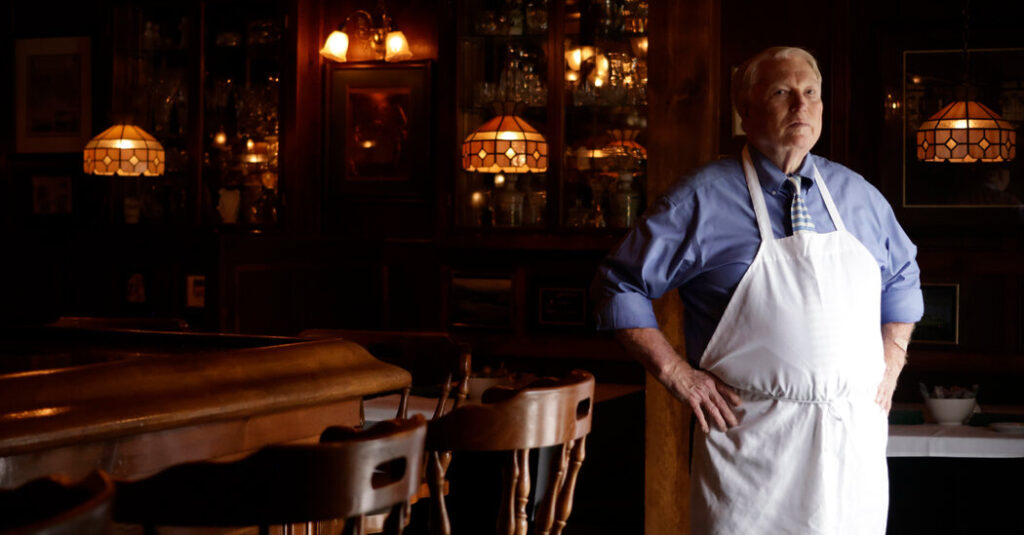
Pat’s Steakhouse is an institution that hums to life during the Kentucky Derby as a who’s who of horse racing come for dry-aged steaks and a kaleidoscope of jockey silks and winning circle photos adorning its walls.
Bill Mott, the winning trainer of the Derby last year, is a regular as is Shug McGaughey, who won it in 2013. They rub elbows with the locals and race trackers in from around the country.
Not this weekend, though, when the Derby happens for the 152nd time. Pat Francis, whose family has owned the steakhouse since 1958, is closing his doors on both Friday and Saturday to protest how Churchill Downs Inc., the racetrack’s owner, has transformed what had long been a community event into what he sees as a corporate cash grab.
The decision this year to move the post time of the Kentucky Oaks, a race run on Friday of Derby weekend, to a prime-time slot at 8:40 p.m. from its usual 6 p.m. start was the final straw amid a string of slights and problems, he said.
The late start, Mr. Francis said, will dissuade racegoers from traveling across town for dinner or a drink after the race, putting a crimp in what should be the biggest night of the year for restaurants in Louisville, Ky. Many racegoers typically arrive at the track in the early afternoon and stay for a number of races that occur before the Oaks, making an early dinner unfeasible.
“They are trying to cut us out of the equation,” Mr. Francis said. “It’s terrible for small businesses. The only thing I see is greed.”
The frustrations have been brewing in Louisville for years, as more residents complain about how Churchill Downs and NBC, which airs the race, have created a moneymaking spectacle at the expense of the local community.
The Oaks race on Friday is special to Louisville. The Oaks has been contested as long as the Derby, which first ran in 1875. But unlike the Derby and its audacious displays of wealth, the Oaks has been regarded as a race for locals — an opportunity for the people of Louisville to put on their own hats and pocket squares and watch the horses run.
It is fitting that the Oaks is run by 3-year-old fillies, who are not flashy or as well known as the Derby’s male colts. When they retire, the best of the fillies will mate with a stallion worth millions and do the hard work of carrying and nurturing a foal year after year.
NBC, which has agreed to air the Oaks in prime time for the next six years, declined to comment through a spokesman about the local pushback over the time change.
In a statement, Churchill Downs said it “takes its responsibilities seriously — both to the community and to the horse racing and breeding industries. In 2025, we contributed millions of dollars to more than 250 local nonprofit organizations and initiatives that strengthen neighborhoods, support local businesses and enhance quality of life across the region.”
The statement added, “While a later post time may require some businesses to adjust, we’re working closely with the Kentucky Restaurant Association to minimize impacts and create greater visibility and opportunities for Louisville’s outstanding restaurants during Derby Week.”
Some opinions of Churchill Downs have soured across the horse racing industry. The company has closed racetracks it owned in California, Illinois and Florida; successfully delayed more stringent safety and antidoping regulation; and recently refused to pay those regulators millions of dollars in fees that it owed for them to do their jobs.
Like the colts that compete in the Derby for a $5 million purse and, even better, the potential to earn tens of millions of dollars as a stallion, Churchill Downs Inc. is in the jackpot business, a publicly held casino and gaming company valued at more than $7 billion.
Greg Braun, a Louisville native and self-professed man about town, had heard complaints from servers, bartenders and restaurateurs about the expected loss of business.
This month, he took to Facebook under his nom de social media — Fred Plotski — to complain about Churchill.
“Churchill Downs has officially decided the Kentucky Oaks belongs to NBC, not Louisville,” he wrote in a post that went viral. He added: “Here at home, the people who actually make Derby week work get the shaft. Restaurants that depend on Oaks are closing early. Servers lose real money. Fund-raisers and long-planned local events get bulldozed without a second thought.”
It’s also not lost on Mr. Braun that the Louisville City Council recently extended a property tax exemption to Churchill Downs for 30 more years.
“At this point, Churchill Downs is not hosting an event for Louisville; they are renting our city as a backdrop and sending us the bill,” said Mr. Braun, who owns a cleaning service.
A spokesman for Mayor Craig Greenberg declined an interview request about how the time change affected the city.
Locals’ agitation with Churchill Downs has grown as ticket costs have soared over the years. Six seat boxes that once sold for $1,500 for the Oaks and double for the Derby now have to be bought as a package and can cost $14,000 or more. To merely get in and walk around without a seat is more than $1,400.
The Derby has also gotten later. In 2000, the start time for the Derby was 6:11 p.m. On Saturday, it will go off at 6:57 p.m.
NBC noted that last year’s Derby was the most watched since 1989. Last year, the Oaks was on one of NBC’s cable channels, USA Network, and drew 300,000 viewers. The media company said the Oaks’ new prime-time broadcast was expected to add one million additional viewers.
Anthony Lamas, the chef-owner of the award winning Seviche restaurant, said that he knew he would not be bringing in as much business as he normally did in previous years.
“We pay a lot of bills Derby week,” Mr. Lamas said. “I’ve gone from nervous and disappointed to hopeful that some people will choose not to stay that late for the Oaks. The Derby is what they bought their hat for.”
For Mr. Francis, he said plans to close his steakhouse this weekend were also born of a sense of realism. At best, he said, it takes 45 minutes to get out of Churchill Downs because streets are closed as the police try to dictate the flow of traffic. In recent years, Churchill Downs has included food and drink in its ticket price, creating another obstacle for local restaurants. It may end up costing him more money to keep his restaurant open this weekend if the crowds don’t materialize.
“It gets too late to eat and people want to go home after a long day,” he said. “We’ve enjoyed the Derby and made a lot of good friends, but Churchill isn’t the same place anymore.”
Joe Drape is a Times reporter writing about how the intersection of money, power and sports impacts our culture.
The post As Kentucky Derby Becomes a Bigger Business, Locals Feel Left Behind appeared first on New York Times.