One of this year’s biggest fights over the future of regulation of the artificial-intelligence industry is about to get even more expensive and contentious.
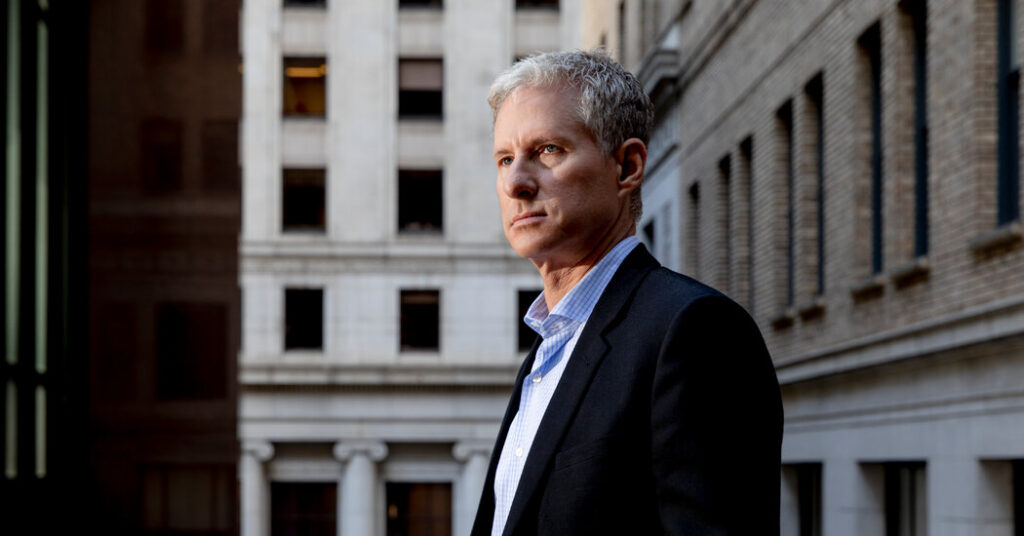
Chris Larsen, a tech billionaire from California, said he planned to spend $3.5 million in the coming weeks to help a New York congressional candidate who is facing a barrage of attack ads from a super PAC linked to OpenAI.
Mr. Larsen is planning to support Alex Bores, a state assemblyman who co-wrote A.I. regulation legislation adopted in New York. Mr. Bores has been targeted by an industry-aligned super PAC that is trying to make an example of him.
The billionaire’s seven-figure infusion into the Manhattan race will ratchet up what is quickly becoming one of the country’s most expensive Democratic primary contests for the House. The primary has also become a major proxy battle for competing factions in the race to develop, profit from and steer regulation of A.I.
Mr. Larsen, an investor in and executive at the crypto-related firm Ripple Labs, called the attacks on Mr. Bores by a super PAC aligned with OpenAI “really despicable.” OpenAI has called for limited federal regulations to allow the “freedom to innovate” and has generally opposed state regulations like those written by Mr. Bores.
“They are trying to destroy and intimidate and send a clear message that if you do come up with clear guardrails, we are going to crush you,” Mr. Larsen said in an interview. He said he hoped his spending would provide a counterweight: “While some of these folks are going to try to crush you, others are going to step up, and we’re going to support you.”
Mr. Larsen said he saw A.I. regulation as one of the nation’s most pressing issues. And the first television advertisement that he is funding tackles the topic directly.
The ad features a child watching an iPad-like screen and warns about what he could be looking at with the assistance of A.I. “Violence, child sexual abuse and predators,” the narrator says. “Who would be against A.I. safety laws? OpenAI.”
The ad then calls out the company for its attacks on Mr. Bores. Mr. Larsen’s super PAC, called You Can Push Back, has been reserving cable and broadcast time in recent days.
Mr. Larsen’s involvement in a race in Manhattan, thousands of miles from his San Francisco Bay Area home, is the latest twist for a House primary contest that is already one of the most crowded, complicated and costly in the nation.
It features an unusually star-studded field including Jack Schlossberg, John F. Kennedy’s 33-year-old grandson; George T. Conway III, a former Republican turned leading antagonist of President Trump; and Micah Lasher, a longtime Democratic operative who serves alongside Mr. Bores in the Assembly.
Mr. Larsen is joining two other super PACs defending Mr. Bores. Both have ties to OpenAI’s main rival, Anthropic, which generally favors stronger federal regulation of the industry. Those groups have spent more than $1.5 million on the race so far.
“I think the Alex Bores race is the most important Democratic primary in the country,” said Brad Carson, a former Democratic congressman who is now helping lead Public First, an Anthropic-aligned group that has funded some of the pro-Bores ads. “We’re really grateful for Chris’s help in this campaign.”
In February, Anthropic announced that it was giving $20 million to Public First’s nonprofit arm.
Mr. Bores and his rivals are competing to succeed Representative Jerrold Nadler, who is retiring from his affluent, well-educated and decidedly liberal district in Manhattan. Running north from 14th Street to around the top of Central Park, it is home to more Fortune 500 companies, major arts institutions and media empires than any other district in the country.
There has been no public polling on the race so far, though a smattering of privately funded polls released by candidates and interest groups suggest that the contest remains wide open.
Mr. Larsen is not the first billionaire businessman seeking to sway its outcome. Michael R. Bloomberg, the city’s former mayor, has spent $5 million so far to help Mr. Lasher, one of his former aides.
But Mr. Larsen’s involvement underscores how the race is being transformed by forces far outside the district, as rival artificial intelligence interests try to alter the future of a multi-trillion-dollar industry and those would seek to regulate it.
“Frankly, I can’t think of a more important topic right now,” said Mr. Larsen, who added that the Bores campaign was the first he was backing in the A.I. fight but that it would not be the last. As an example, he pointed to an open seat in San Francisco where the architect of another A.I. regulation bill, State Senator Scott Wiener, a Democrat, is running for Congress.
Mr. Larsen said that he had reached out to Mr. Bores after he heard what was happening in the race and “came away very impressed.” He added that he opted to fund his own effort — rather than contribute to other super PACs — because that way he “could have a message that was very clearly about OpenAI.”
Mr. Larsen is no stranger to politics. His crypto company, Ripple, is a major contributor to the crypto industry’s leading super PAC, Fairshake, giving $93 million since 2023. He argued that the “big difference” between that spending and the industry money he opposed from OpenAI was that the crypto industry “wanted regulation.”
The A.I. regulation fight involves both deep policy consequences and personal disagreements between powerful industry figures. Anthropic’s chief executive, Dario Amodei, was once colleagues with OpenAI’s leader, Sam Altman, but now they have publicly and sharply disagreed on how the industry should be regulated.
In political races this year, a handful of super PACs associated with OpenAI and other industry players generally opposed to greater federal regulation have pledged to spend tens of millions of dollars. So far, the top super PAC, Leading the Future, has been chiefly funded by Andreessen Horowitz, a prominent A.I. investing firm, and by Greg Brockman, a co-founder of OpenAI, and his wife.
That faction has pledged to start by opposing Mr. Bores, a second-term state lawmaker and former tech industry worker who helped steer an A.I. regulatory framework into law in New York last year. The state law requires large firms developing A.I. models to formulate and publicize safety plans for advanced products. He has pledged to do something similar at the federal level.
Two of the PACS, Leading the Future and Think Big, have already spent more than $2 million attacking Mr. Bores, and they say more is on the way.
Among other things, their ads accuse him of helping build technology for Immigration and Customs Enforcement when he was an employee at Palantir Technologies. Mr. Bores worked for the company, but has said he had no role in its work with ICE.
Shane Goldmacher is a Times national political correspondent.
The post A Midterm Clash of A.I. Giants Escalates as a Tech Billionaire Jumps In appeared first on New York Times.