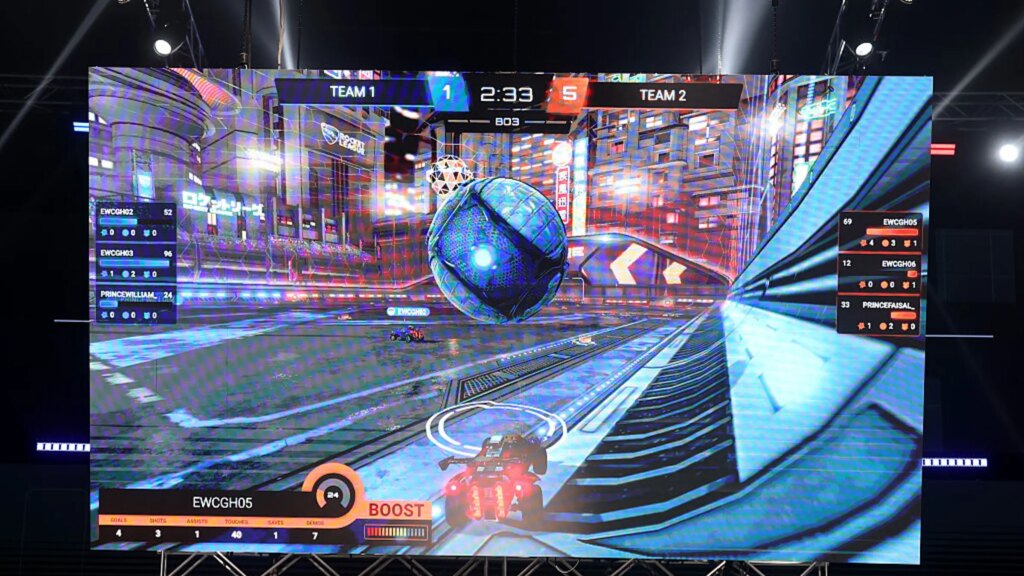
On July 6, some 2,000 of the world’s top gamers will descend on the Saudi capital Riyadh for the third annual Esports World Cup, where they will lock horns at 24 different video games—including TEKKEN, Call of Duty, and League of Legends—in pursuit of $75 million in prize money.
At least, that is still the hope of tournament organizer Ralf Reichert, who’s determined to forge ahead with the event despite the turmoil wrought by the Iran war, which has already forced a slew of high-profile postponements and cancellations across the Kingdom. “It’s definitely made our lives harder,” Reichert, CEO of the Esports World Cup Foundation, tells TIME. “People obviously are more hesitant to book their travel. Though we’ve seen ticket sales pick up since the ceasefire.”
It’s no secret that the Iran war has dented Saudi Arabia’s sporting juggernaut, which under Crown Prince Mohammed bin Salman has plowed upwards of $1 trillion on sports and sports-related projects. In recent years, the Kingdom has hosted chess, handball, horse racing, golf, motor racing, boxing, MMA, cricket, WWE, and the world’s first electric raceboat championship, dubbed E1.
But following American and Israeli attacks on Iran, and Tehran’s retaliation against U.S.-aligned states across the Gulf, Saudi Arabia has canceled sporting events from the Jeddah Formula 1 to Fanatics Flag Football Classic, while a pall of uncertainty hangs over many more. For Saudi sports fans, it appears the war couldn’t have come at a worse time, coinciding as it has with the Kingdom withdrawing from hosting several marquee events due to cost.
In line with new guidelines set out in the state Public Investment Fund (PIF) report published April 16, which sets out a transition “from a period of rapid growth and acceleration to a new phase of sustained value creation,” events including snooker’s Saudi Arabia Masters, the Women’s Tennis Association finals, and 2035 Rugby World Cup have been nixed. The Saudi-funded LIV golf tour, meanwhile, remains on life support.
Against this backdrop, squeezed between a regional war and strategic drawdown, you could forgive Reichert for feeling glum about prospects for the Esports World Cup. Yet experts say his brio is not mere wishcasting with Saudi Arabia simply recalibrating after a glut of very heavy spending.
Moreover, vulnerabilities underscored by the Iran war have underlined the 35 million-strong nation’s exposure to external shocks given 40% of GDP is tied to hydrocarbons.
“It’s emphasized that they need to continue spending on the likes of sport to help diversify their economy away from dependence on oil and gas revenues,” says Simon Chadwick, professor of AfroEurasian Sport at Emlyon Business School.
Indeed, Saudi Arabia is not backing away from sport wholesale but refining its bets around mega-events, youth appeal, and image management at home and abroad. Chief amongst this recalibration is a jettisoning of sports seen as staid or cost sinks and a doubling down on those with broader mass appeal, especially with young people. So while golf, tennis, and snooker are backburnered, expect robust support for soccer, MMA, and especially esports.
“I view it as more of a cold calculation than a flailing move away from sports,” says Jules Boykoff, a professor at Pacific University in Oregon who studies the politics of sport. “And esports is the next frontier of big money.”
For while Saudi Arabia’s sudden embrace of seemingly every athletic pursuit has been snidely branded “sportswashing” by the West, that framing is reductive. There are, of course, PR elements to an Arab Islamic state hosting sport’s biggest events and bankrolling its top stars—helping, as it does, to distract from blood-soaked proxy wars and egregious human-rights abuses, including the gruesome murder of journalist Jamal Khashoggi. The impending 2034 soccer World Cup—the planet’s most-viewed sporting event—is the apogee of that propaganda blitz.
However, a lot of messaging is directed inwards in order to persuade a youthful populace—around two-thirds of Saudis are under 35—that the nation is modernizing to cater to their aspirations. “It’s really important to look at domestic audiences as well,” says Boykoff. “Young people are playing the sports, or are at least interested in the sports, that Saudi Arabia is continuing to fund.”
Indeed, along with a perturbing reliance on fossil fuels, around 18–20% of Saudi youth are unemployed, meaning developing productive avenues for them is a policy priority as set out in Saudi Arabia’s Vision 2030. Sport offers opportunities to develop adjacent media, hospitality, advertising industries that are vital both economically and socially.
In a prominent 2017 address in Riyadh, bin Salman spoke about Saudi Arabia’s lost years to radicalization and pledged a return to “moderate” Islam. “We will not spend 30 years of our lives dealing with extremist ideologies,” he vowed. “We will destroy them today and immediately.” An abundance of bored and unproductive youth are a clear challenge to this mission given the state’s theological underpinnings.
As such, the Esports World Cup serves several purposes as a global tentpole event for a borderless industry, which Saudi Arabia is backing as aligning with youth culture, economic development, and the forward-looking entertainment. “It’s the sport of the future,” says Reichert. “It’s just here to grow, there’s no doubt about that, so there’s almost no risk attached.”
Moreover, esports remains the clearest example of Saudi Arabia trying to build a full ecosystem spanning events, coding, manufacturing, and consumption. While soccer remains Saudi’s most popular mainstream sport, by participation esports leads the way, with some 23.5 million gamers in the Kingdom, or 67% of the national population. Esports is also comparatively inclusive; over a quarter of Saudi gamers are women.
While video game addiction is a growing problem around the globe, even prompting China to limit gaming time for under-18s to just three hours per week, there are distinct benefits to inculcating a tech-savvy population amid a drive to diversify into next generation industries.
To that end, in September a PIF-backed consortium agreed to buy the Electronics Arts (EA) videogame firm for $55 billion, reputedly the largest leveraged buyout in history. In addition, Chinese electronic maker Lenovo is establishing the Middle East’s largest tech manufacturing hub in Riyadh to produce “Saudi-made” laptops, servers, and smart devices by 2026. (Both EA and Lenovo have been key partners of the Esports World Cup.)
“You’ve got events, software, and now you’ve got the hardware,” says Chadwick. “So that’s an ecosystem.”
One dedicated to an industry that’s only set to grow. Some 3 million people attended last year’s Esports World Cup—just 400,000 fewer than the 2022 soccer World Cup in Qatar—while online viewership topped 750 million. As well as July’s World Cup based around clubs, the Esports Nations Cup—where countries compete against each other—launches in Riyadh in November, spotlighting how esports, along with mainstream sports like soccer and MMA, will remain a core priority long into the future. Adds Reichert: “The opportunity and the ambition is to speak to all 3.4 billion gamers around the world.”
The post Why Saudi Arabia Is Betting Big on Esports appeared first on TIME.