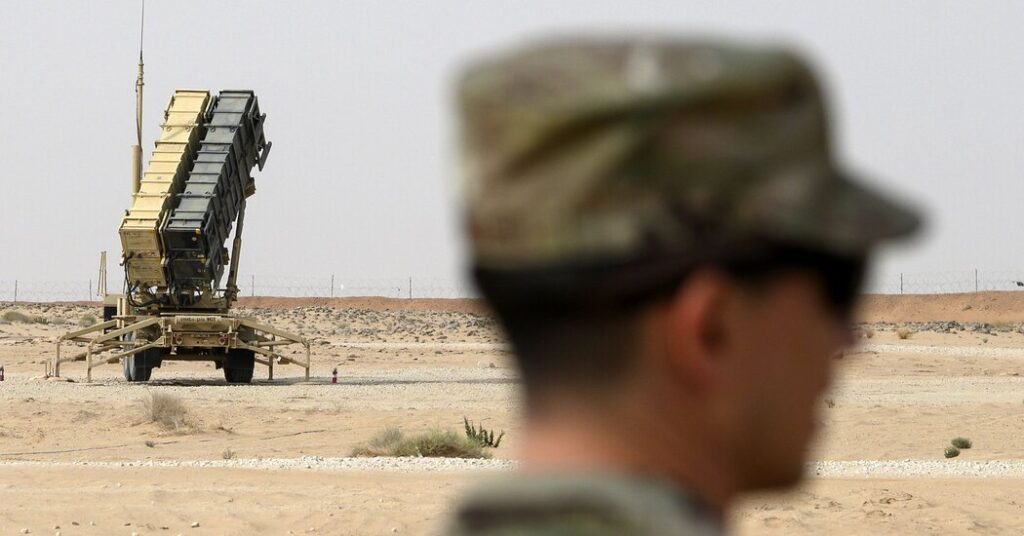
For months, President Trump and Defense Secretary Pete Hegseth have celebrated tentative agreements with defense companies to expand production of Patriot air defense systems, Tomahawk cruise missiles and other weapons believed crucial for a war with China, Russia or North Korea.
“Exquisite Class Weaponry,” the president said on Truth Social on March 6 after meeting with executives from seven major defense companies.
Lockheed Martin, for instance, would increase production of its PAC-3 Patriot missile interceptors to 2,000 a year, from 600. It would quadruple production of its Terminal High Altitude Area Defense, or THAAD, interceptors to 400 from 96.
Trouble is, the administration does not yet have the funding or congressional support for the weapons it needs for the possible future wars. And the Pentagon is diverting munitions deliveries intended for allies for its own use as a stopgap measure until large new arms orders begin.
While the U.S. defense industry has announced those ambitious plans to make more critical munitions and interceptors, much of the expanded production will not kick in for several years.
In appearances before the House and Senate Armed Services Committees on Wednesday and Thursday, Mr. Hegseth urged lawmakers to approve the funding so that the Pentagon could buy the weapons from the companies that are supposed to increase production capacity. It is part of the Defense Department’s $1.45 trillion budget request, which does not include the additional money the department is expected to seek for the cost of the Iran war.
The Pentagon’s acting comptroller this week put the cost of the Iran war so far at $25 billion, though war funding experts say that the final amount will almost certainly be far higher.
The war has significantly drained much of the U.S. military’s global supply of munitions, as the Pentagon rushes bombs, missiles and other hardware to the Middle East from commands in Asia and Europe, leaving them less ready to confront potential adversaries. And it has forced the United States to hunt for ways to increase production, Trump administration and congressional officials say.
“If we’re running low after a few weeks of fighting Iran, we’re nowhere near where we need to be for Russia and China,” said Todd Harrison, a defense budget expert at the American Enterprise Institute. “We’ve never built up our stockpile of munitions to what they need to be for war plans, especially if you’re thinking about being able to fight a major war.”
Defense officials said that munitions stockpiles were already low because of the war in Ukraine and Operation Midnight Hammer, the U.S. bombing of Iranian nuclear sites last year.
The Pentagon received $825 billion from Congress last year, plus $150 billion in supplemental funding. But there is no solid prediction for what Congress will do this year with the Trump administration’s requested $1.45 trillion for defense.
At the moment, the Pentagon is putting American needs first. Last Monday, Mr. Hegseth told his Estonian counterpart that he was suspending delivery of six units of High Mobility Artillery Rocket Systems, or HIMARs, that Estonia, a small but frontline nation in NATO’s standoff with Russia, had contracted to purchase from the United States. Estonian officials said the delay, which would probably extend at least several months, was caused by the war in Iran.
U.S. officials have told several other European and Asian countries essentially the same, according to an American official and a European official. Reuters earlier reported the message.
The rapid depletion of weapons “does create risk in future conflict scenarios,” said Jerry McGinn, a defense industry expert at the Center for Strategic and International Studies. “We’ve done a lot of war games on the Taiwan Strait, and in all of those games, we run out of key munitions in a couple of weeks.”
Given the Pentagon’s munitions shortfall, a big question this week was how Mr. Hegseth would interact with congressional lawmakers charged with scrutinizing his funding request. Would he strike a conciliatory tone in an effort to try to help the Pentagon get the additional money? Or would he be combative?
His opening remarks quickly answered that question.
The $1.5 trillion budget would ensure that the United States “continues to maintain the world’s most powerful and capable military as we grapple with a complex threat environment,” Mr. Hegseth said.
But he went on to say that his critics in Congress were a bigger problem for the United States in the Iran war than Iran itself.
“The biggest challenge, the biggest adversary we face at this point are the reckless, feckless and defeatist words of congressional Democrats and some Republicans,” Mr. Hegseth told the House Armed Services Committee on Wednesday.
And that was just the beginning.
Through nearly six hours of the contentious hearing, the defense secretary became so belligerent that Representative Mike D. Rogers, the Alabama Republican who leads the committee, gently admonished him to show more respect. “Once I recognize a member, they have control of that five minutes,” he told Mr. Hegseth. “The witness has to recognize it’s their time.”
The contentiousness of the hearing did not bode well for the Pentagon request for more money for munitions, congressional staffers and some defense officials acknowledged on Wednesday.
Representative Austin Scott, Republican of Georgia, appeared to sum up the situation the Pentagon was in with Mr. Hegseth on Wednesday. Midway through the hearing, after Mr. Hegseth had castigated a number of lawmakers, Mr. Scott advised caution.
“It takes 218 votes to get something across the floor of the House of Representatives,” he said. “We’re going to lose some Republican votes, and we’re going to have to have some Dem votes to do the things that we have to do to fund the Department of Defense.”
“And I just would encourage everybody to keep that in mind,” he added.
On Thursday, before the Senate Armed Services Committee, Mr. Hegseth doubled down. “I’ll say it again today: The biggest adversary we face at this point are the reckless naysayers and defeatist words of congressional Democrats and some Republicans,” he said.
Defense contractors have been watching warily. In an earnings call last week, Lockheed Martin officials indicated that the defense contractor would wait until the Pentagon secured funding before moving forward to expand production, according to several people who were on the call.
Helene Cooper is a Pentagon correspondent for The Times. She was previously an editor, diplomatic correspondent and White House correspondent.
The post Trump’s Plans to Boost Weapons Production Might Not Deliver for Years appeared first on New York Times.