Iran’s supreme leader issued a rare statement on Thursday saying that the United States had no place in the future of the Persian Gulf region and making clear that his country planned to manage the strategic Strait of Hormuz waterway going forward.
In the defiant message, Ayatollah Mojtaba Khamenei also vowed that Iran would retain its nuclear capabilities. The lengthy statement from the Iranian leader, who has not been seen in public since he was named to the top post nearly two months ago, was shared by his office.
It touched on two of the thorniest issues stalling talks on permanently ending the U.S.-Israeli war with Iran, which began in late February and paused when a cease-fire was reached this month. Those positions put Iran at odds with the United States, which has sought to curtail Iran’s nuclear ambitions and insisted that it cannot restrict use of the Strait of Hormuz to vessels of its choosing.
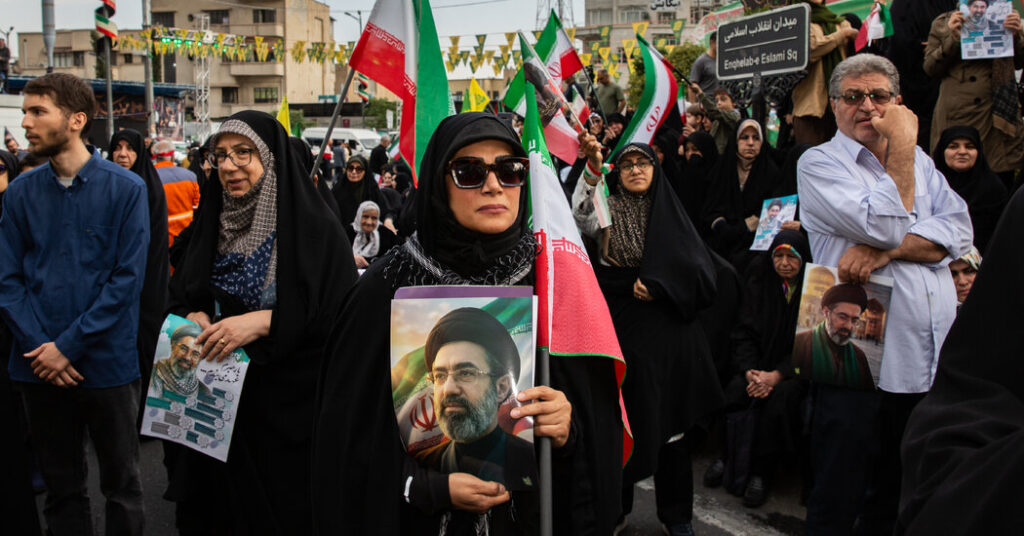
“By the will and power of God, the bright future of the Persian Gulf region will be a future without America,” said the statement, which was released on Iran’s National Day of the Persian Gulf, an annual commemoration of a 1622 military victory over Portugal in the Strait of Hormuz.
Of the battle over the narrow waterway, one of the most important shipping routes for global oil supplies, the statement said: “Foreigners who come from thousands of kilometers away, acting maliciously out of greed, have no place there, except at the bottom of its waters.”
It went on to say that Iran would implement “new legal frameworks and management of the Strait of Hormuz,” suggesting that the country had no plans to relinquish control over the shipping route. Such a system, it added, would benefit its neighbors and prove economically fruitful.
Iran floated plans in a proposal over the weekend, since dismissed by the Trump administration, to reopen the strait but impose a hefty toll on passing tankers. Arab countries in the Persian Gulf, including Oman, which borders the southern part of the strait, have also objected to the idea.
Negotiations to end the war appear to be at an impasse. President Trump told his advisers this week that he was dissatisfied with Iran’s latest proposal, which would have reopened the strait while setting aside questions about Iran’s nuclear program.
The two sides are implementing dual blockades around the Strait of Hormuz, which is normally used to transport as much as one-fifth of the world’s oil supply. Energy prices have spiked as a result.
The war has devastated Iran’s economy, with the Iranian rial currency sinking to new lows against the dollar this week.
Mr. Khamenei’s statement included Iran’s nuclear and missile capabilities on a list of “national assets” for Iranians to safeguard “just as they would their land, sea, and air borders.”
Mr. Khamenei filled the statement with references to National Day of the Persian Gulf, which has taken on added political significance for Iran’s authoritarian clerical rulers. In posts on social media, he and other leaders used the date to link Iran’s current effort to control the waterway with a long list of historic battles against European colonial powers over the strait.
Mr. Khamenei was selected as supreme leader after Ayatollah Ali Khamenei, his father and predecessor, was killed in the opening salvos of the U.S.-Israeli attack on Iran in late February. Since then, he has rarely been heard from and has never been spotted in public.
The New York Times has reported that Mr. Khamenei was gravely injured in the same airstrikes that killed members of his family. He does not wield the same level of authority that his father did, with a collective of powerful Islamic Revolutionary Guards Corps commanders making key decisions on matters of security, war and diplomacy, The Times reported.
Sanam Mahoozi and Leily Nikounazar contributed reporting.
The post Supreme Leader Says Iran Is Planning for Ongoing Control of Strait appeared first on New York Times.