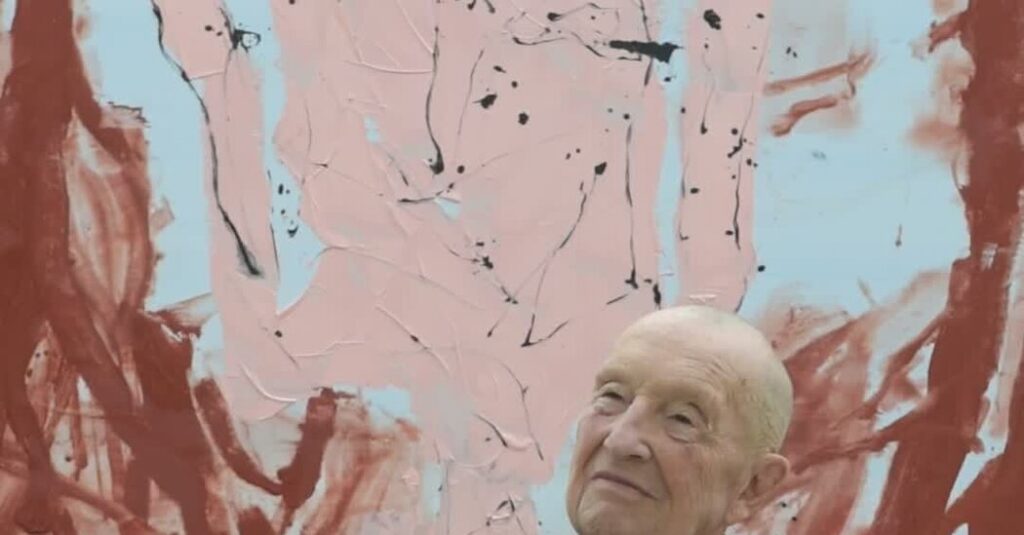
Georg Baselitz, a German painter in the vanguard of the Neo-Expressionist movement that took the art world by storm in the 1980s, has died at 88.
Thaddaeus Ropac, one of the galleries that represented him, announced the death in a news release, but provided no other details.
Mr. Baselitz, along with German contemporaries like A.R. Penck and Anselm Kiefer, mounted a frontal attack on Minimalism and Conceptualism, the dominant “cool” styles of the 1970s. In contrast to the refined intellectualism and impersonal aesthetic of artists like Sol LeWitt and Donald Judd, he offered an art that reveled in raw emotion, extroverted brushwork and a fierce engagement with the complexities of 20th-century German history.
Well-known in his native country since the 1960s, Mr. Baselitz catapulted to fame in the early 1980s as curators and dealers began promoting the work of like-minded painters in several countries, notably Julian Schnabel in the United States and the Italians Sandro Chia, Francesco Clemente and Enzo Cucchi, fostering a powerful international movement.
Mr. Baselitz’s “Hero” series of 1965 and 1966 — blocky figures in thick impasto stumbling through tormented landscapes — plunged the viewer into a nightmare vision of postwar Germany. No less disturbing were the woodsmen, hunters and cows of the “Fracture” series, disassembled into horizontal strips and merged with the landscape.
In a break with convention, Mr. Baselitz began turning the central images in his canvases upside down in the late 1960s, forcing the viewer to engage first and foremost with the formal aspects of the work. In his later paintings, which verged on abstraction, it became a challenge to disentangle the images from a tangle of calligraphic lines and bright splotches.
“The hierarchy where the sky is at the top and the ground down below is in any case only an agreement, one we have all got used to, but one that we absolutely do not have to believe in,” Mr. Baselitz told the critic and historian Walter Grasskamp in 1984.
This signature, first seen in “The Man at the Tree” (1968) and the upside-down pine trees in “The Wood on Its Head” (1969), defined his work for years, as he came to be recognized as one of Germany’s pre-eminent artists. He was “one of the great artists to have breathed visceral, mythic, tragically aware new life into German culture since the 1960s,” the critic Jonathan Jones wrote in The Guardian in 2016.
Hans-Georg Bruno Kern was born on Jan. 23, 1938, in the village of Deutschbaselitz, about 35 miles northeast of Dresden. His father, Johannes Kern, was a schoolteacher who, as required, joined the Nazi Party. When the East German government barred him from teaching for several years after the war because of his party membership, his wife, Lieselotte (Block) Kern, became a teacher to support the family.
Hans-Georg, who began using the name Georg Baselitz in art school, performed poorly as a student in nearby Kamenz, where the family moved in 1950, and failed to gain admission to the art academy in Dresden. Instead, in 1956 he enrolled at the College of Fine and Applied Arts in East Berlin (now the Berlin Weissensee School of Art). After two semesters he was expelled — “like a sick cell,” he later said — for “sociopolitical immaturity” and moved to West Berlin, where he studied at the College of Art.
A traveling show of American Abstract Expressionists in 1958 kindled an admiration of Jackson Pollock, Willem de Kooning and Philip Guston, but also reinforced his determination to create a purely German art. Already deeply interested, like the Expressionists, in folk art, children’s art and outsider art, he resisted the internationalist impulses of his teachers.
“I am brutal, naïve and Gothic,” he told Artforum in 1995. “I was born into a destroyed order, a destroyed landscape, a destroyed people, a destroyed society. And I didn’t want to reestablish an order: I’d seen enough so-called order. I was forced to question everything, to be ‘naïve,’ to start again.”
He wanted, he told The Guardian in 2014, “to examine what it was to be a German now.”
In 1962, the year he graduated from art school, he married Johanna Elke Kretzschmar, who survives him. His survivors also include their two sons, Daniel Blau, who owns an art gallery in Munich, and Anton Kern, the owner of the Anton Kern Gallery in Manhattan.
Mr. Baselitz’s first solo show, at the Werner & Katz Gallery in 1963, created a scandal. The police seized two paintings featuring men with enormous penises, “The Naked Man” and “The Big Night Down the Drain,” and the government prosecuted him, unsuccessfully, for offending public morality.
The “Heroes” and “Fracture” series, though, brought him acclaim in Europe. The Kunstmuseum in Basel, Switzerland, mounted an exhibition of his prints and drawings in 1970, and he was included in the influential Documenta show in Kassel, Germany, in 1972.
Mr. Baselitz caused an uproar at the 1980 Venice Biennale, at which he shared the German pavilion with Mr. Kiefer and contributed his first major work of sculpture: a recumbent man, carved roughly from several pieces of wood, with one arm raised upward in what some critics took to be a Nazi salute. (In the late 1960s, Mr. Kiefer had also made art that referenced the salute.)
Mr. Baselitz, stunned by the blowback, said that the gesture derived from African art, in which an upraised palm signaled surrender in battle. Blending African and German Gothic elements, he used chain saw, chisel and ax to carve dozens of wooden sculptures in the years to come, among them “Tragic Head” (1988) and the fabric-covered “Armalamor” (1994).
Mr. Baselitz and his fellow Germans attracted worldwide attention in 1981 when the Royal Academy of Arts in London turned the spotlight their way in the groundbreaking exhibition “A New Spirit in Painting.” A solo show of Mr. Baselitz’s work at the Xavier Fourcade Gallery in New York quickly followed.
“The images have the kind of dogged immediacy that just won’t let us get away,” John Russell wrote in his review of the solo show in The New York Times. “The use of paint is everywhere rich, thick, juicy and strong. We can almost feel in our bones the weight of the brush as it is pulled across the canvas.”
The work, he added, seemed as though “dredged up from the German past, and the man with the shovel doesn’t mind getting up a good sweat.”
In the early 1990s, Mr. Baselitz’s work became more abstract, emphasizing color, line and brushstroke in paintings like “Red Arm” (1991) and “Was Once” (1992). In 2005, he embarked on a series called “Remix,” revisiting his earlier paintings and revising them in quickly executed, lighter paintings and watercolors.
He was the subject of a large-scale retrospective at the Guggenheim Museum in New York in 1995 and the Royal Academy of Arts in 2007. In 2018, a retrospective at the Galerie Beyeler in Basel traveled to the Hirshhorn Museum and Sculpture Garden in Washington.
Mr. Baselitz also ventured into theater. The sets for a Munich production of Wagner’s “Parsifal” in 2018 were based on his drawings, and he designed the puppets for a marionette show in Salzburg, Austria, last summer.
“Whenever I start a painting, I set out to formulate things as if I were the first one, the only one, and as if all the precedents didn’t exist,” he told the art critics and historians Jean-Louis Froment and Jean-Marc Poinsot in 1983. “One always has to think of making something, something valid. That’s my life.”
The post George Baselitz, German Neo-Expressionist Painter, Dies at 88 appeared first on New York Times.