The Voting Rights Act of 1965, one of the most momentous pieces of civil rights legislation in the United States, was passed almost 100 years after the 15th Amendment prohibited racial discrimination in voting in the wake of the Civil War.
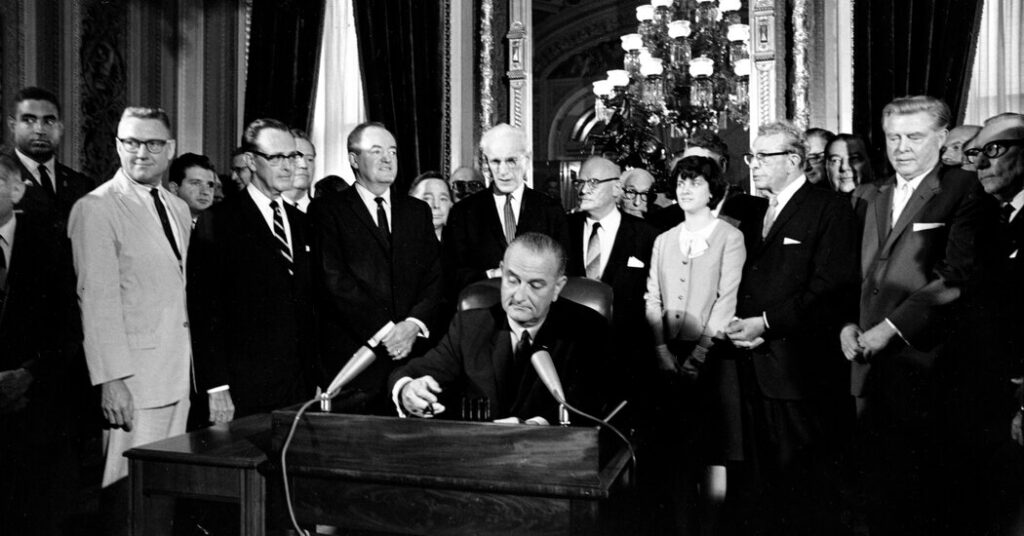
The bill, championed by Black activists and signed by Lyndon B. Johnson, a white president from a segregated state, culminated decades of activism by those who fought for voting rights in a country scarred by slavery.
Here’s what to know about it.
What is the Voting Rights Act?
Even after the 15th Amendment was ratified in 1870, Black people in the South during the Jim Crow era faced intimidation that prevented them from voting, including poll taxes, literacy tests and crusades of violence.
The Voting Rights Act, signed by Johnson during the height of the civil rights movement, was meant to enforce the rights that were protected by the Constitution.
Provisions of the law helped thousands of voters get to the polls, and for the first time since Reconstruction gave Black citizens in the South a significant voice in their government.
What does it do?
At the time the law was passed, only one-third of eligible Black voters were registered in the states where voting was the most difficult, compared with two-thirds of white people, according to the Justice Department.
One section of the act required several Southern states with histories of discrimination to obtain federal permission before changing voter laws. Those states included Alabama, Georgia, Louisiana, Mississippi, South Carolina, and Virginia and many counties of North Carolina.
The measure also prevents voter discrimination based on the language they speak, and provides protections for blind, disabled and illiterate voters. The Justice Department has called the law the “most successful piece of civil rights legislation ever adopted by the United States Congress.”
What challenges has it faced?
Congress has extended the Voting Rights Act several times, but there have been many legal challenges as well.
In 2013, the Supreme Court dealt a sharp blow to the law with its ruling in Shelby County v. Holder, a case filed by an Alabama county near Birmingham. The court ruled 5 to 4 that states could change election laws without federal approval, which contributed to a wave of voting restrictions from Republican-led states.
On Wednesday, the Supreme Court ruled 6 to 3 to strike down a voting map in Louisiana, finding that lawmakers had illegally used race when drawing it, further weakening the act.
Sonia A. Rao reports on disability issues as a member of the 2025-26 Times Fellowship class, a program for early-career journalists.
The post What to Know About the Voting Rights Act appeared first on New York Times.