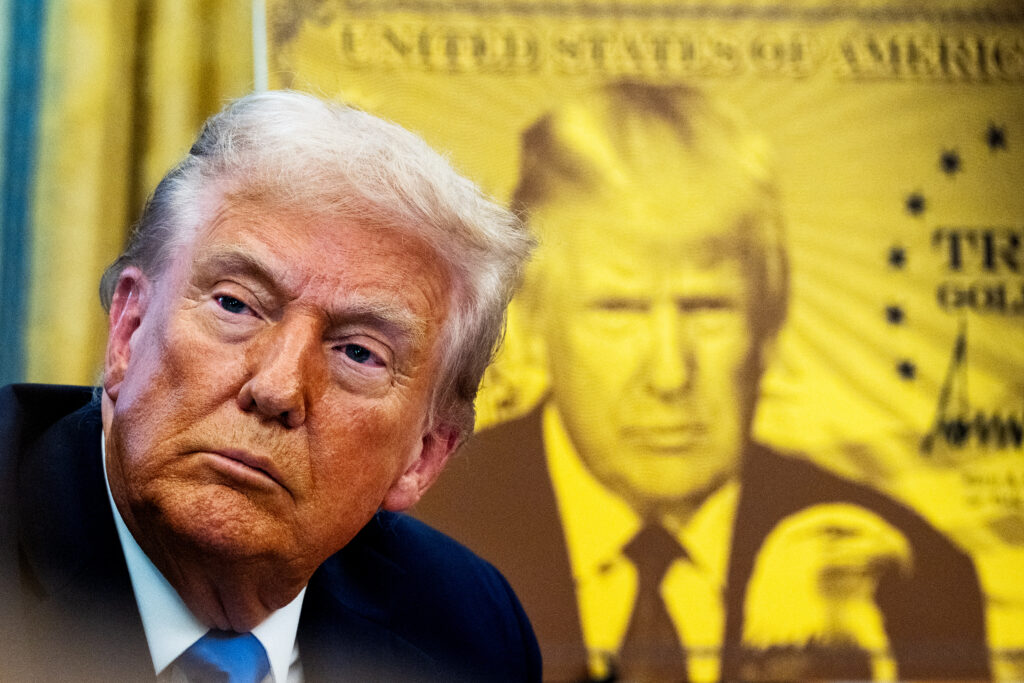
In the months since President Donald Trump launched a special “gold card” visa that would grant citizenship to people willing to pay $1 million, his administration has touted the program as a success. The president has called it a “green card on steroids,” and Commerce Secretary Howard Lutnick claimed the program has brought in $1.3 billion in revenue.
But in a new legal filing, the White House admitted that only a small pool of people have even started the process, let alone paid the government. In the court document, the administration said it has received 338 requests for the gold card visa and, of those people, 165 have actually paid the nonrefundable $15,000 filing fee to move forward. Just 59 people have moved on to the subsequent step of filling out paperwork from the Department of Homeland Security.
When he announced the program in December, Trump touted it as a way for wealthy people to gain entry into the United States, for American companies to recruit top talent and for the country to reduce its debt.
“Quite a beautiful thing,” Trump said, holding up a gilded card featuring his face. “Just in a few days, you’ve taken in over a billion and a half dollars. That gold card all goes toward reducing debt. Goes into the treasury.”
In the filing, the government’s attorneys said the wealthy individuals and companies will not get to skip the line, as the hefty payments do not guarantee speedier processing or take away slots from others applying for the same visa category without paying large sums.
The administration was sued by university professors and others who argued that the gold card visa program illegally upended the EB-1 and EB-2 visa programs, which were designed to recruit extraordinarily talented immigrants. But the government’s attorneys said in the filing Tuesday that those immigrants could still get visas without having to pay the same lofty cost.
Lutnick has publicly offered a slew of alternative numbers to refer to the program’s interest: In February last year, he said 250,000 people were in line for a visa, suggesting the government might sell cards to 200,000. Last week, Lutnick acknowledged that just one person had been approved and paid the $1 million fee, but he said “hundreds” were in the queue and being processed. At the same time, a White House spokesman told The Washington Post “thousands” had paid the nonrefundable $15,000 fee — though the court filing said the number was actually far lower.
“The workload from the Gold Card program is quite small,” DHS official Cara Selby wrote in a document supplementing the filing. Six adjudicators are tasked with processing the requests, Selby said. DHS declined to answer questions about the process and the person who received the visa and referred The Post to the Commerce Department, which didn’t respond to requests for comment.
The website for the gold card, TrumpCard.gov, promises that it’s a speedy method for residency, estimating the process should take “weeks” once the fee and application have been received.
But the government said in its filing Tuesday that it is not any faster than the normal speed of existing EB-1 and EB-2 visa applications. And it said there would be a surplus number of slots for visas that could go toward gold card applicants.
“Aliens who must wait for visa availability will continue to have their immigrant visa applications processed according to their priority date and the current final action date, regardless of whether they are a Gold Card applicant,” the filing stated.
Leon Fresco, an immigration attorney and partner at Holland & Knight, reviewed the government’s filing and said the administration could have a strong argument to dismiss the lawsuit against it if it can convince the court that it will only give the gold cards out at the end of the year if the green card categories aren’t oversubscribed.
“But by doing this,” he said, “the speed element of the gold card is undermined.”
The post Trump’s $1 million ‘gold card’ visa has not been as popular as advertised appeared first on Washington Post.