The Supreme Court on Wednesday will consider whether the Trump administration can immediately end humanitarian protections that have allowed hundreds of thousands of Haitians and Syrians to live and work legally in the United States.
President Trump has moved to terminate a program, known as Temporary Protected Status, that has provided humanitarian relief to migrants from more than a dozen troubled nations by allowing them to settle temporarily in the United States.
The two cases the justices will hear involve more than 350,000 Haitians and about 6,000 Syrians the Trump administration has sought to expel from the United States, potentially forcing them to return to dangerous conditions in their home countries. The court’s ruling, expected in late June or early July, will also likely have implications for more than one million people from other countries whose protections under the program the administration has sought to terminate.
The justices fast-tracked the cases, scheduling them for the final day of arguments in a court term that began in October and has already included challenges to other major aspects of Mr. Trump’s agenda. In February, the court ruled against the legality of the president’s sweeping tariffs, and the justices will soon decide whether Mr. Trump can end the longstanding guarantee of birthright citizenship for the U.S.-born babies of illegal immigrants and certain foreign visitors.
Like his birthright citizenship restrictions, the president’s plan to end T.P.S. protections is part of Mr. Trump’s broader effort to crack down on legal and illegal immigration. His heated rhetoric about immigrants and disparagement of Haitians, in particular, are likely to be highlighted during oral arguments.
At issue is a federal program created by Congress in 1990 with bipartisan support that gives the homeland security secretary authority to grant temporary refuge to citizens of countries affected by armed conflict, natural disaster or other catastrophes, if they are already in the United States.
The law allows the secretary to periodically review such protections, terminating or extending them for certain countries. It lays out that the secretary must consult with federal agencies, review conditions in a country, and then make a decision based on those assessments.
Lawyers for the Haitians and Syrians, who filed lawsuits in Washington and New York, said Kristi Noem, who until March 24 was the homeland security secretary, failed to take those steps. Instead, they accuse her of ending the programs based on political considerations and orders from the president.
The class-action lawsuits were filed by T.P.S. holders, including engineers, students, doctors and caregivers, who want to continue to work and live in the United States because their lawyers say they could be killed if they are forced to return to Syria or Haiti.
D. John Sauer, the solicitor general, told the justices in legal filings that the courts cannot second guess the secretary’s decision-making steps. He pointed to the text of the statute, which prohibits “judicial review of any determination” of the secretary “with respect to the designation, or termination or extension of a designation.”
In each matter, the administration said the continuation of the protections would be “contrary to the national interest.”
Lower court judges, however, sided with the migrants, finding that the secretary’s decisions had been preordained and not based on meaningful analysis. The judges postponed the terminations, prompting the government’s lawyers to ask the Supreme Court to intervene.
In a separate case, the Supreme Court previously allowed the Trump administration to move forward with its plans to lift protections for more than 300,000 Venezuelans who had been living in the United States. The justices ruled twice in that case in emergency orders, providing technically temporary authorization to revoke the protected status while litigation over the issue was underway.
But those orders did not include the justices’ legal reasoning, a common feature of the court’s so-called emergency or shadow docket, so it was unclear why the justices chose to handle the cases from Haiti and Syria differently by deciding to hold oral arguments and presumably issue a more formal opinion in coming months.
Both sides agree that the law allows the administration to remove countries from the T.P.S. program. But immigrant rights advocates are asking the court to order the administration to restart its review process for these countries to make new fact-based, good-faith assessments before ending protections for migrants from each.
In the Haiti matter, the lawyers said, the administration was also motivated by anti-black and anti-Haitian prejudice, in violation of constitutional prohibitions of discriminatory government actions. They cite the president’s false accusations during the 2024 campaign about Haitians in Springfield, Ohio, eating the pets of neighbors and his comments in December about Haitian immigrants being undesirable because they come from a “filthy, dirty, disgusting” country.
In response, the administration said the termination decisions were based on foreign policy and national security considerations. Mr. Sauer rebuffed the claim of unconstitutional racial discrimination, saying the court should not consider campaign rhetoric and that the president’s quotes had been taken out of context.
“The president’s and secretary’s statements nowhere invoke race; they simply advocate for curbing illegal immigration, including from particular countries,” Mr. Sauer wrote in a court filing.
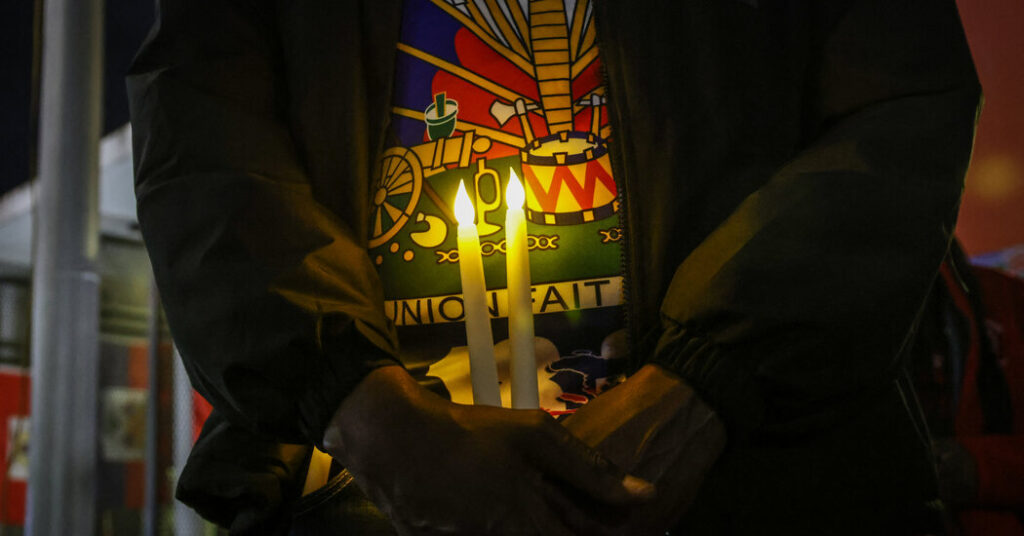
Haitians first received protections in 2010 after a devastating earthquake. The program has been extended several times, including by the Biden administration after the assassination of the country’s last elected president in 2021. Since then, Haiti has grappled with gang violence, political instability and food shortages.
Mr. Trump tried to end protections for Haitians in 2018, but was blocked by lower courts and those efforts stalled before the case reached the Supreme Court.
As for the Syrian migrants, the government initially put protections in place in 2012, citing the “extraordinary and temporary conditions” in the country resulting from “a brutal crackdown” by the nation’s president at the time, Bashar al-Assad. Those temporary protections were repeatedly extended, including during the first Trump administration, based on armed conflict and the aftermath of the 2023 earthquake.
Ann E. Marimow covers the Supreme Court for The Times from Washington.
The post Supreme Court Considers Trump’s Plan to Revoke Deportation Protections appeared first on New York Times.