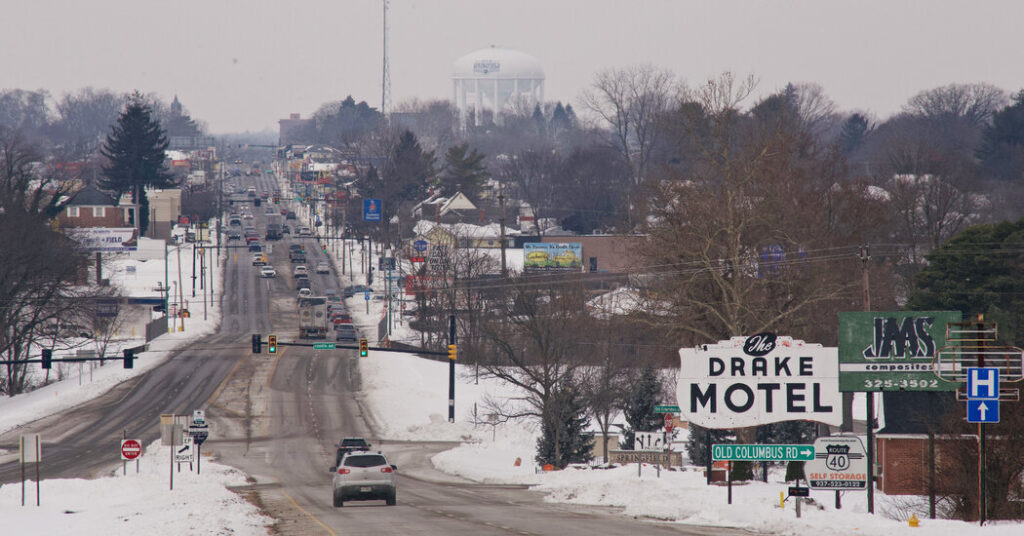
When Stanley Charles, a Haitian immigrant, arrived in Springfield, Ohio, in 2021, “it was like a desert,” he recently recalled.
The industrial city had been losing population for decades, and some streets were lined with boarded-up, dilapidated homes.
To revive the city, Springfield’s leaders lured auto parts manufacturers, warehouses and other businesses to the area. But once the companies began operating, they struggled to find workers.
Then a wave of Haitian immigrants arrived, helping fill the labor shortage.
Now, many of those Haitians are facing a very uncertain future. The Trump administration wants to end Temporary Protected Status, a humanitarian program that has allowed about 350,000 Haitians, including thousands in Springfield, to live and work in the United States for years because of instability in their home country.
The program’s fate rests with the Supreme Court, which is hearing oral arguments on Wednesday to determine whether the administration has the legal authority to terminate it. A decision is expected by July. If the court rules in the administration’s favor, Haitians would lose their work permits and become subject to deportation.
Springfield, about an hour’s drive west of the Ohio capital, Columbus, could be reshaped by the Supreme Court’s decision.
A few years ago, word spread among Haitians that jobs were plentiful in Springfield. Thousands, some newly arrived to the United States after crossing the border, others relocating from states like Florida and New York, settled there.
“We Haitian people came, we began to work, pay taxes,” Mr. Charles said. “We helped this city develop.”
Between 10,000 and 15,000 Haitians live in the city of 58,000, according to county estimates.
The influx of newcomers initially caused friction. A local health clinic had to hire additional staff; schools had to accommodate new students; and some city services were strained.
Then during the 2024 presidential campaign, Donald J. Trump and his Ohio-born running mate, JD Vance, repeated a baseless claim — that Haitians in Springfield were eating their neighbors’ pets.
White supremacists descended on the city, bomb threats were made against schools and some Haitians moved to other cities. But many remained and carried on with their lives, said Heidi Earlywine, who mentors Haitian families and teaches them English at Central Christian Church.
Now, though, the Trump administration’s push to end T.P.S. has left many Haitians anxious and injected uncertainty into the local economy.
A Haitian exodus could derail Springfield’s momentum just as it rolls out “Springfield 2051,” a road map for the city ahead of its 250th anniversary.
While most employers have not spoken publicly, local and state officials have voiced concern about losing Haitian workers.
“We would have manufacturers and businesses that don’t have employees,” said Charlie Patterson, a commissioner in Clark County, which includes Springfield.
“They will be looking for workers for jobs they couldn’t fill before,” he said in an interview.
The Ohio governor, Mike DeWine, a Republican who has championed the contribution of Haitians, has warned that ending T.P.S. would be a “mistake.”
In early February, a federal judge in Washington paused the government’s termination of T.P.S. for Haiti, finding that the administration’s move had been “arbitrary and capricious” and had failed to consider the perilous conditions in Haiti. On March 6, a three-judge appellate panel affirmed that decision. Five days later, the Trump administration asked the Supreme Court to intervene.
Mr. Charles, 45, who worked at a telecommunications company in Port-au-Prince, fled Haiti after being threatened and imprisoned for his political opposition activities, he said.
After entering the United States in 2021 on a tourist visa, he qualified for T.P.S. under the Biden administration. He also applied for asylum, which, if granted, would allow him to remain in the country even if T.P.S. is revoked.
For now, he operates robots at a manufacturing plant and sends money to his wife and other family members in Haiti.
“They all depend on me,” he said. “We are here because our country is not functioning.”
Miriam Jordan reports from a grass roots perspective on immigrants and their impact on the demographics, society and economy of the United States.
The post Springfield’s Haitian Workers and Businesses Face Uncertain Future appeared first on New York Times.